Political reporter Tessa van Viegen: ‘I was there when Zelensky addressed parliament’
From law student to political reporter at WNL: Tessa van Viegen (30) learned the trade from the inside. She stands face to face with ministers and world leaders: ‘My first time in front of the camera was on Prinsjesdag.‘
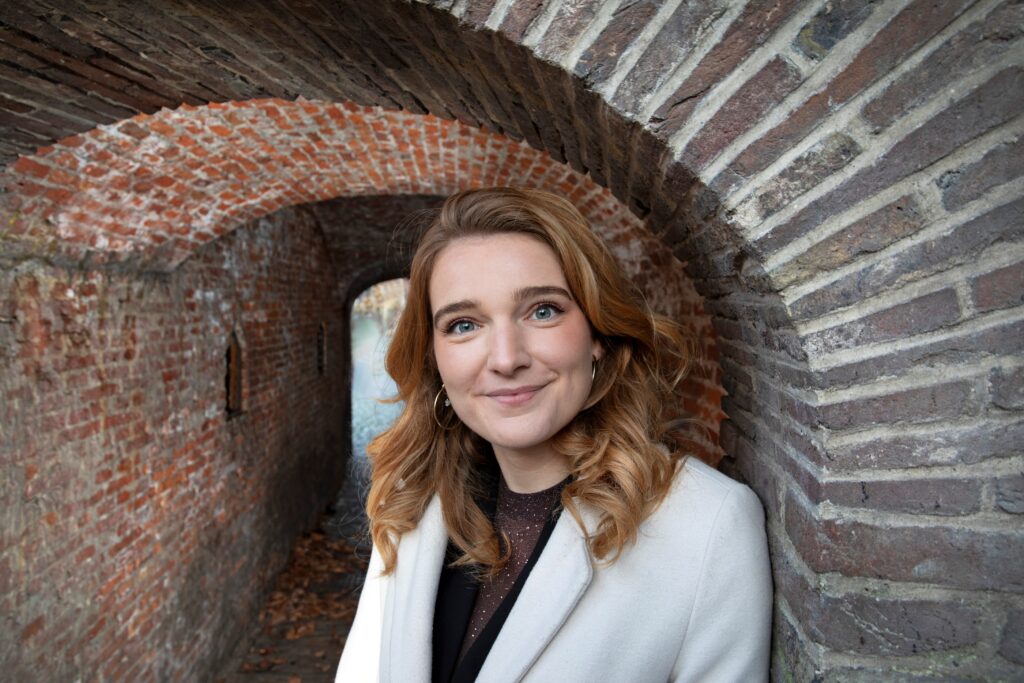
Tessa van Viegen earned her degree from Tilburg University during the coronavirus pandemic: first in tax law, then in Dutch law. She started out as a lawyer but quickly switched to journalism. She now closely follows politics in The Hague as a political reporter for Omroep WNL.
Univers spoke with Van Viegen in a café in her hometown of Utrecht about her dream career, which she managed to build without a background in journalism.
How did you get into journalism?
‘During the coronavirus pandemic, I took weekly walks with WNL presenter Frank van Leeuwen, who was the political editor at the time. We met during my year on the board of the Front Party and became good friends. He always spoke enthusiastically about his work, while I realized I couldn’t express myself in my own role. At one point, he said: “Just come and have a coffee at WNL. Maybe journalism is for you.”
‘I did, and that’s how I got into the profession. The then-head of WNL, Bert Huisjes, not only brought in people with a journalistic background, but also deliberately brought in people from outside the organization to create space for fresh ideas. My law degree turned out to be a plus, not a disadvantage.
‘Initially, I worked as a political editor for programs like Goedemorgen Nederland (Good Morning Netherlands), WNL op Zondag (WNL on Sunday), and the radio program De Haagse Lobby (The Hague Lobby). Behind the scenes, I did all sorts of things: approaching guests, preparing interviews, writing texts, and gathering background information. That’s how I learned the trade from the inside out. I am now not only behind the scenes, but also in front of the camera as a political reporter.’
When did you make your debut in front of the camera?
‘My first time on camera was during Prinsjesdag (Budget Day), and that was quite nerve-wracking. The broadcast lasted four hours, and I was live in The Hague interviewing ministers and party leaders. I’d never been on camera before, and I even had to call someone the night before to ask: should I look into the camera or not? I was thrown in at the deep end, but it was incredibly fun.
‘I’d already indicated I’d like to try this, and then they said, ‘Great, I think you’re ready, so go for it.’ That’s the beauty of a small broadcaster like WNL: you quickly gain a lot of trust and responsibility. This allowed me to quickly make progress on television, go out on my own, and create great stories with interesting people in unique locations. That’s what I enjoy most about my job.’
Which news story stands out for you?
‘Two years ago, Ukrainian President Zelenskyy secretly came to the Netherlands. The news leaked the night before. We discovered that Zelenskyy would be going to the Senate to address parliament. Apart from the members of parliament, almost no one knew about this.
‘Along with De Telegraaf, WNL was the only press present. We were there when he addressed parliament, and I was even able to ask him a question. It was a tense and special moment, especially because Zelenskyy played an important role in world history, both then and now.’
What does your work week look like?
‘On Tuesdays, my day starts early for WNL’s morning program ‘Goedemorgen Nederland’ (Good Morning Netherlands). I start by reading all the newspapers so I’m fully up-to-date on the news. During the broadcast, I explain the week’s political agenda and discuss what’s happening in The Hague.
‘Tuesday is also the day for parliament, especially because of question time, when members of parliament question ministers. Between tasks, conversations often arise at the so-called ‘patatbalie’ (chips counter); the place where politicians and journalists meet and exchange behind-the-scenes information.
‘On other days, I spend a lot of time in The Hague, at the newsroom or out and about, for example, following ministers on working visits or reporting on important events. For each interview, I do my own thorough research, devise the questions, and sometimes briefly spar with colleagues.
‘It’s not a 9-to-5 job; workdays can easily stretch late into the evening. The beauty of political reporting is that you’re always right on the action and present wherever something interesting is happening.’
What role do you think political journalism should play in informing the public?
‘I hope that political journalism will return more to the substance and that we’ll experience fewer riots (such as the reporting on, and the resignation of, informateur Wijers, ed.).
‘It’s a collaborative effort between media and politics: both have a responsibility in this regard. Good journalism must make the content clear and accessible, so that people understand what’s happening in The Hague and why it’s important.’
What are your journalistic ambitions?
‘I’d love to make political documentaries in the future. I’m also a huge fan of talk shows. I recently had the opportunity to join Jinek, which I found very inspiring. Jinek makes a huge impact with the conversations she has at the table. Hosting a talk show someday would be fantastic.’
Advertenties.