What happens to moral ideals when they become inconvenient?
Ever heard of Tilburg University’s educational profile? I hadn’t, at least not until my third year. To be fair, it is not even ten years old. Still, for something that supposedly shapes the way we are educated, it took surprisingly long before I encountered it in an actual classroom, writes Yeşim Topuz.
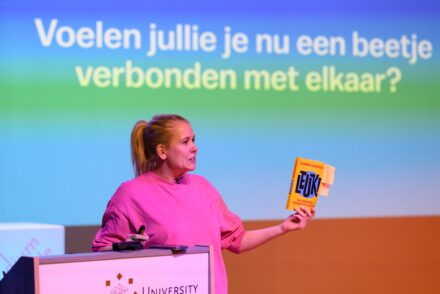
Sitting in my lecture, we went through Tilburg University’s educational vision: The four C’s (Caring, Connected, Curious and Courageous), its legacy, and something referred to as the Tilburg University-shaped professional. The vertical bar of the ‘T’ stands for disciplinary depth, while the horizontal bar represents breadth: the ability to connect expertise across disciplines, societal contexts, and ethical questions.
In short, the university wants its students to get more than just an education. Tilburg ‘weaves’ its students, inspired by the concept Bildung, and uses science to ‘help us make the world as close as possible to our ideal.’ On what values? Solidarity with the less fortunate, empathy and openness to different views, and responsible care for our society.
So, a TiU-shaped professional is a ’thinker of character’, who has both academic skill and strong ethics. This professional is not passive; rather, they are defined by an ‘urge to act’ and the ‘courage it takes to act’.
I pause. It rubs me the wrong way because it seems so disillusioned, given the current situation in the world. Where has all this been lately?
Funnily enough, the TEP proudly cites the 1969 student occupation of the university. It quotes a wall poster from that time: ‘We’ve all of us just about had it with the bunch of aging governors that disregard any wish for democratization. We have only one option left, and that is to occupy the Business School.’ What if we replaced democratization with suspending ties with Israel? Or opposing genocide? I am wondering, did the university also call the police on its students back then?
I mean, the executive board itself established an advisory committee in response to the escalating conflict in Gaza and the campus discussions and protests. And they didn’t just ask anyone; they appointed four professors, chaired by Human Rights professor Nicola Jägers, to conduct what she later described as ‘surgical precision work.’ For five months, they practiced the kind of ‘slow thinking’ the brochure loves to tout, building a human rights framework from scratch.
The committee’s conclusion was clear: Israeli partner universities are deeply intertwined with the Israeli defense apparatus. Because these institutions fail to challenge what the International Court of Justice calls ‘gross and systematic violations of human rights’, the committee warned that Tilburg University could not remain neutral—doing so makes it a bystander.
What happens to moral ideals when they become inconvenient? I found myself wondering how seriously Tilburg University’s values are meant to be taken once they collide with politics and power. Morality, after all, is easy to preach where it is not being challenged.
Tilburg University teaches us to think critically and act morally, yet it seems reluctant to apply those lessons when doing so carries political risk. Ignoring its own committee’s advice shows a gap between what students are taught and how the institution behaves; what remains is not neutrality, but the avoidance of responsibility.
Still, the story does not have to end here. As students, staff, and alumni, we can insist that the university’s actions match its stated values by reopening dialogue and demanding meaningful accountability. If Tilburg’s moral vision is to matter, it must be practiced, not merely taught.
Yeşim Topuz is a bachelor’s student in International Sociology at Tilburg University.