Pleading for virtual judges: will law students soon practice in a digital courtroom?
The Moot Court is a familiar part of the training to become a lawyer. Law students plead a case in front of real judges. In the meantime, a virtual version of the final presentation of the Moot Court is being developed and tested behind the scenes in the DAF Technology Lab. Will it replace the real one?
The Moot Court is the final piece of the Bachelor’s degree in Law. ‘It is a compulsory course for third-year students,’ explains Joyce Esser. She is an assistant professor of administrative law and coordinator of the practice court. ‘Students first attend lectures, they visit the court and follow pleading training. And the highlight is the annual final presentation in which students make a plea for real judges.’
Simulated
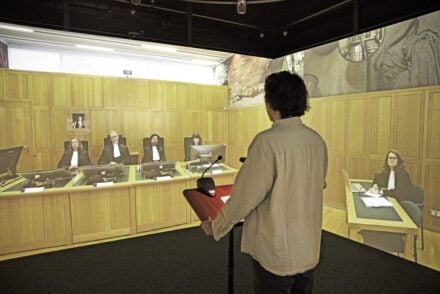
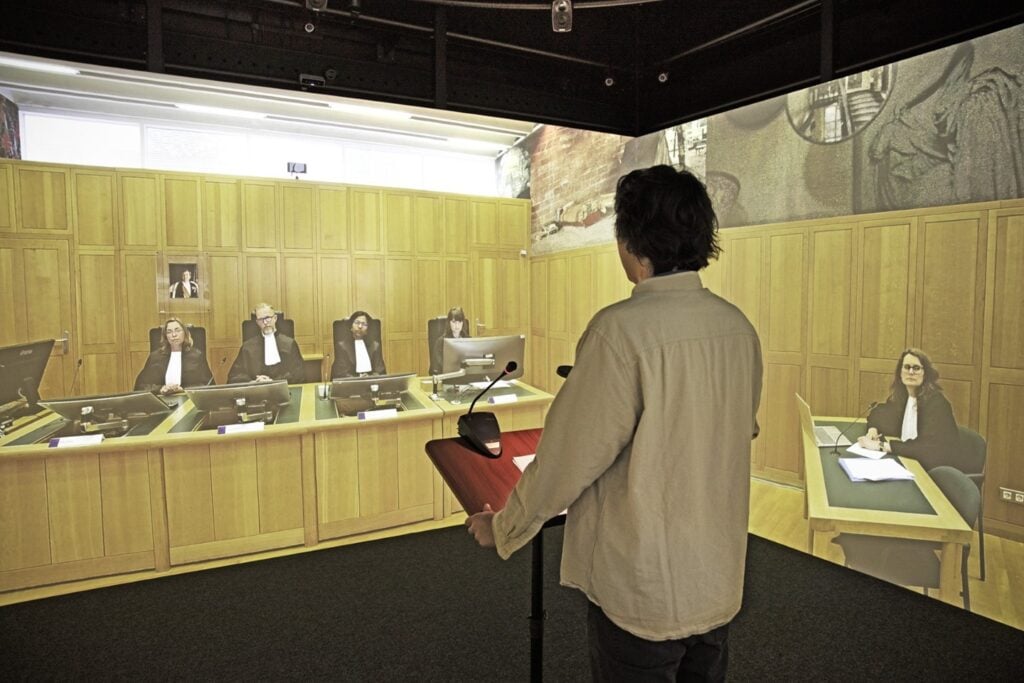
This year, research will be conducted in the DAF Technology Lab in which the court session will be simulated on large digital screens. In one of the so-called CAVE systems (Cave Automatic Virtual Environment) in CUBE, images of a real courtroom with judges are projected on four walls. This allows students to practice pleading.
Next to and behind the student are images of the opposing party and of the audience. This gives the student advocate, with all eyes on him, a good impression of a plea during a court case. Esser: ‘We focus on practicing within a real-life context, with people watching you. That is why it was very important to imitate the real court environment as closely as possible.’
In front of the mirror
In the pilot, a conscious choice was made for a physical space in which the projection takes place, and not for VR glasses, which require much less space. Esser: ‘Students argue from a printed text and also make notes on paper. So you can’t do that with VR-glasses on your head.’
The video images are lifelike, but not interactive: the judges depicted do not respond substantively to the plea, or to verbal qualities and body language. They provide an introduction and conclusion to the plea in general terms. ‘As soon as you start with interactive images, like in a video game, you get avatars,’ explains postdoctoral researcher Liam Wietzorrek. ‘They often don’t look like real judges yet.’
Nevertheless, the test environment does offer essential feedback. The presentation is monitored by all kinds of cameras and sensors. Wietzorrek: ‘Afterwards, students see a list of scores on all kinds of points on a screen. This way they immediately see: am I talking too fast, am I standing well in front of the judges? So this test environment offers a lot of advantages over practicing in front of the mirror at home.’
Practical application
The initiative for this pilot comes jointly from the DAF Technology Lab and the Tilburg Law School, in the context of an externally funded CLICKNL project. In the CLICKNL knowledge and innovation network of the creative industry, knowledge institutions work together with the business community, including in the field of virtual reality and so-called immersive technologies.
Wietzorrek: ‘To further develop the lab, we cannot do without cooperation with the faculties. We look for projects with a practical application that we can test in the lab. We developed this simulation from scratch, starting from the needs of education. First we do research, then we apply it to education.’
Real judges
The video footage of the courtroom was recorded in the spring of 2026. Wietzorrek went to the Court in Den Bosch with a team from the DAF Technology Lab: ‘The images are shown in a continuous recording of a maximum of twenty minutes. Several recordings have been made, so that the student does not get the idea that the images are repeated over and over again.’
The videos were recorded with a 360-degree camera. This is a camera with eight lenses that sits in the middle of the room and automatically records everything, similar to the cameras on Google Maps’ cars that image streets. ‘And they are real judges, who have made time for this project,’ Esser emphasizes.
Reading emotions
‘I think it’s very positive that as a law faculty we are working together with other partners, also within the university,’ says coordinator Joyce Esser. ‘But before the pilot started, I wondered whether we were developing applications in this way that would eventually replace traditional education.
‘I believe that the profession of a lawyer requires that you can read emotions while pleading, and as a student you should also be able to practice with real people. And that will always remain, at least as a teacher,’ says Esser. ‘Maybe I’m a bit of an old-fashioned lawyer and humanities scholar for that.’
No replacement
The added value of such a virtual environment in the training of lawyers is being investigated. ‘But this pilot was never intended as a replacement for traditional education,’ Wietzorrek emphasizes. ‘You have to see it as an extra opportunity to immerse yourself in a realistic test environment.’
‘In addition, it has extra added value for the English-language law programme, because those students do not practise pleading in their programmes. So we also made a version in which the judge speaks English and the entire feedback system is also in English.’
Advertenties.