Tilburg University signs sustainability manifesto but bids farewell to sustainability coordinator
The Executive Board has signed the sustainability manifesto drawn up by De Jonge Akademie and the Green Young Academy. However, Tilburg University has not made clear which specific recommendations it intends to adopt. What is certain is that the university will no longer have a dedicated sustainability coordinator after 2027.
Tilburg University has signed the sustainability manifesto ‘Sustainable Thinking, Sustainable Action’. The manifesto is an initiative of De Jonge Akademie and the Green Young Academy, which are calling on Dutch higher education and research institutions to give sustainability a more prominent place in their teaching, research, operations and governance.
In announcing its signature, the university has primarily highlighted what it is already doing in the field of sustainability. Its buildings are equipped with solar panels, it has a community garden and it reimburses sustainable commuting. Sustainable choices are also incorporated into its procurement policy and resource management. In addition, the university opened the Green Office last year, providing space for sustainable initiatives and the exchange of knowledge.
It remains unclear whether signing the manifesto will lead to any new sustainability measures. In a message posted on the university intranet on 12 November, Tilburg University stated: ‘The implementation will be shaped by the university’s own context and strategic direction, building on the sustainability approach it has been following for some time.’ Which specific recommendations will Tilburg University adopt, when will they be implemented and how will progress be monitored?
For now, these questions remain unanswered. The university told Univers that it is working on ‘a reassessment of the Strategic Housing Plan (SHP), in which sustainability targets (including KPIs) will be explicitly incorporated. This means that specific reduction targets will become an integral part of the SHP process, which is currently being revised.’
Responsibility
Martijn Groenleer welcomes Tilburg University’s decision to sign the manifesto. Groenleer is a professor of public administration and academic lead of the Academic Collaborative Centre for Climate and Energy. He emphasises the importance of universities speaking out about their responsibility in the transition towards a sustainable society.
At the same time, Groenleer says the signing raises the question of what will actually change. Sustainability is already part of everyday practice in various areas of Tilburg University, but simply continuing along the current path will not be enough, he argues. Further progress and acceleration will be needed in the coming years.
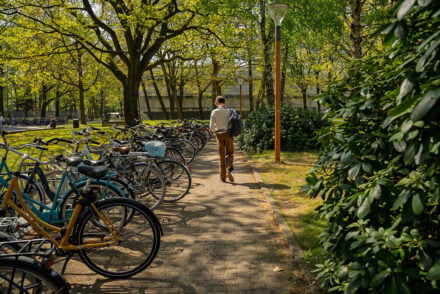
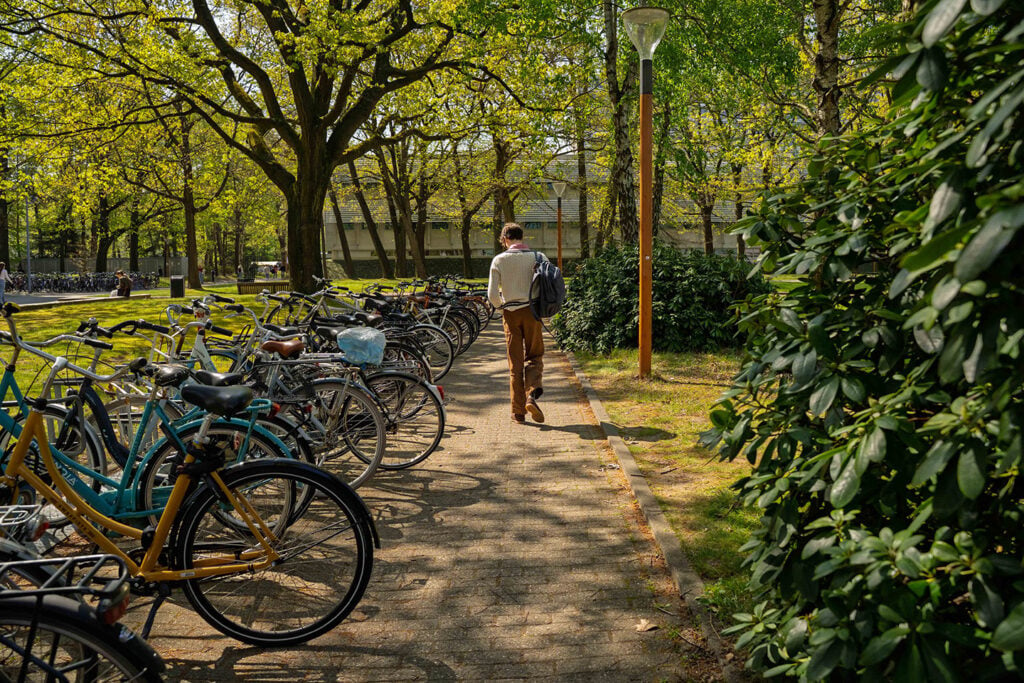
Former Tilburg Young Academy board member Caspar van Lissa also believes there is room for improvement. ‘It would be great if our operations were as green as our beautiful campus. Compared with other universities where I have worked, Tilburg still has a lot of room for improvement.’ Van Lissa points to better waste separation in all university buildings – an option that is currently unavailable at Reitse Poort, for example – and more plant-based catering, with oat milk as the standard option.
Climate neutral by 2050
The manifesto calls on higher education and research institutions to translate their sustainability ambitions into concrete targets. This includes developing a roadmap to achieve climate neutrality by 2050 at the latest. For 2030, the initiative’s organisers have set an interim target of reducing CO₂ emissions by at least 60 per cent, calculated on the basis of the institution’s entire carbon footprint.
The organisers also advocate annual ESG reporting, through which institutions can provide insight into their performance in the areas of environmental, social and governance issues.
A spokesperson for the Executive Board says Tilburg University supports the importance of the CO₂ reduction target outlined in the manifesto. However, it remains unclear whether the university itself intends to pursue a reduction of at least 60 per cent by 2030.
Sustainability coordinator to leave
It is not just the university’s operations that need to change. Sustainability must also become a permanent part of the organisation and its decision-making processes. The manifesto calls for a permanent sustainability coordinator position, with sufficient budget, authority, time and support.
It also calls for someone to be responsible for sustainability at every level of governance, including within the Executive Board. This would ensure that sustainability does not depend on individual initiatives but is consistently taken into account in decision-making.
‘We do not see sustainability as a temporary project with a beginning and an end,’ Wilma de Koning, Vice-President of the Executive Board, stated on the university intranet. However, the Executive Board told Univers that the current sustainability programme will come to an end in 2027. After that, there will no longer be a dedicated sustainability coordinator, even though the manifesto the university has signed specifically calls for the position to be made permanent.
According to a university spokesperson, responsibility for sustainability will instead be assigned to existing departments. This is intended ‘to embed sustainability in all of the university’s operational processes and decision-making, thereby ensuring broader ownership and making it a structural part of the organisation. A separate sustainability report is also being developed.’
Dirk van den Berg, a project manager at the university and chair of Protect Our Winters Netherlands, questions whether sustainability will continue to receive sufficient attention within the organisation once the sustainability manager leaves. ‘What receives attention grows. But what receives no attention disappears.’
Research must change too
University research must also contribute to a more sustainable society. The manifesto’s organisers advocate dedicated research grants for sustainability and clear guidelines for public-private partnerships. Among other things, these guidelines should require partners to act in accordance with the Paris Climate Agreement.
Groenleer sees room for improvement in the university’s research activities. According to him, Tilburg University has considerable expertise in climate, energy and sustainability, but this knowledge remains too fragmented.
By encouraging researchers from different disciplines to collaborate more closely and strengthening the connection with real-world practice, the university could increase its societal impact. Groenleer points to initiatives such as the Academic Collaborative Centres and the Tilburg Sustainability Center.
Van den Berg agrees. He believes researchers working on sustainability could use their expertise to address societal challenges at both national and European level. However, they need to make their voices heard more clearly among policymakers in The Hague and Brussels.
Sustainability in education
Education should not be left behind either. The manifesto’s organisers believe sustainability should have a permanent place in university curricula. This is not a new call. Tilburg University researchers and staff members Anne Lafarre, Dirk van den Berg, Martijn Groenleer, Marleen Balvert and Florine Linnenbank already made the case for this during the opening of the academic year in 2025, when sustainability was the central theme.
According to Lafarre, Professor of Corporate Law and Finance, little has changed since then. Although some degree programmes and courses address sustainability, the subject has yet to be sufficiently embedded in university curricula.
Students in many more degree programmes should learn about the role their own disciplines play in sustainability challenges, both in finding solutions and in contributing to the problems themselves.
The manifesto also calls on universities to begin assessing all their degree programmes against the European GreenComp framework within one year. This framework outlines the knowledge, skills and attitudes people need to think and act sustainably. Univers asked whether Tilburg University intends to adopt the GreenComp framework, but the university did not provide an answer.
Among others, Erasmus University Rotterdam and the Royal Netherlands Academy of Arts and Sciences (KNAW) have signed the sustainability manifesto. Utrecht University was the first university to sign it, more than a year ago. Tilburg University is now following suit.