Library employee Emmy Golstein: ‘Our work is often underestimated’
After forty years at Tilburg University, library employee Emmy Golstein is retiring. She arrived at the university library via the Faculty of Theology, where she witnessed major changes. From medieval manuscripts and coax cables to grilled sandwich Wednesday — this is the story of Emmy Golstein.
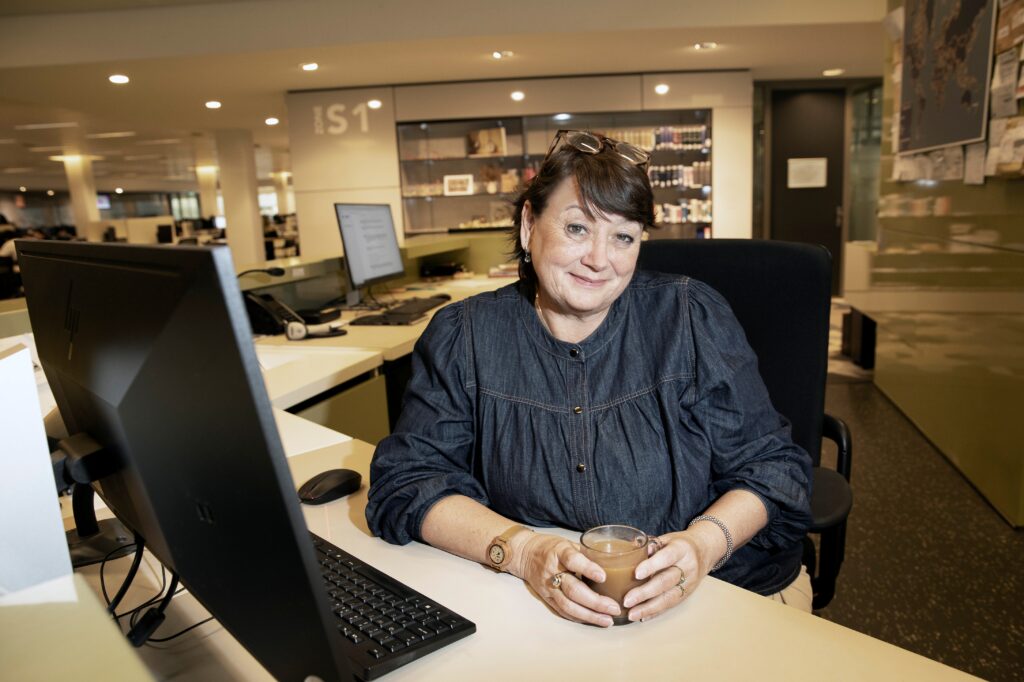
If you’ve worked at the university for forty years, what story do you tell when retirement approaches? Emmy Golstein (1961), library services staff member (LIS), has reflected on that question. ‘When I was clearing out my desk drawer, I realized that a number of events had a big impact on me.’ Emotional: ‘Like the passing of a dear colleague. That still affects me.’
Emmy, for years a familiar face behind the library desk, can already smell her retirement. Just a few more pages and the book of Tilburg University will truly be finished. The university she leaves behind is very different from the one she joined in 1985 as a newly graduated documentalist.
Students are more focused on themselves
‘At that time it was very difficult to find a job; there were hardly any vacancies. The university was only my second application, so I was very happy that I could start quickly,’ Emmy says in a meeting room on the first floor of the university library. ‘I ended up in the library of the Faculty of Theology, then still an independent foundation.
‘It was the kind of library many people would love to see return today: a place you enjoy coming to, where you feel connection, and above all share things with one another. Think of information, books, knowledge, and study spaces. I always try to explain that at the front desk as well, because I notice that students are increasingly focused on themselves and seem to think they’re entitled to everything but don’t want to share.’
As an example, Emmy mentions not returning books on time. ‘Students often think: I need that literature in two weeks for my exam, another student can just wait. But that’s not how it works,’ she says firmly. ‘A library means sharing.’
From coax to the internet
Back to the Faculty of Theology, where Emmy’s career began. ‘After I’d worked there for about twenty years, it was decided that theology would be integrated into the university. The collection of theological books went to the university library. And I came along with that collection of about 400,000 volumes,’ she says in her characteristically ironic tone. ‘Most of those volumes are still downstairs in the repository on the ground floor.
‘Around the same time, the university was digitizing. For staff who had basically always worked with card catalogues, that required some adjustment. You didn’t have to do digitalization, but you did have to be able to work with it.’
The library also became digitally accessible. The Faculty of Theology was connected to the university network with a coax cable, and later came the internet. ‘Imagine: first you had to dial in for the catalogue, then we had that coax cable, and eventually there was internet everywhere. Completely normal now, but back then something special.’
Loyal to the university
For someone who loves holding medieval books, digitalization can be a frightening prospect. But Emmy also saw opportunities. ‘I realized that well-functioning digital systems would give access to even more information. I ended up training countless colleagues and students and testing various systems, including our current library system — we were actually the first in Europe to get it.’
Emmy is not the only LIS employee to leave after more than four decades. ‘The department is changing and getting younger.’ Asked why so many colleagues remain loyal to the university for so long, Emmy answers firmly: ‘That’s mainly because of my colleagues. Also a few students, but it’s primarily my colleagues that do it.
‘I’ve worked with the same people for a long time and together we create something that helps others. That’s really how it feels, and it’s very nice.’ With a wry look: ‘I can’t imagine having always worked alone, like freelancers.’
The top tier of libraries
‘This environment also plays a major role: university libraries are the top tier of libraries. That’s partly because of the enormous collection, from handwritten material to the most digital content you can imagine. We have the systems, infrastructure, and knowledge for that in-house.’
Emmy graduated from the Library Academy in the 1980s. ‘Even then it wasn’t an easy program to choose. Unfortunately, the academy has since disappeared. That means that with the upcoming retirement of several colleagues, a lot of technical library knowledge will also disappear.
‘The problem is that students — and even researchers — think they can find everything digitally on their own, but they can’t. They often don’t know the scholarly route. Just yesterday a student came to the desk who couldn’t get into a database. I take someone like that with me and show them in detail how it works. Usually students are very happy afterward that they can move forward again.’
Knowledge disappearing
‘Our work is often underestimated,’ Emmy concludes, feeling slightly unappreciated. ‘People sometimes think we’re receptionists behind the desk. It’s important to understand how many people need help finding good information — and how you provide that help. That’s a very large group. I don’t know what will happen when more colleagues with specific knowledge retire and no new people are trained.
‘A lot is currently being invested in hospitality and innovative management. But students don’t care whether there’s a doormat at the entrance or that free coffee is served. Those are things “to make it nice for students”. But when you’re working on your thesis, you simply want access to the right literature. And if you get stuck, you want help from a real person.
Losing a colleague
Working with people also means losing people. But the memory of Emmy’s colleague Marjolein Dijkstra, who died in 2007, is still vivid. ‘Together with several other colleagues, I also saw Marjolein privately.
‘We would go on those NS walks: taking the train somewhere and walking back. We had so much fun along the way. Marjolein had an incredible sense of humor, was sporty, and very quick-witted. She was a wonderful woman and colleague.’
Grilled sandwich Wednesday
Emmy’s husband, who had worked at the university since 1984, retired some time ago. With a smile: ‘It’ll take some getting used to when I’m at home full-time too. But I’m looking forward to traveling with our little camper.’
Emmy certainly won’t completely detach from Tilburg University. ‘I’ll stay a member of the staff association and still have good contact with former colleagues. And our son has been working at the university for a few years now. We have lunch together every week on what we call “toastie Wednesday”. As far as I’m concerned, that tradition will continue after I retire.’
Emmy Golstein will retire on 1 January 2026.
Call
Would you also like to take part in Permanent Staff? Are you or do you know someone who has worked at Tilburg University for 20 years or longer and has a great story to tell? Then contact the editors of Univers: univers@uvt.nl.
Advertentie.