Influencer Maysa de Oliveira: ‘We can question the 40-hour work week’
Influencer Maysa de Oliveira (26) is ditching her office job for a life online. With humor, criticism of the forty-hour workweek, and her ‘Boomer Olympics,’ she’s conquering TikTok and Instagram, inspiring Gen Z to voice their doubts. ‘When I had thirty followers, I already said: I’m going to be an influencer.‘
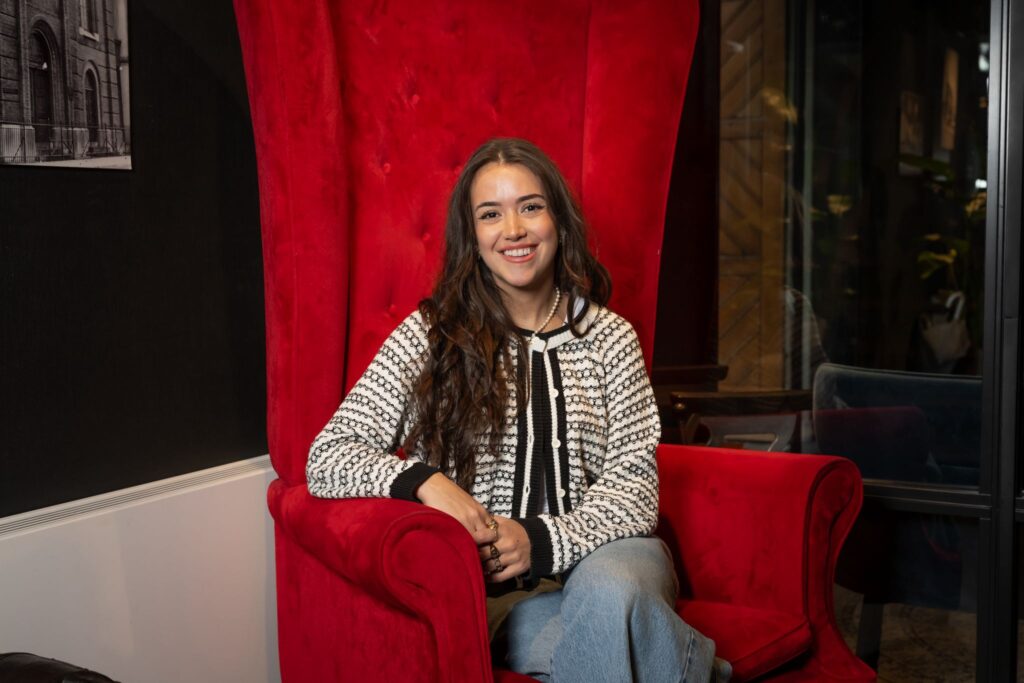
Brazilian-Dutch Maysa de Oliveira (@maysadeoliveir) grew up in Spain, moved to Hilversum at thirteen, and never consciously considered the difference between ‘above’ and ‘below’ the rivers. That is, until she stumbled upon Tilburg University at an open day. ‘I especially loved the campus. Green, peaceful, and well-organized. And I absolutely had to get out of the house. I could easily find a room in Tilburg, so moving south was a logical choice.’
She ended up staying in Tilburg for four years. She briefly lived in a student house run by Olof: ‘Three months, then I was gone. It wasn’t my vibe.’ After that, she moved into a shared apartment and finished her student days in a studio apartment ‘above the Albert Heijn supermarket on campus, super chill, but still always late for classes.’
Maysa is studying International Business Administration (IBA) and combines her studies with board work at the CrossFit association Fortis. I was part of the second board ever, very small-scale but so much fun.
From Excel to algorithms
After her bachelor’s degree, she continued her studies in Rotterdam, earned her master’s degree in accounting, and immediately started working at a large firm. It wasn’t a dream start.
Maysa: ‘I really enjoyed the program. But working full-time… I spent hours typing away in Excel spreadsheets, thinking: is this it? Forty years?’
A career change turned out to be closer than she thought. A chance event set everything in motion: Maysa made a viral video about her nose job. Within a few weeks, more videos followed: about work, social expectations, and boomer comments. ‘I only had thirty followers when I told my friends: ‘I’m going to be an influencer.’ When I watch my first videos, I think: how cringeworthy. It was really embarrassing in retrospect, but apparently it caught on,’ she says, laughing.
Her reach on TikTok and Instagram quickly grew, and more and more companies and organizations contacted her for collaborations. Step by step, she scaled back her office hours. Until the moment comes when she knows: a choice has to be made.
‘I always thought there would be a magical point where you could suddenly say: now I can quit my job; I feel secure enough and can at least afford peanut butter sandwiches from influencer income. But that point never came. Ultimately, I simply couldn’t combine my job with creating content anymore, so I took the plunge. And I quit.’
Boomer Olympics
A large part of her online success stems from the way she handles criticism. ‘Especially on TikTok, I got a lot of nasty comments in the beginning. From people commenting: ‘Your forehead is big,’ ‘Your chin is too small,’ that kind of thing.’ But her critical and humorous take on the forty-hour workweek also caused a stir. ‘I got so many responses from boomers who thought Gen Z shouldn’t complain so much, that my generation is lazy, and that we ‘just have to work for our money.”
She grins. ‘And that was precisely the fuel to create content.’ Instead of blocking or ignoring annoying followers, she created the infamous ‘Boomer Olympics’: short, sharp, and humorous responses to judgmental comments.
‘And it worked. The negativity subsided, and in a funny way, I also conveyed a kind of message: we’re allowed to question work, expectations, and the standard 40-hour workweek.’
Volunteer Friday: Using Visibility
What sets her content apart is not only humor and relatability, but also social engagement. Since this year, ‘Volunteer Friday’ has been a regular feature: one Friday a month, she volunteers at a community organization. She documents this on camera and shares her experiences with her followers.
‘I sometimes felt like influencer work was meaningless. You film yourself, you sell things, and that’s your raison d’être. I wanted to do more, give more back.’ Maysa has already worked with a bird sanctuary, Utrecht Pride, the buddy project Big Friends, and a video about Abortion Buddies, where volunteers accompany people to abortion clinics to avoid anti-abortion protests, will be released soon.
‘Some projects are less commercially viable, but so much more meaningful. That gives me so much satisfaction,’ she says.
Work, identity and future
She’s honest about one thing: being an influencer means your work never really stops.
‘You’re always thinking about content. Or I open Instagram or TikTok without even wanting to, purely out of instinct.’ Maysa is still finding her boundaries. Her boyfriend, who regularly appears in her videos, enthusiastically joins in, but even then, balance is essential. ‘Not everything has to be filmed. Sometimes you just want to be together without the camera.’
But where many twentysomethings stress about career paths, Maysa is making room for the unknown for the first time. ‘When I wanted to be an accountant, everything was already set in stone: finish my studies, get a degree, follow a career path. Now everything is open. I have no idea where I’ll be in a year, and I love that.’
She deliberately doesn’t have big dreams: ‘I want peace and quiet. I want to be able to travel, exercise, cuddle my cat, read books, and stay creative. That’s enough.’
Advertentie.