Plea for pleasure: ‘When you have fun together, something magical happens’
Carnival is about to start. For real carnival revelers, that means having fun for days and letting things be. In her new book Leuk! Plea for pleasure, media and cultural scientist Linda Duits makes a case for casual pleasure. Because it is not that obvious.
She herself is not going to celebrate it, as someone from above the big rivers. But Linda Duits wishes us southerners a lot of fun with the carnival party, as a good example of what she means by having fun together.
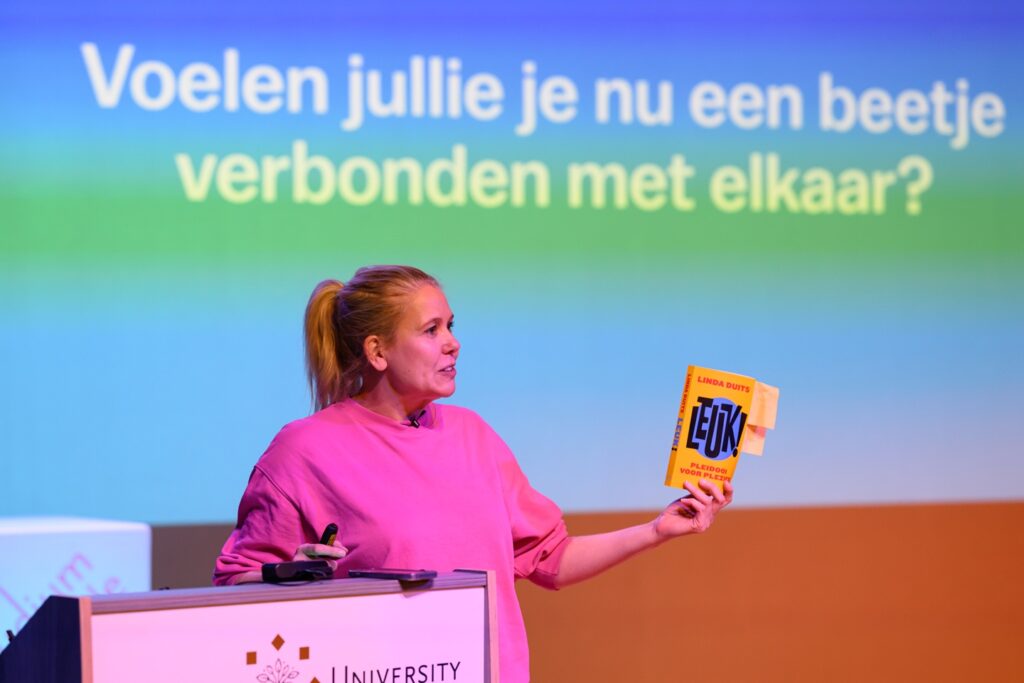
The theme gives her noticeable pleasure, as visitors to a lecture for Studium Generale on Monday 9 February in the Black Box see. Equally enthusiastic, Duits starts a conversation with Univers about the meaning of fun in our fragmented society.
Sourpuss
Duits is a cultural and media scientist, but this is not scientific work, she emphasizes, because she wants her insights to be accessible to a wide audience. Although numerous scientists and thinkers are discussed in the book and in her lecture.
Nice! is a reckoning with a very long tradition of suspicion of pleasure for pleasure’s sake. For example, the German cultural critics Adorno and Horkheimer had little to do with the emerging popular culture in America in the 1930s, 1940s and 1950s. Cinemas, comics and jazz music were inferior, according to the German sourpusses who swore by intellectual European culture ‘with a capital C’.
Intellectual
‘Still, I also love Adorno,’ admits Duits: ‘He may have been a German, but he was just right. Just look at the Marvel movies. Of course, it’s all uniformity. And after the war, he already warned against the emergence of new forms of the extreme right in Germany.’
‘But that tradition of European intellectual elevation still has an impact on academic research into popular culture. I am a television scientist and in my discipline there are all television scientists who do not watch TV. They hate TV,” Duits almost exclaims in surprise. ‘Imagine that you are a literary scholar and that you never read a book!’
Feminism
Even during the second feminist wave, cultural expressions such as the Bouquet series and soap operas on television were viewed very disparagingly. Soap operas were seen as extremely anti-feminist, because women were ‘disciplined in patriarchy’, and more of those kinds of texts.
That attitude only slowly changed in the eighties and nineties with the rise of Cultural Studies, such as a groundbreaking study of female viewers of the soap opera Dallas. The researcher also liked to watch Dallas herself and found that she enjoyed it, without losing her feminist faith, according to Duits.
Power
The aversion to pleasure by cultural critics, authorities and certainly also the church stemmed from fear of the loss of power, of grip and control over the masses, Duits argues. And although we live in a time in which we have shaken off the Calvinist yoke and in which ‘freedom, happiness’ predominates, having fun is still the first thing that dies in times of crisis.
This became apparent during the corona period, when nightlife was restricted and the writer and her friends ’threw themselves into the nightlife like starving hyenas’ during one of the easing of the lockdown. There came her idea for the book, in which she wants to make a plea for ‘pleasure for pleasure’s sake’.
Standards
There are all kinds of norms and values about pleasure as an emotional experience in our society, writes Duits in Leuk! In the book, she explores and dissects these norms and values in conversations with philosophers, media scientists and people from the practice of the experience industry.
In doing so, she wanted to stay away from psychology. Duits: ‘Psychological studies are often inclined to reduce pleasure to chemicals in the brain. We in society have been completely obsessed with that lately. We live in a kind of dopamine moment.’
More than chemistry
But pleasure is always the result of the meaning you give to it yourself, not of physically perceptible substances, according to Duits. And she is mainly concerned with the connection with others: ‘Psychology researches individuals, but in my approach the experience of pleasure is a social phenomenon. In social interactions, pleasure and connection arise between people.
‘To understand the attraction of pleasure, I ended up with the French sociologist Émile Durkheim,’ says Duits. With him she found her favorite principle: sharing is multiplying. When people have fun together, something magical happens, Durkheim thought: ‘Energy is released and you can feel it. That sounds very esoteric, but it is not at all,’ says Duits.
Collective discharge
‘If the connection is lost, society fragments. You can also see this fragmentation in the media: we no longer all watch the same program and therefore no longer have a shared frame of reference. That common framework is crumbling and I see an enormous desire from people to experience together. Just look at programs like B&B Full of Love.’
‘Of course, you can also feel recharged when you listen to music and sing along on the couch on your own,’ says Duits. ‘But if you have fun with others, more happens than the sum of its parts. Then there is a connection and an exchange of that energy that is much greater.’
‘Durkheim saw that at religious events. But this collective experience of pleasure can also provide magical moments in ordinary, non-religious events, for a release in the form of dance, song, cheering or play. It brings people closer together. Charging the collective’s battery is the glue for communities.’
Advertentie.