Tuition-free boarding: ‘A board year shouldn’t just be for rich students’
It is not easy for many associations to find student board members. That is why, since this academic year, new board members have been able to schedule a tuition-free year under certain conditions. Univers asked two student board members how they experience the scheme.
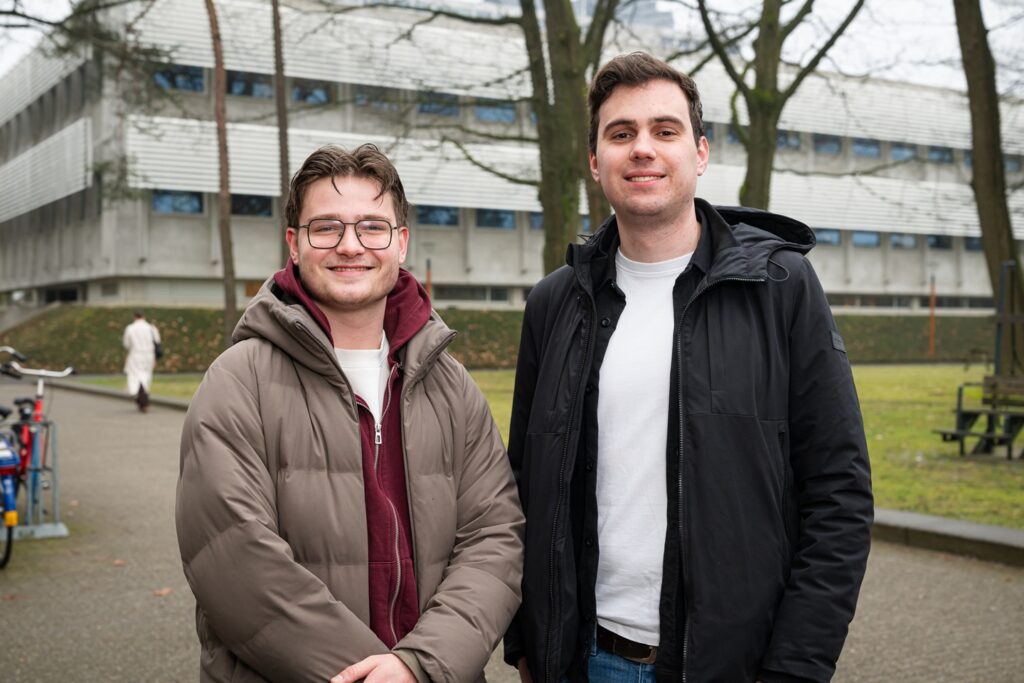
Koen Smits and Merijn Maas have put their studies on the back burner for a board year this year. Smits studies Organization and Management Studies and is active for POLIS, the study association of his studies. Maas is studying law and this year is committed to SAM, a student faction in the University Council.
Both are full-time active for their supporters and have little to no time to take courses. But in order to be a director, students must be enrolled at the university and therefore also pay the mandatory tuition fees.
Since this academic year, Tilburg University has therefore had a regulation whereby student board members of ‘large or extra large student organizations’ are exempt from tuition fees during their board year, under certain conditions.
Is it so difficult to find new directors?
Koen Smits: ‘Yes, and I think that’s because parents don’t like it when their son or daughter takes longer to study. It also costs a lot of money. Students spend much more time with their part-time jobs to pay their room rent. So we have less free time for a board year. And a board year also entails a lot of expenses.’
Are you happy with the arrangement?
Merijn Maas: ‘My parents pay my tuition fees, and I already know that I will never pass the ten courses I have to pass. So this way my parents don’t have to pay an extra year of tuition fees.’
Smits: ‘I’m working full-time on the board, and I’m not going to be in education. The university doesn’t have to incur any educational costs for me, so it feels a bit crooked if you have to pay the full tuition fees anyway.’
You do not have to pay tuition fees, but you will still receive a board grant. How does that work?
Smits: ‘POLIS is a larger association and receives sixty board grants a year. There are five of us, so we each receive twelve grants of 314 euros. In my case, seven scholarships are deducted from this because I participate in the new scheme. So I only have five scholarships left, which is about 110 euros per month. It’s not a fat pot.’
Maas: ‘You get about 1,800 to 2,000 euros less in board grants, and you don’t have to pay the tuition fee of 2,600 euros. You still have an extra 600 to 800 euros per year left. And for students who are a bit tighter, that can make all the difference. Precisely because you have to pay the tuition fees in advance.’
Smits: ‘In this scheme, your ‘debt’ is canceled. So I feel like I still owe that 2,600 euros. I think that ‘frame’ could be better, because study associations add value to the university, the well-being of students and social cohesion.’
Do you see a board grant as payment for your work?
Smits: ‘A board grant should not be seen as a salary, but as compensation for the study delay you incur during a board year. The strange thing is that that money comes from the same pot as someone who is an informal caregiver. You should split those pots, because informal care is of course very important, but we also add value to the training.
‘For example, we help the TSB faculty association with organizing the Master Experience Days. That is a kind of open day. Those hours are ‘compensated’ with board grants, not with an hourly wage, while these are formal events. We also organise the Social Career Week, the faculty’s business week, together with the career officers, and they get paid as usual.’
Is tuition-free board a good scheme?
Smits: ‘Yes, it is definitely a good scheme. It is really much better than last year, because all in all it still saves a lot of money compared to the old situation. I think a board year is a great concept, and I think the university also helps very well and supports us with everything.’
Maas: ‘I would also do this board year without the scheme, because I have parents who can help out. But I could very well understand that someone who cannot fall back on that, then still refrains from a board year.
‘Because there is quite a lot involved. You have to organize events that also involve costs. And if you also have to study, it can cause a lot of financial stress, because you have less free time to go to work.’
How important is it that students can do a board year?
Smits: ‘We do a board year mainly because we like it, because you really do a part-time job for the money and a board year you do not only do for fun, but also for the work experience and for your CV. You could compare it to an internship where you don’t earn that much either.
‘But a board year must remain affordable. You shouldn’t have to work yourself completely into debt for it. So I think it’s important that everyone gets a chance to do it. Such a scheme should ensure that not only rich students can afford another board year.’
Will this scheme result in more student board members?
Smits: ‘Personally, I don’t think so, because it’s just too little for poorer students. They have to turn over every dime and there are a lot of them. So if you want to persuade more students, you will have to tinker with it in the long run.’
Maas: ‘I think we have to look at the conditions. For me, the scheme works very well, but as SAM we are going to see if it will also be possible for the smaller associations, for example, to do a tuition-free board year.’
University’s response
Tilburg University is pleased that since the 2025/2026 academic year, it has been able to support students who take on an extensive administrative or participation role through the Tuition-Free Boards scheme. Within the legal frameworks, this regulation provides that students are exempted from paying tuition fees during their board year and do not attend any education during that year. In doing so, the university recognizes the great responsibility and time investment that comes with these roles.
Advertentie.