Brenda Espinosa: ‘In the Netherlands I reinvented myself’
As collaborative grants officer Brenda Espinosa (33) had stayed in her birth country Colombia, she would have had to start a family young and spend the rest of her life as a well-behaved married ultra-fit career woman. At fifteen she decided she wanted a different life. In 2016 she came to Tilburg for a master’s in international business law, and she will soon become a Dutch citizen. ‘The person I can be here, I like much better.’
A river at the foot of a waterfall where families splash around cheerfully on rocks. An oasis of tropical plants as far as the eye can see. Anyone who sees the photos of the tropical landscape in which Brenda Espinosa grew up can hardly imagine why she traded this green idyll for Tilburg ten years ago. From the kitchen table in her cosy living room she looks out at a freshly planted small tree swaying in the wind. Behind an electricity pylon the provincial road hums with traffic.
Two years ago she moved into this owner-occupied home on the edge of Berkel-Enschot with her Dutch partner. Her entire family still lives in Mocoa, the capital of the southern Colombian province of Putumayo, where the Andes end and the Amazon region begins.
‘But the definition of a large city in Colombia is very different from in the Netherlands,’ Espinosa explains in fluent English – she expresses herself just a little more easily in that language, even though she speaks excellent Dutch. ‘In Mocoa we had lots of small shops, restaurants and cafés, but there was no McDonald’s, no cinema and no big supermarket.’
How did you spend your free time?
‘Every weekend we swam at one of the many rivers and waterfalls. As a child we could play outside without parental supervision, but to everyone’s surprise I was often inside reading. My mother taught me to read and write at the age of four. When my father went on trips he brought back books, because there were no bookshops in the city. I was overjoyed when I got the chance to study in Bogotá.’
Why exactly?
‘Mocoa is small, everyone knows each other. That’s nice, but it also means you’re constantly being watched. People readily give their opinion about your life, your relationship or your body. Colombians put a lot of pressure on appearance, especially for women. The ideal is to be slim and athletic, and to look good in a bikini. From childhood my weight was under a magnifying glass. Once a year I go back, and the first thing people say is: oh, you’ve put on weight, or oh, you look great, have you lost weight?’
What values did your parents instil in you?
‘That it’s important to do something for society. My parents worked for the government. My father did finance for the municipality and the province, my mother works as a social psychologist with victims of the armed conflict (since the 1960s an armed struggle has been waged in the country between the Colombian government, paramilitary groups and communist guerrilla fighters, ed.)
Internationals in Tilburg
Chinese, German, Brazilian: internationals from all corners of the world have been moving to the Netherlands for a long time. Science crosses national borders and Dutch universities want to score well on the world academic stage. But a lot of internationals came this way: lecture halls and student houses are overcrowded and many courses are only taught in English.
Time for a turnaround, it now sounds. Politicians want fewer internationals and English at universities. Universities are making plans to reduce internationalization. There’s a lot of talk about internationals. But who are they actually? And how do they see their future? In this section, Univers talks to international students and employees of Tilburg University.
‘Everything revolved around a good education, and that meant university. Women are expected to have a career and be successful, but also to have a partner and have children. My parents had no objection to me studying in Bogotá, as long as I came back to settle down. The idea was: you stay here and follow the beaten path.’
Why is there such an emphasis on university education in Colombia?
‘More than a third of Colombians live below the poverty line, there is great inequality. With a university degree you earn much more than without one. A bachelor’s degree is not enough, because there is enormous competition among employees. It’s as if employers are doing you a favour by taking you on.
‘People do everything to keep their job, because benefits are far too low to live on. Calling in sick with a heavy cold is not an option in Colombia. You only have 15 days of holiday a year there, and you practically have to beg to be allowed to take them. I was surprised that in the Netherlands I could simply say that I felt ill or that I wanted to go on holiday.’
You left home at fifteen to study in Bogotá, because you had skipped a few years. Did you feel ready for that step?
‘Absolutely. My parents were caring, but also very protective. I was longing for freedom of movement, for a big city where I could be anonymous and make my own decisions. I desperately wanted to leave home, away from my parents’ strict rules about what time I had to be back and who I was allowed to spend time with.’
What was it like to live in a big city at fifteen?
‘Very mixed. Everything I didn’t have at home was suddenly possible: going to the cinema, and eating sushi for the first time. But I had to live with acquaintances of my parents, so they could keep an eye on me. After a year I moved to a university boarding house for women, run by nuns. At ten o’clock the gate was locked.
‘When my parents saw that I had grown accustomed to the city, I was allowed to share a flat with a classmate. But they called every evening to check that I had got home safely. There was a lot of fear in Colombia, not just of poverty but also of insecurity.’
Was that fear justified?
‘Yes, because Bogotá is a large city where things can sometimes be very dangerous. Public transport is a kind of Russian roulette, because of all the pickpockets. You can’t hail a taxi on the street, you have to call one or order it via the app, because people keep finding new ways to rob you.
‘They drug you with an injection or sedate you by making you sniff a cloth, which leaves you conscious but completely defenceless. Then they force you to enter your PIN at a cash machine. It was a huge transition when I could walk around in the Netherlands with my phone in my hand.’
I understand that Colombia is a class society. How does that play out in education?
‘Both my parents have university degrees and belonged to the upper middle class, but we were certainly not wealthy. The best education is provided at private schools; I attended a private university. My parents had to take out a loan for that.
‘Working alongside your studies is seen as something for the lower class, there’s a strange stigma attached to it. In Colombia a bachelor’s degree takes five years, my parents paid my living expenses all those years. In return I made sure I was a good student. Because of my high grades I had three years’ tuition fees reimbursed, so my parents had fewer debts.’
It sounds as though you were under pressure in every area of your life.
‘That’s right. My brother is six years younger, yet he had much more freedom than I did. As a woman you get the message that nobody should be able to gossip about you. Fine to have a boyfriend, as long as it’s just one, and it’s a serious relationship. Men didn’t get those kinds of warnings, but they too weren’t allowed to stand out too much. If a boy was very overweight, for instance, he was heavily bullied.’
Was that fear of danger also connected to the open violence by drug cartels?
‘Certainly, but the impact of the drugs trade came in waves. My father was born in 1964 and as a teenager was asked to go and work for the drug cartels. The idea was that he would take enough chemistry lessons to be able to make cocaine. He didn’t want that, because he knew that many of his classmates had been murdered doing that work.
‘After his refusal he had to move immediately. I was born in 1992. Just before that, in the late 1980s, a bad period began, because the major drug cartels, such as Pablo Escobar’s, carried out many bombings and violent attacks.
‘My childhood was mainly shaped by the armed conflict between groups such as the FARC. Sometimes we had no electricity, because guerrilla groups bombed the infrastructure. Mocoa, as the regional capital, had the protection of the army and police, but a few hours’ drive to the south, in the jungle, coca was grown and many armed groups were based, some of which played a role in the drugs trade.
‘That area is so inaccessible that it is a perfect hiding place for drug laboratories. Especially in the remote villages to the south of where I lived, people were murdered or kidnapped. The danger was close by, it could happen at any moment.’
What did that mean for your daily life?
‘I saw little of my province, because it wasn’t always safe to travel. But it wasn’t only about freedom of movement. If I want to criticise the government here in the Netherlands, I can. In Colombia you can’t just say anything in public. Many community leaders are murdered when their interests clash with those of the guerrilla fighters or other armed groups. Think for example of people who campaign for human rights or for the environment.’
How did you come to choose a bachelor’s in law?
‘After a great many discussions with my parents. As soon as I suggested a field of study that was even slightly more creative than medicine or law, they were sceptical. My father’s view was: if you love art, that’s something you do as a hobby. Law wasn’t my first choice, I wanted to study international relations, so that I could travel and learn other languages. In the end my father would only give his blessing to a law degree.
‘Fortunately I found my studies wonderful from day one. I love logical things, and legislation is the ideal way to organise a society. It’s a degree where you have to read and write a great deal, and I was good at that.’
When did you decide you wanted to do a master’s abroad?
‘In the first year of my bachelor’s. Some professors had done their master’s in Paris and taken their doctorates in Rome. They sounded so cool and intelligent, I thought: maybe that’s something for me too?’
Yet you first worked for a few years, as a lawyer.
‘Near the end of my bachelor’s I heard that people who had graduated abroad received a low salary on their return to Colombia, because they had no work experience in Colombia. I wanted to go into academia, but it seemed sensible to gain work experience first, so I had something to fall back on.
‘I thought: whatever happens, I’m not going back home. I’ll stay in Bogotá and prove that I can take care of myself. That’s also why I later chose a master’s in international business law: it’s easier to find work with that than with a theoretical master’s.’
You just said that the government offered the best jobs, but you went to work in the private sector.
‘That was a deliberate choice. In Colombia the government is the biggest employer, but politics determines who gets those jobs. I didn’t want to be dependent on the whims of some random politician. I’ve seen how friends of mine had to cosy up to politicians, by donating to their campaign or by doing them all kinds of favours. They now hold senior positions in government, and say to me: I think you’re brave, because you dared to leave all this behind and go abroad.’
Did you enjoy working as a lawyer?
‘In itself yes, but the workload was very high. After four years I was 24, I had a boyfriend, the plan was to settle with him in Colombia. But I thought: I must be mad, what am I doing? I’ve wanted to study abroad for so long, I’m just going to do it. Maybe this is the last time I can do something this big entirely for myself?’
Why did you choose a master’s in Tilburg?
‘That was a happy coincidence. I wanted to study in Italy, but with an eye to a future job it seemed smarter to do a degree in English, and that’s not possible there. A Colombian organisation made scholarships available for Tilburg and Groningen. The master’s in international business law in Tilburg had good reviews on various platforms. At a fair I had attended an interesting lecture by someone who worked in Tilburg, and I had met a few Colombians who were enthusiastic about the innovative programme.’
What did you know about the Netherlands before you came here?
‘No more than that knowledge was held in high regard here, and that education and research were wholeheartedly supported here.
Well, those days are over.
‘Rather, yes. It makes me sad, especially when I think back to how enthusiastically we were received as international students nine years ago. I felt very welcome.’
What do you remember about your first time on campus?
‘I felt at home straight away. There was a good mix between Dutch students and internationals. People were very willing to communicate in English. I could get by everywhere.
‘It was confronting to study in English for the first time. I had always been the brilliant student who learned effortlessly, and suddenly I couldn’t follow everything. But after a while it was fine.
‘After Bogotá, Tilburg was a pleasant surprise. There was a relaxed vibe, people were friendly. From my room in Talent Square I cycled to the university and to the centre of Tilburg in 5 minutes, and the Albert Heijn was just around the corner.’
Did you notice cultural differences?
‘Yes, punctuality and time management! In Colombia you have half an hour’s leeway, here you don’t. In my class there were six other Colombians. Our group became friends with Dutch, Swiss and Austrian students. Whenever we made arrangements we checked: is this Dutch time or Colombian time?
‘I noticed that most Dutch classmates lived independently. In Colombia you don’t do your master’s straight after your bachelor’s, but often only after you’re 30, having worked for a while. I have friends in their thirties who still live with their parents in Colombia.
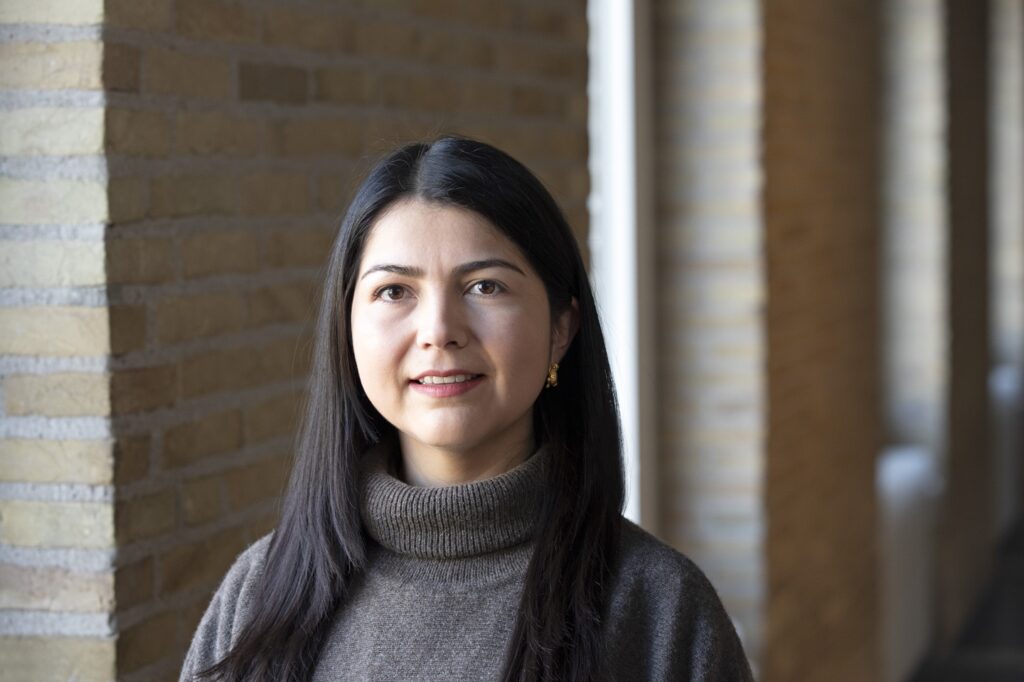
‘In Colombia you have to wear a suit as a lawyer, and women are expected to wear make-up. I don’t care much for that. When I started my doctorate in Tilburg, I noticed that colleagues dressed casually and that many women wore no make-up. It might seem like a detail, but for me it meant a lot. I can relax here and be more myself.’
Yet after your master’s you went back to Colombia.
‘It had always been the plan to return to Colombia. At the end of my master’s I was having such a good time that I wanted to stay, but I had to go back, because as a citizen from outside the European Union you cannot remain in the Netherlands on a student visa without a job guarantee.’
After six months you were back in Tilburg.
‘In Colombia I came across a vacancy for a PhD position. Besides, I had acquired a new boyfriend, a classmate, and that played a part too. I realised how much I had enjoyed being in the Netherlands, far away from all the expectations of my social circle and my family. They are dear to me, but in the Netherlands I could reinvent myself.
‘I feel liberated. Of course women here are also under a certain social pressure, but at least you don’t have to look a certain way or be thinking about marriage at 25. My boyfriend and I have now been living together for seven years, but we are not married, and we have no plans to have children for the time being.
‘The person I can be here, I like much better. But I only realised that once I had distanced myself from my old life. In Colombia I toed the line, but once you step out of the system you see: it wasn’t that great.’
In 2018 Espinosa began her doctoral research at TILT, the Tilburg Institute for Law, Technology, and Society of the law faculty. She researched the legal challenges in the exchange and use of data collected by utility companies. In 2022 a postdoc on AI policy and responsible data processing in the energy sector followed. One day a week she worked as a member of the university council. Since March 2025 she has been collaborative grants officer.
‘I help researchers find the right funding for their projects. Nowadays you see more vacancies for that kind of role than for academic positions. Because research budgets at universities are being cut, they increasingly have to look for external funding. It’s a completely different role from what I had before, because I no longer do research myself.’
In Colombia you dreamed of an academic career. Would you have wanted to become a professor?
‘Not necessarily. Knowledge has taken me far and I love teaching. But becoming a professor is a long road, and I didn’t have the feeling that it would make my life better or more exciting. The logical step after a postdoc is to become a lecturer, but after that it’s not a given that you automatically move up a rung once you’ve written x number of papers and taught x number of hours. And if there’s no work in your region, you have to move. I don’t want to build my life from scratch one more time.’
When I approached you for this conversation, you indicated that you were sorry you no longer do research. From that I infer that you would have liked to become a lecturer.
‘It’s not that I don’t want that. I tried to get that job, but there is a lot of competition, and the focus is increasingly on people who can teach in Dutch. Previously the job postings were bilingual, but for the past year university vacancies have only been appearing in Dutch.
‘I get the impression that applications from people who don’t speak Dutch are being discouraged. I could have kept applying, but I was longing for security, so I started looking into a support role. But I’m not sure whether I have permanently given up my research ambitions or hopes of an academic career.
‘When in 2024 there was talk of legislation to curb the influx of international students, it was suggested within the university that staff would need to reach a certain level of Dutch in order to continue teaching. The rector indicated that the university council might in time conduct its meetings only in Dutch, instead of in English. I got the impression that it would fairly quickly become policy to speak predominantly Dutch at the university.
‘But still, I don’t want to flatten this complex issue by making it seem like the question is whether I like speaking Dutch. That’s not the problem, because I do speak Dutch and I’m on the path to becoming a Dutch citizen. It’s mainly the shift in mentality that concerns me.’
I notice that you’ve started looking a little sad.
Espinosa thinks for a moment. ‘Maybe that’s because most of my colleagues and people I’ve become friends with in Tilburg didn’t come from here. It suddenly feels as if, because of the language barrier, we’re not getting the same opportunities as Dutch people with the same qualifications as ours. That hurts me. It’s sad to notice that international students are no longer as welcome here as they used to be.
‘Many English-language programmes are being discontinued, and more emphasis is being placed on Dutch-language programmes. One of the reasons I chose the Netherlands back then was the importance attached to the exchange of knowledge between cultures. But I doubt whether I would still choose the Netherlands as a student today.’
Do you feel treated differently outside the campus now compared to when you came here nine years ago?
‘No, not really. It helps that I now speak Dutch, people appreciate that. It also makes a difference that I have a Dutch partner. Through his family and friends I’ve had more contact with Dutch people.’
What appeals to you most about Tilburg now?
Enthusiastically: ‘That I can contribute to society at the university, even though I no longer teach and I help researchers instead of doing research myself. I could have had a fine career in the private sector, certainly in the field of data and AI, but I’m no longer driven by a hunger for money and prestige, as is customary in Colombia. I know many people who after their doctoral research went into a completely different field, and I find that refreshing. I only recently allowed myself that freedom.
‘At the university I got to know my best friends and met my partner. When my father fell ill last year and lay on his deathbed, it was hard to be so far away. I was very well supported by the department and was given all the time I needed to go to him.’
Do you ever feel homesick?
‘Constantly. I miss my family and friends, and I miss the variety of fresh fruit and vegetables. I miss the spontaneity and relaxed atmosphere, even though I’ve grown accustomed to my full diary dictating my life now.’
Espinosa bursts out laughing. ‘Do you know what I find strange? That on your birthday you have to bring your own cake! In Colombia my colleagues would have decorated my room, brought a cake and treated me to lunch. Here the birthday person has to treat others, but I still refuse to do that.’
About Brenda Espinosa, 1992, Mocoa, Colombia
2008 – 2013 Bachelor of Law, Universidad Externado de Colombia, Bogotá
2014 – 2018 Working as a lawyer in Colombia
2016 – 2017 Master’s in international business law, Tilburg University
2018 – 2022 Doctoral research, Tilburg University
2022 – 2025 Postdoc, Tilburg Institute for Law, Technology and Society (TILT)
2025 – present Collaborative grants officer, Tilburg University
Advertentie.