From the Verberneflat to City Hall. The story of alderman Yusuf Çelik
He grew up in poverty and had to support himself financially during his studies. His parents would have preferred him to become a lawyer, but Yusuf Çelik decided otherwise. ‘I am persistent in everything I do.’
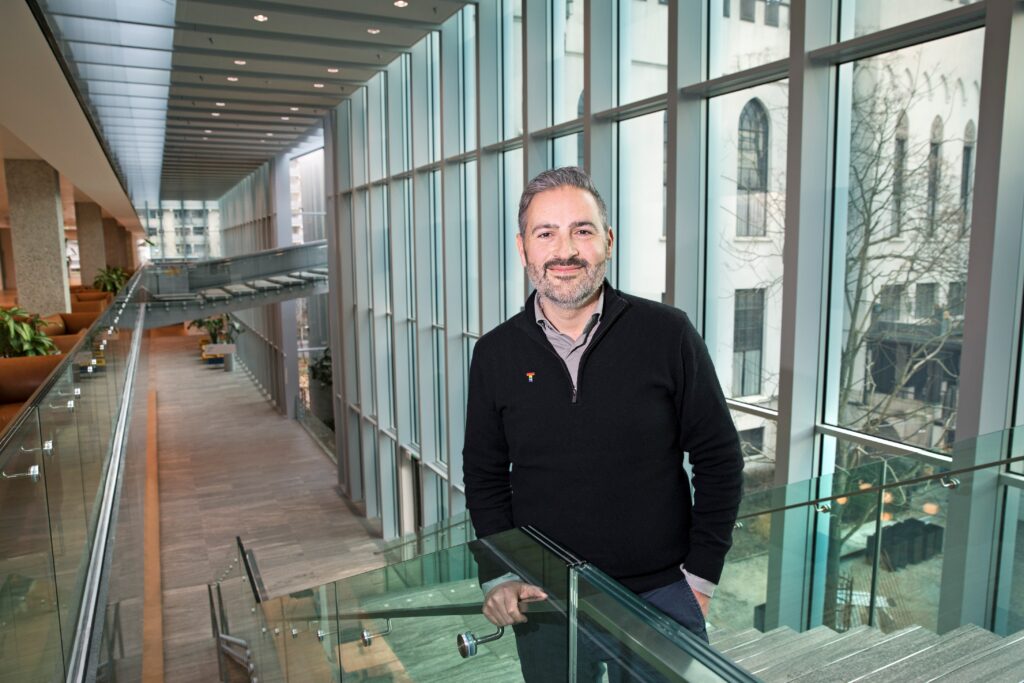
Since 2022, Yusuf Çelik has been alderman for Housing, Neighborhoods and Integration. Univers speaks with him at Tilburg City Hall, in the middle of the campaign rush. Together with alderman Evelien Kostermans, Çelik is the lead candidate for GroenLinks-PvdA. But before discussing the municipal elections, Univers first wants to know how Yusuf Çelik (46) experienced his student years.
What kind of student were you?
‘I am what you would call a “stacker”: I started at the mavo level and eventually made my way to university. In 1999, I moved from my hometown of Enschede to Tilburg to study marketing, sports and communication at Fontys.
‘But I missed deeper academic substance there. After obtaining my bachelor’s degree, I found that depth in the master’s program in leisure studies at the university.
Started here
Professional footballers, parliamentary group leaders, ministers, presenters, media personalities and judges. Tilburg University has produced many well-known alumni. In the section ‘Started here‘ Univers looks back with them on their student years.
‘As the son of a textile worker, I have always followed my heart, even though my parents thought it was important for me to become a lawyer. By choosing my own path, I ended up in sports at a university of applied sciences, and at university I delved further into that.’ Laughs: ‘And look, now I’m an alderman.’
How was it for you to go against your parents’ wishes and not choose to study law and become a lawyer?
‘Complicated. Parents always want the best for their child. Sometimes they want to steer you in a certain direction because it offers opportunities they never had themselves. When I told them that law didn’t suit me and that I would go into leisure studies, they wondered whether I could make anything of it. Well, dad and mom, you can become an alderman with it.
‘What makes it complicated is that my parents have a certain frame of reference. They think: as a lawyer you earn well, that provides security.’
How did you deal with those expectations?
‘By leaving my parental home. Enschede is two and a half hours from Tilburg, which literally creates distance. It was a leap into the deep end. Some people drown, others keep paddling and resurface. Nothing was handed to me.’
What does the fact that you are a “stacker” say about you?
‘I am used to cycling against the wind. My parents had little money and I lived in poverty for eighteen years. And during my studies, I always had to support myself.
‘I therefore think it is important that everyone in our municipality can participate. Some people simply cannot because of the circumstances they live in. How do we ensure that they can? That question is very deeply rooted in me.
‘It is an advantage that I am an alderman who can shape policy based on certain experiences: I literally arrived in Tilburg with zero euros in my bank account. I have a relatable story, which also makes me approachable as a politician.’
How do you notice that in practice?
‘I do everything by bike and try to cycle through as many neighborhoods as possible to see how things are going. When people address me, I make time for them.
‘In my view, the municipality is too often seen as a company. But we are a values-driven organization, a kind of association. Proximity and solidarity are important within that.’
Back to your student years. What were they like?
‘As a university student, I was somewhat searching. The fact that I had to support myself played a role: I worked throughout my entire study period. I lived in the Verbs, in one of the legendary student flats on Professor Verbernelaan. There were quite a few house parties.
‘My student years were great, but it was a constant balancing act between studying and working. If I came home from a long night shift, I really wanted to go to bed. But then I had to go straight to a morning lecture. It helped when a lecturer could present the material in an engaging and lively way.’
What kind of jobs did you have?
‘I worked at a call center and in hospitality. Café Storm no longer exists, but I worked there for a long time. It was a fun and sociable place. Of course, I sometimes stayed a bit too long, and that affected my performance. But all in all, I had a wonderful time.’
How did your study period shape you?
‘I am persistent in everything I do. My experience is: if you want something, you have to put in the effort to make something of it. That’s also the message I pass on to my two children.
‘And I met my girlfriend during that time. She didn’t study herself, but she is a true Tilburg local. I stayed in Tilburg for love. We live with our children in the Jeruzalem neighborhood.’
What is the difference between Yusuf just after graduating and Yusuf as an alderman now?
‘Looking back, I was quite naive when I left university. I strongly believed in the idea that society is malleable: if I do x, y will move. As an alderman, and before that as a city council member, I only then saw how complicated and complex it is to set things in motion.
‘For example, you cannot just suddenly build 35,000 homes. You also have to think about necessary facilities such as schools, general practitioners and meeting places. You need approval for all those things. Why is it so complicated, I sometimes wonder. People first, then rules, then policy. That is the order I try to apply.’
Do people experience it that way in practice? Trust in both local and national politics is very low.
‘The government has not always been a reliable partner for citizens—just look at the childcare benefits scandal. So I understand the cynicism and sentiment in society. At the same time, that does not absolve the national government and municipalities from always carefully considering what we are doing it all for: our residents.
‘If you, as a resident of Tilburg, for whatever reason have bad luck—and many people in our city do at some point—do you encounter a government that says: okay, your relationship has broken down, but fortunately we have invested in temporary housing? Or: too bad, you’re on your own? Those are important choices that we as the municipal executive make.’
What advice would you give students?
‘As alderman for Housing, Neighborhoods and Integration, I am of course very aware of the situation in the rental and housing market. But if at all possible, make sure you have a pleasant living environment.
‘On my floor in the Verberneflat, I had sixteen housemates. I liked having a quick chat when I got home. And if someone needed help, we helped each other. So look for a place where you can rely on people.’
Why is it important that young people go out to vote tomorrow?
‘Because you can make a difference locally. You have a direct influence on the decisions made here at City Hall. That is not the case in many countries, and in the Netherlands we may take it a bit too much for granted. So make use of your right to vote and make your voice heard.’
CV Yusuf Çelik (concise)
1999–2003 Bachelor Marketing, Sports and Communication, Fontys University of Applied Sciences Tilburg
2003–2006 Master Leisure Studies, Tilburg University
2006–2010 KNKF/SenS Consultancy
2010–2015 NIVM (Netherlands Institute for Martial Arts and Society)
2014–2022 Rotterdam Sportsupport
2014–2022 City council member for PvdA, Tilburg
2016–2022 Parliamentary group leader PvdA, Tilburg
2022–present Alderman for Housing, Neighborhoods and Integration, Tilburg
Advertentie.