University wants to shorten the academic year, but is there still room in the overcrowded program?
The exam weeks are too long, the summer holidays too short. A special project group is now investigating how the academic year can be shortened, so that there is more breathing space in the program of students and teachers. But where is there still room in the overcrowded education calendar?
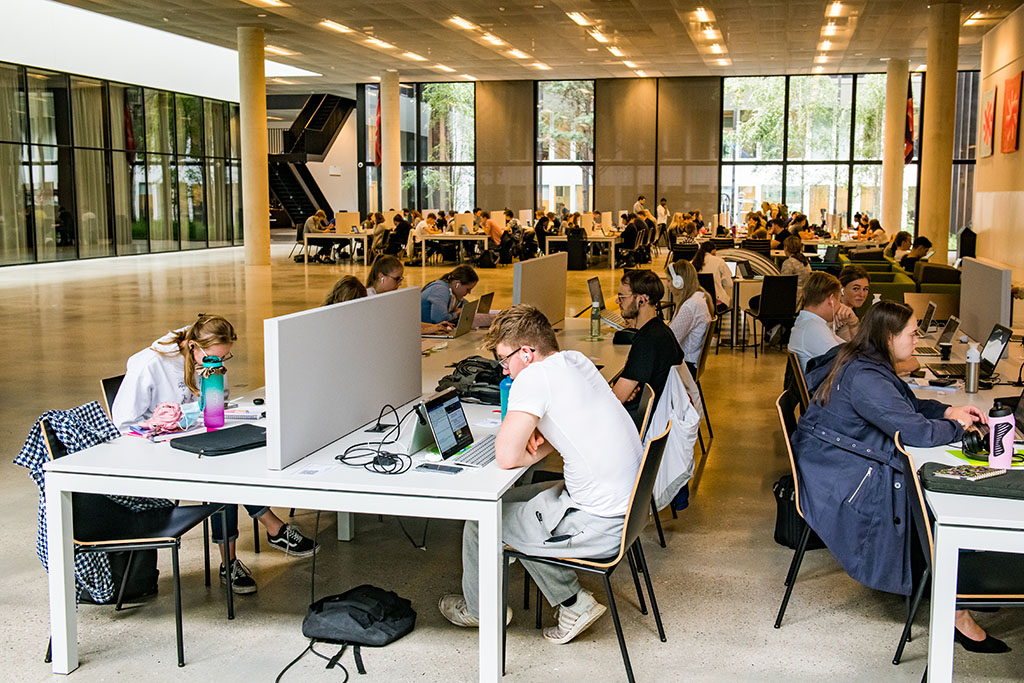
‘If we start tinkering with that academic year, what will we run into?’ That is the big question that Gert-Jan Leenknegt, as Academic Lead of the project group ‘A shorter academic year’, is struggling with. This project group was set up by the Executive Board to investigate what scope there is for a shorter annual calendar.
Leenknegt: ‘We start from three main lines. We want to start later, because next academic year starts on August 24, which is exceedingly early. And we want to stop in time so that people are not busy with resits until well into the summer. Finally, we want a solution for the overly busy period with exams and resits in December and January.’
Exam weeks
As Vice-Dean of Education at the Faculty of Law, Leenknegt is actively involved in the organization of the programmes. He sees that the Tilburg education program offers too few places of rest: ‘We have a long academic year compared to universities abroad, but even compared to the other Dutch universities, students and teachers have to work for a long time.’
Leenknegt: ‘That’s because we have a lot of exam weeks. We have programmes that are organised in four blocks, with an exam period after seven or eight weeks. In addition, we have programmes that are divided into semesters, of which the exam weeks follow a different cycle.’
Bottleneck Christmas
The time around December and January is the most complicated. Then two entire exam periods in a row are scheduled, with the holidays in between, in which staff are obliged to take time off. And during those collective days off, many teachers are still marking exams.
In addition, the Education and Examination Regulations (OER) prescribe that there must be twenty working days between the first and second chance for a test, according to Leenknegt. ‘Grading takes teachers up to fifteen days. With the days for review of an exam, students then have too little time left to prepare for a resit. It just doesn’t fit into the schedule’.
Students have to register for the resits in the last weeks of December, if they have not yet received the results of their exams. Leenknegt: ‘So many students register for the resits just to be sure. And that means that our organization is obliged to schedule exams for many more students than will eventually come.’
Reflecting
The call for a less full annual schedule has been heard for some time. In 2023, The Young Academy argued for a shorter academic year. The national club of young scientists found that the academic year is too long and the workload too high. By organizing education differently and creating ‘breathing space’, there is more time to let the material sink in, to reflect or to broaden the field of vision, according to the young academics.
Several pilots have recently been carried out to make the year ‘smarter’, also at this university. ‘But this Tilburg project is more comprehensive. We look at the annual calendar of the entire university’, says Leenknegt. ‘This goes a step further and has a deeper impact than previous pilots. How are we going to organize the teaching and exam weeks in a smarter way for all students and lecturers?’
Not a perfect solution
The answer to that question is still some time away. Only when all alternatives have been considered and all parties have been heard, will the Executive Board take a decision. That decision will be taken in the autumn at the earliest. ‘We want to discuss these matters with faculty councils, student representatives, examination boards, education agencies and other stakeholders in the coming period.’
And if all goes well, the new academic calendar can be introduced as of September 2027. ‘But there is no perfect solution,’ warns Leenknegt. ‘We are going to try it with a solution that is workable for everyone.’ This should lead to the new schedule providing more space and both students and teachers experiencing more breathing space.
Advertentie.