‘What do you mean, copyright?’ Students sell Tilburg University exams
Students are selling exams and lecture slides from Tilburg University on study-help websites such as Stuvia and Studeersnel. That is not allowed, yet it happens more and more often. ‘They don’t mean any harm, but students are selling my work.’
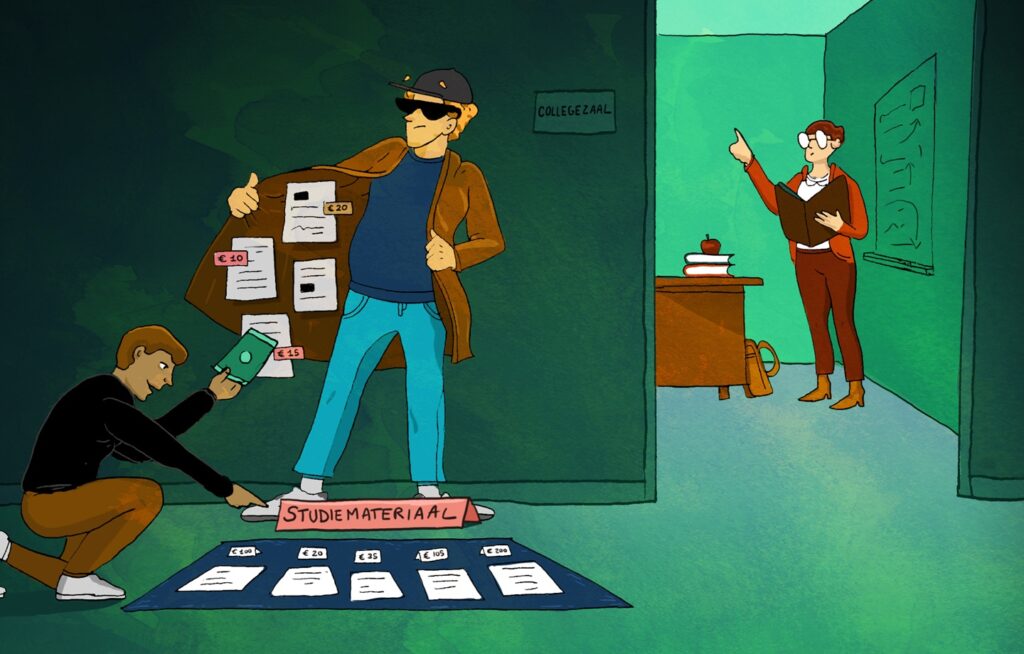
‘Sell your summaries, your knowledge is worth money,’ reads Stuvia, one of the largest study-help websites in the Netherlands. Students can buy or sell summaries there, as well as other study materials. But the question is: how much of that knowledge actually belongs to the students themselves?
Students also upload slides, readers and sometimes even exams to these platforms. Stuvia currently hosts more than 10,000 documents related to courses at Tilburg University. On the popular Studeersnel, there are over 50,000 documents.
Floortje Mols, associate professor of Medical and Clinical Psychology, also sees her teaching materials appearing online. ‘Students download slides from Canvas, sometimes add one sentence, and then sell them online. These are our own students. They don’t mean any harm, but they are selling my work. And when you confront them, they say: “What do you mean, copyright?”’
And it doesn’t stop there: some students even hand out flyers at the entrance of lecture halls to promote Tilburg University teaching materials such as exams, readers and PowerPoint slides. ‘As a lecturer, you literally walk past it,’ says Mols. ‘That feels strange, because legally it’s simply not allowed.’
Copyright
‘In principle, the copyright of teaching materials lies with Tilburg University and its lecturers,’ Tilburg University’s Legal Affairs department states. Everything created by lecturers employed by the university – slides, exams and readers – falls under copyright and therefore belongs to the university. Students are not allowed to distribute or sell this material without permission.
Only a genuinely self-written summary falls outside this. But once parts are copied verbatim from lecture slides or readers, it becomes a different matter. Then the lecturer’s material is being used.
‘That is a grey area,’ Legal Affairs acknowledges. ‘For personal use, it is allowed. But as soon as a student uploads such a summary containing lecturers’ information online, it constitutes an infringement. Whether a summary may be shared on a platform therefore depends on its content.’
Unacceptable
Rector magnificus Wim van de Donk, also chair of the Executive Board, calls the situation ‘extremely worrying and unacceptable’. He also sees the problem growing, which concerns him because it touches the core of education. ‘That core is that we stand for the quality of our education and of the degrees we award as a university. These kinds of practices undermine our educational ethos.’
It also affects the university’s reputation, he explains. ‘It undermines the integrity of exams. If our exams are for sale, students can pass courses based on prior information. That is something we do not want to be suspected of as a university.’ And according to him, students should not want this either: ‘then you pass through prior information, not through knowledge.’
The burden shifts
Most students using these websites seem unaware that they are doing anything wrong. A former student who sells exams on Stuvia says he uploaded his exams to help others. ‘Some courses don’t have practice exams. I found that frustrating. I could have studied better if they had existed. By sharing my old exams, I thought I was helping others. I didn’t know it wasn’t allowed.’
It is not allowed, but it still happens. Yet the consequences for websites such as Stuvia and Studeersnel are rarely serious. In practice, it usually amounts to warnings and takedown requests, which solve little. When a lecturer reports copyright infringement, the material often disappears after a removal request. But not for long.
One academic year later, the material is often back online. ‘You want to invest your time in good education, not in chasing commercial websites,’ says assistant professor of biological psychology Dounya Schoormans. Yet that is what happens. For lecturers, it is a frustrating cycle of reporting and removal. For students, it feels like harmless help. And the university is stuck in between.
Responsibility
‘The problem is bigger and needs to be addressed at a central level,’ Mols argues. Van de Donk agrees. ‘I raised this at the council of rectors to see what we can do together.’ According to him, however, the greatest responsibility lies with companies such as Studeersnel and Stuvia, and with the students themselves.
‘Raising awareness among students about what may and may not be shared is the foundation,’ says Legal Affairs. Van de Donk agrees. According to the rector and board chair, the university can also define a clearer internal policy and better protect its teaching materials. ‘And perhaps regulations need to be tightened here and there to tackle the earning model of these kinds of dubious companies.’
The university is currently trying to warn students via Canvas, and lecturers address students when they distribute study materials. But it remains a losing battle as long as students and commercial platforms can make money from other people’s work. In a world where knowledge is worth money, someone will always try to profit from it.
Advertenties.