Erik Scherder warns: ‘Keep using your brain, even in the age of AI’
Does AI make us less intelligent? Is stress bad for the brain, and what is the best way for students to prepare for their exams? Univers put five questions to neuropsychologist Erik Scherder. ‘If you want to drink alcohol, do so after your exams.’
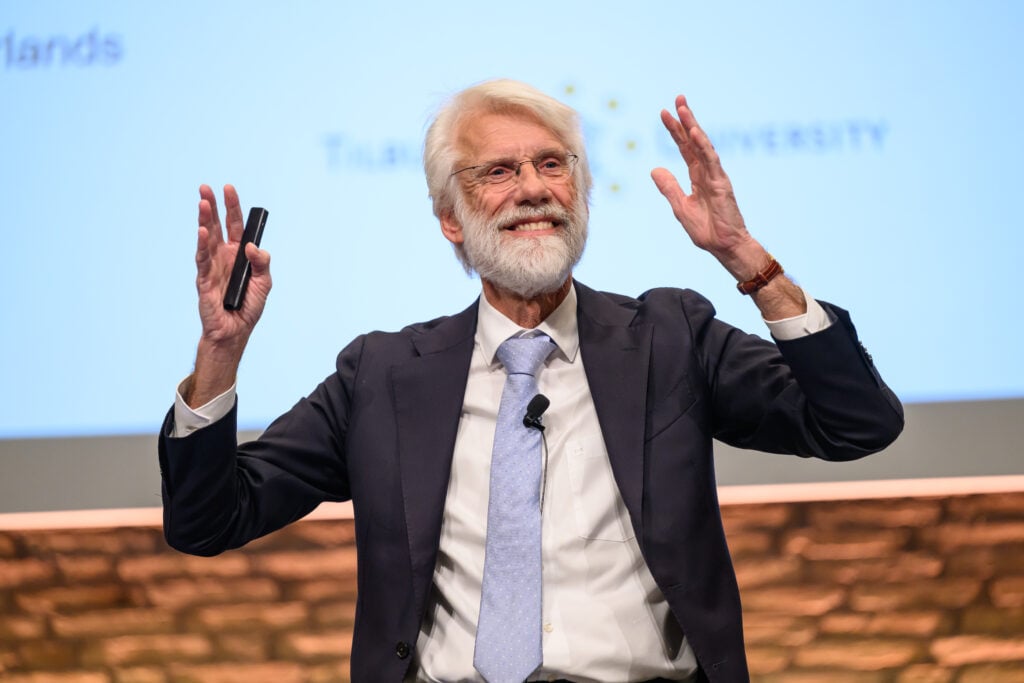
Energetic, enthusiastic and with a healthy dose of self-deprecation, Professor of Neuropsychology Erik Scherder (VU Amsterdam) takes the stage in front of a packed auditorium in the Cobbenhagen Building on Thursday, 12 November. Scherder is one of the speakers during Tilburg University’s Inspire (Y)ourself Week and spends more than an hour sharing insights into the human brain with the audience.
Ahead of the lecture, Univers put five questions to Scherder. The neuropsychologist is clear in his answers: ‘There is nothing wrong with stress or performance pressure.’
At what stage of their development are young adults’ brains, and what changes are still taking place?
‘To answer that, you need to look a little further back, to around the age of fourteen. This is when an important stage of brain development takes place. Here’s how it works: your brain contains grey and white matter. Around the age of fourteen, the amount of grey matter decreases while the amount of white matter increases.
‘The cognitive functions associated with this development are important for becoming independent, such as planning, organising, making decisions and managing emotions. Think of impulse control and learning to think before you react.
‘Most of these skills develop most rapidly up to the age of twenty-two, after which development continues at a slower pace until around the age of thirty-five.
‘But you have to keep working on these skills yourself if you want to maintain them at a high level. For example, by not jumping on the ChatGPT bandwagon too readily and continuing to think critically for yourself.’
What effect does the use of AI have on your brain?
‘First of all, I am absolutely not against AI. You can use AI to take over simple tasks, giving you more time to think for yourself. But if you fill that extra time with even more screen time, then I start to get concerned.
‘The question is: how deeply do you still think when you know you have AI as a backup? You run the risk of underuse: not making full use of your capabilities.
‘This applies to everyone, including me. I have been giving lectures for years, yet I still need to make sure I reflect, keep up to date and gain new insights. I have to keep using my own brain.’
What happens in your brain when you get distracted while studying or working, for example by your phone?
‘There are actually two sides to this. Because people no longer have an attention span, they actively want to be distracted. In other words, you’re doing something that requires effort, you can’t keep it up, and so you automatically reach for your phone. That’s worrying.
‘It also happens that you’re working away happily when your phone rings. On average, it then takes about ten minutes to get back to where you were in your work.’
Scherder, of course, has a useful tip for this: ‘Suppose you get distracted while working, studying or taking an exam. Briefly shift your attention to something completely different. This works like a kind of reset. Afterwards, you can return to what you were doing with a fresh mind.’
How bad is it to experience a lot of stress and performance pressure?
‘We’ve all reached a point where people say: Oh dear, don’t take on too much! But there is absolutely nothing wrong with stress or performance pressure. If you want something, you also have to put in the effort: pressure is part of performing.
‘Of course, things are different if you lie awake night after night, your heart rate is too high and won’t come down, or you experience muscle tension that simply won’t go away.’
As a neuroscientist, what do you consider the best way to prepare for exams?
‘You can look at an exam as something that can actually be enjoyable. Something you work towards and that is over and done with afterwards.
‘On a practical level, I would say: make sure you get enough sleep. Don’t think that three or four hours will have to do, because your performance will be significantly worse the next day. And keep exercising. People tend to skip exercise when they’re busy, but you should do exactly the opposite.
‘What’s more, it’s not about the number of hours you study, but about how efficiently you study. It’s a good idea to get up every half hour and move around for three minutes. Sitting for hours on end is bad for your circulation.
‘And don’t drink alcohol. If you want to drink, do so afterwards, not before you have to perform or before going to sleep. You sometimes hear people say: I have to drink, otherwise I won’t fall asleep. But you really do sleep less deeply, so in the end you’ll pay the price. So make sure you look after yourself in every possible way.’