‘We’re educating ourselves into ruin’, says economist Jona van Loenen
It was hard to avoid Jona van Loenen over the past year. In talk shows and on his own social media, he explains in clear language how our economy works – and especially how it doesn’t work. The Tilburg University alumnus was not a standard student: ‘I don’t understand how you can be busy with just one degree.’
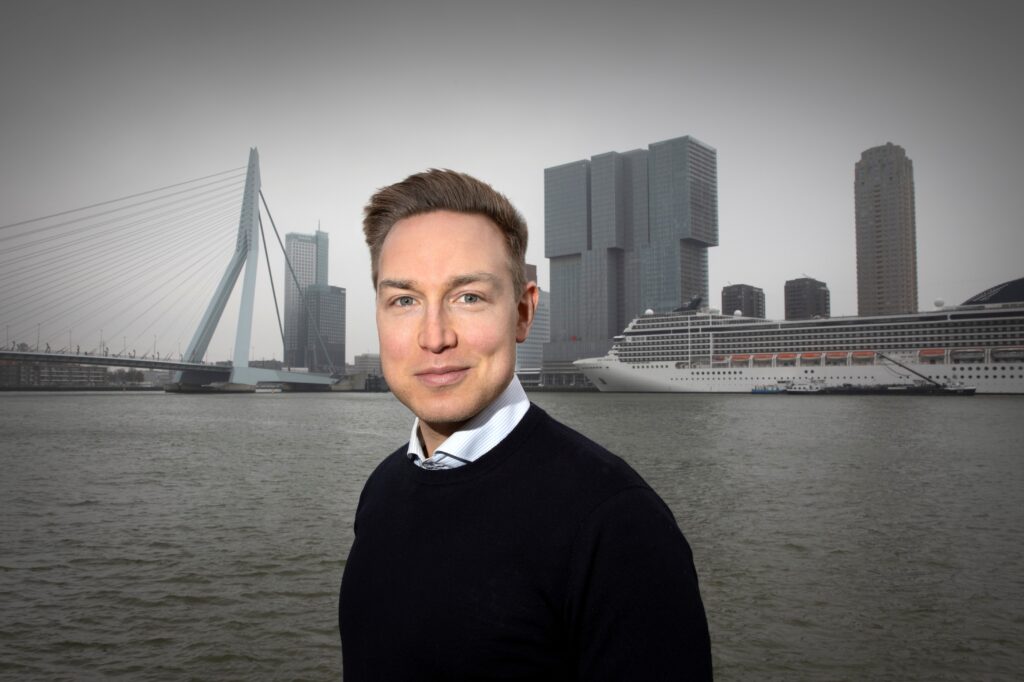
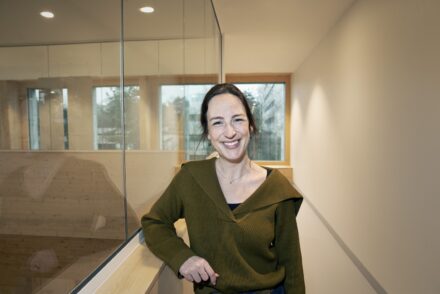
Jona van Loenen (Venray, 1994) is not easily fazed. For the photo he braves the icy wind cutting mercilessly through his favourite setting: the Rotterdam skyline. At his request, Univers meets him in a restaurant on the Maaskade, just a stone’s throw from his home.
The media economist, who regularly appears on talk shows such as Vandaag Inside and Goedemorgen Nederland, talks about his years of study and student life with a glass of fresh mint tea in his hand. ‘If you have no idea where you’re going, then you’re on your own path.’
What kind of student were you?
‘If you think of the standard image of a student, then I was exactly the opposite. I never understood going to a bar three nights a week where the music is so loud you can’t even have a proper conversation.
‘At the end of such an evening you’ve spent seventy euros, and the next day you can’t remember any of it.’ With a chuckle: ‘Some students call that the best time of their lives. Maybe it’s the Dutch nightlife culture – extreme partying just doesn’t suit me very well.
‘Now it sounds like it wasn’t fun, but I had a fantastic time as a student. I did two degrees at the same time and honestly don’t understand how you can be busy with just one. You hardly do anything as a student. If you have ten hours of classes a week, you still have an enormous amount of time left.
‘That’s why I also enjoyed being active in student associations, including UniPartners and Asset. I also had my own little investment club, because I thought I might go into the financial sector.
‘I wouldn’t necessarily advise students to do it the way I did. What really matters is making clear choices. What is important to you? Everything else you should cut out of your life.’
Does the life you lead now suit you better than student life did?
‘During your student years, everything you have to do is laid out for you, and you’re expected to do it very well. As a student you do have quite a bit of freedom, but that’s also where it ends. For me, life after my studies is infinitely more enjoyable. In fact, the older I get, the more I like it.
‘I also love moving like a kind of einzelgänger between all sorts of groups. Often I’m happiest when I’m alone – which doesn’t mean I don’t have a social life. My friends don’t call me an einzelgänger-allemansvriend for nothing.
‘What’s nice about my current work is that I function within a team, but at the same time I’m a bit of an island within it. I experience that in relationships too: living together is absolute hell for me – I just can’t do it.’
Did you live in a student house during your studies?
‘Yes, and that went fairly well, but at a certain point there was a mismatch between what I needed and what the average student needs. I like certain structures, so I ended up taking a studio.’
You get up at five every morning. Some students are just stumbling back into their rooms at that time.
‘Isn’t it great that everyone finds their own way in that? I hate it when people tell others they should get up at five, just because that would supposedly be the only way. No – just do whatever you want.
‘As long as you do something with passion and full commitment, I don’t care what it is. I do think, though, that if you feel the need to party three nights a week, it might be better to build a life you don’t need to escape from.’
What wisdom do you have now that you wish you’d had back then?
‘After secondary school I wanted to become an officer in the marines. I went to open days and did all the tests, until I thought: why do I actually want this? That’s when I realised there’s a difference between who you are and who you hoped you would be.
‘I realised that again when I was hired by a London investment bank after my studies. I thought it was my dream job – until I once again asked myself why I wanted it so badly.
‘So if you ask me what I would have liked to know earlier, it’s this: if you have a concrete idea of where you want to be in five years’ time, then you’re walking someone else’s path. If you have no idea where you’re going, then you’re on your own path.’
Don’t many people think exactly the opposite?
‘I don’t know what people think. But the idea that you have to work for a big, bigger, biggest company, or for a famous name… We’re far too focused on striving for what we think will make us happy, and that’s why we end up deeply unhappy. Collectively, we’re striving ourselves into depression.’
Why did you choose economics?
‘I was a somewhat recalcitrant teenager who needed a lot of structure. That changed when I took economics in secondary school. For the first time, I felt like I understood the world around me better.
Started here
Professional footballers, parliamentary group leaders, ministers, presenters and judges – Tilburg University has produced many well-known alumni. In the Started here section, Univers looks back with them on their student days.
‘I like the fact that everything is economics. It’s a combination of public administration, philosophy and psychology. I’m convinced that economics is the satay skewer of society. All the major problems we’re facing now – nitrogen, climate, migration, housing – are all economic problems. Economics determines our entire lives.
‘Unfortunately, what you see is that economists have made economics something very dull and talk about it in an overly complicated way. When I’m a guest on a TV programme, I always think carefully about how to explain something as simply as possible. Just like on my social media.’
You went to Bocconi University in Milan for your master’s. What’s the difference compared to Dutch education?
‘Bocconi is one of the best economics universities in Europe, and I noticed that the quality of education was much higher and also very practical. In Tilburg it was very much: this is the model, and now we’re going to spend ten lectures explaining why this model is correct. In Milan they said: this model actually isn’t correct, but we’re going to apply it anyway.
‘The Netherlands is rather small-minded in that respect: you’re not supposed to stick your head above the parapet. In Milan everything is more ambitious, and that also attracts ambitious people.’
You say that one of the biggest hidden problems in the Netherlands is that we are educated far too theoretically.
‘In all the sectors where we have staff shortages, we’re talking about practical professions – construction workers, mechanics, teachers and people in healthcare. That’s where we’re going to hit a wall. We’re really studying ourselves into ruin.’
How do you get people to make different study choices?
‘If those practical jobs are better paid, you’ll see people switch quickly. And besides: if medicine has a numerus clausus, why not communication studies?
‘We currently let students choose freely, while you could also steer towards what we actually need. Moreover, I don’t know whether individual freedom of choice will still be so important once we’re facing severe staff shortages.’
What kind of labour and housing market will students soon be entering?
‘Objectively speaking, their future prospects are worse than those of the past three decades. When I graduated seven years ago, I stepped into an elevator going up. Someone graduating now is walking into an abyss.
‘That’s partly because artificial intelligence is going to radically change the labour market. We don’t yet know exactly how that will play out, but many companies are already hiring very cautiously as a result.
‘On top of that, it has become impossible to leave home without help from your parents – truly impossible. That’s going to have a major disruptive and societal impact.’
What advice would you like to give students and recent graduates?
‘Once you have that piece of paper in your hand, you should just get started. For example, start your own business, or choose something else. Ask yourself three questions: what am I good at, what can I earn money with, and what does the world need?
‘Take a sheet of paper, draw three circles, answer those three questions, and where the circles overlap is what you should be doing.
‘For students who are still studying, I’d like to give the following tip: do as much as possible, be active. Because often you only find out what you do want by realising what you don’t want.’
CV Jona van Loenen (brief)
2013–2016 Bachelor’s in Business Economics, Tilburg University
2015–2017 Bachelor’s in Organisation Studies, Tilburg University
2016–2016 CentER Honors Program, Tilburg University
2017–2018 Finance, Bocconi University
2018–2022 Head of Research, Gain.pro
2021–present Columnist and publicist for, among others, de Volkskrant, Trouw, NRC, Het Parool
2025 Book Why the Lowest-Price Guarantee Makes You Pay Too Much
2025–present Guest on various television and radio programmes
2025–present Undercover economist, column in Trouw
2026 New book to be published in September
Advertentie.