Roxane van Iperen: ‘Big Tech is turning us into fruit flies’
Scrolling, swiping, texting. Flying from app to app. ‘We are a generation of fruit flies,’ states Roxane van Iperen. Attracted by the spiciest-smelling garbage dump. Now that tech bosses are gaining an increasingly firm grip on the world, she realizes: ‘Even I am sometimes a fruit fly.’
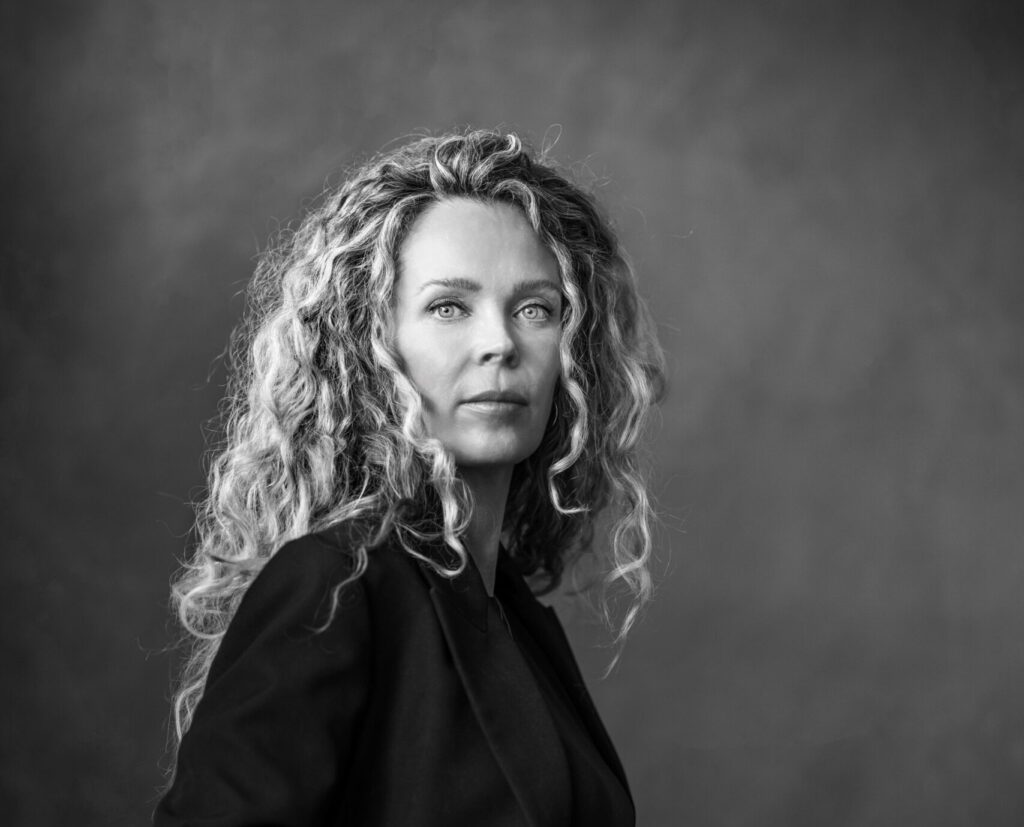
In the essay I See What I Believe, Roxane van Iperen (49) shows how Big Tech holds us captive with minimal effort through addictive algorithms, endless scrolling functions and personalized content that plays on our attention and emotions. Univers speaks with the lawyer and author about how people can arm themselves against this technological power grab. On Sunday, April 12, Van Iperen will come to Tilburg to open the Day of Philosophy at the LocHal.
The World Health Organization calls this the century of loneliness, while we are more technologically connected than ever. What does that say about the nature of that technological connection?
‘Part of the answer lies in a broader shift. We have increasingly come to view ourselves as a mini-marketplace, a personal limited liability company in which we determine how smart, successful, healthy, or attractive we are. From that idea arose the promise of technology: apps and platforms were supposed to help us get a grip on our lives and our performance.
‘But in practice, this overlooks what people really need. The current wave of loneliness shows that synthetic relationships—created through technology, such as interactions with chatbots, AI assistants, or other human-robot interactions—are no substitute for genuine human connection. Moreover, contact between people is increasingly taking place via a screen, which can actually amplify those feelings of loneliness.
‘So the question remains: what do we need to experience a sense of purpose and not feel lonely? And how do we give concrete form to that?’
According to you, history, philosophy, and literature offer a crucial counterweight to the technological power grab. What role do you envision for a university?
‘The skills you develop through the humanities are what make a human being “human”: free will, critical thinking, creativity, and compassion. It is not without reason that tech bosses raise their own children in a tech-free environment with an emphasis on history, literature, and philosophy.
‘That does not mean we should punish students who choose market-oriented studies. What is needed, however, is for universities to actively and honestly inform students about technological developments. Jobs in fields such as law, data science, and marketing are precisely the first to be replaced by AI.
‘In addition, universities would do well to explicitly create space for in-person meetings and exchanges, as a counterweight to an increasingly digital world.’
What exactly do you mean by that?
‘If you look at major resistance movements in history, it is striking that they often rely on two pillars: the awareness of shared suffering and the ability to form collectives. Take women’s emancipation: it gained momentum when women recognized among themselves that their role, staying at home and caring for the children, limited them.
‘Among many young people, that mechanism seems to be precisely what is lacking. Certainly among so-called digital natives, who grow up in a fully digital age, there is little sense of oppression. On the contrary, they experience extreme freedom: they can buy whatever they want, are constantly connected, and feel they are making their own choices.
‘As a result, the first pillar is missing: the sense of suffering. And without that shared awareness of suffering, the second step, seeking each other out physically and taking collective action, hardly emerges either. A united front fails to materialize.
‘This is where the university has an important role to play. It can demonstrate that perceived autonomy is often limited and that choices are driven and manipulated by technology. In addition, the university must provide space for physical meetings that are fundamentally different from digital contact, so that students can not only exchange insights but also experience a genuine, personal connection with one another.’
In the essay, you also warn about declining literacy. What role does that play in this story?
‘Literacy has meant a great deal to humanity. It was a gigantic step in emancipation, especially because reading and writing were no longer reserved for an elite, but became widely available to broad segments of the population. This is indispensable for the functioning of a democracy.
‘If people are no longer able to understand complex texts and ideas, and I am not even talking about academic texts here, but about texts from the newspaper, a letter from the municipality, or other forms of information that guide daily social life, then a democracy risks imploding in the long run.
‘Moreover, with the erosion of those cognitive skills, a generation emerges that resembles fruit flies: constantly flying from place to place, attracted by the strongest-smelling garbage dump of human emotions.’
What advice would you give to readers who want to resist the increasing technological power?
‘For me, it started when I faced my own patterns. I had a tendency to live a solitary life, to retreat to a small study and stay there for days on end, without truly being part of a community.
‘To change that, I decided to rent a workspace. It is located in a workshop with other solo practitioners who, alongside their own work, also contribute something to society. On a small scale, this offers me the opportunity to form collectives and explore together with others what we can mean for our community.
‘In addition, I started swimming in the municipal pool. This allows me to focus more on the presence of my physical body in public space, something I previously barely reflected on.
‘Although this works well for me, I am a bit wary of ready-made advice. I, too, sometimes turn into a fruit fly: distracted, half-present, my attention consumed by my phone while my children are talking to me.
‘At home, we hold each other accountable for this and try to remain honest about the allure of the telephone. My essay is therefore not a manual, but a starting point for a conversation about Big Tech. Ultimately, it is up to readers to take away from it.’
CV
1996 – 2001 Law, University of Amsterdam
2001 – 2016 Worked as a lawyer and legal advisor
2016 The Scum of the Earth
2017 VOJN Award for Best Journalistic Opinion
2018 The Sisters of Auschwitz (’t Hooge Nest)
2019 Opzij Literature Prize for The Sisters of Auschwitz
2021 4 May Lecture
2021 Dutch Book Week Essay: The Genocide Fax
2021 Guest on the television program Zomergasten
2021 Letters to ’t Hooge Nest
2022 Essay: Own Well-being First
2023 I Promise You That
2025 Voices from the Deep
2025 Own Planet First
2026 Philosophy Month Essay: I See What I Believe
Advertentie.