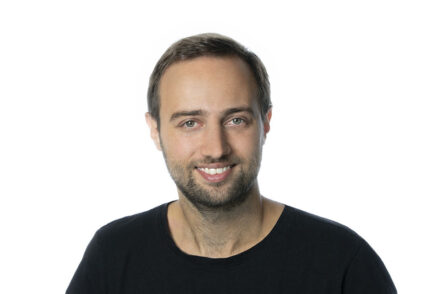
Student assessor Thijl joins the university board: ‘AI in education will be one of the biggest challenges’
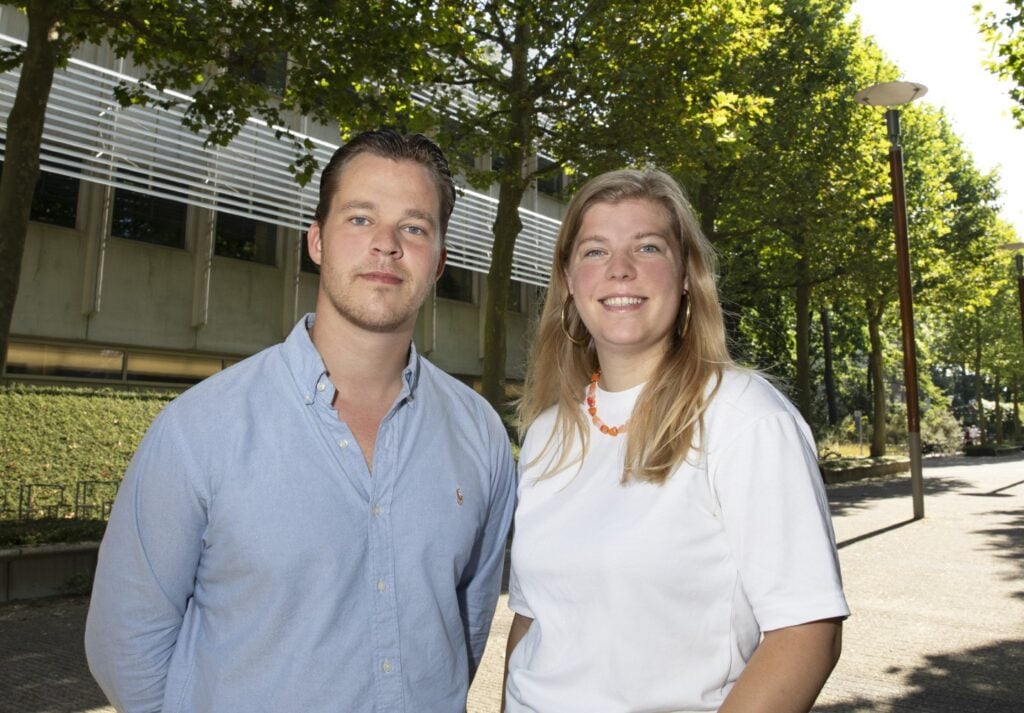
Thijl van der Rijken will be the new student assessor from September. He takes over from Charlotte Kerckhaert, who joined the Executive Board as a student for the past two years. Univers asked them about their role as student representatives on the university board.
Why is a student assessor needed?
Charlotte Kerckhaert: ‘The Executive Board makes decisions for the entire university and of course these also have consequences for students. Because we as students notice the impact that certain decisions can have, it is very important to involve the students’ perspective from the start of a process.’
Van der Rijken: ‘The Board must include so many aspects of the university in its policy. Then there can occasionally be a blind spot for small things that are going on among students, but that can be very important. Just physically joining the table ensures that the Board also includes the students in its decisions.’
Kerckhaert: ‘In addition, as an assessor, you sometimes try to build a bridge between the board and the students of the participation council. In addition to the Executive Board assessor, each faculty board also has a student assessor. For the past two years, I have been working on making this a strong network.’
Thijl, you already know the administrative side of the university?
Van der Rijken: ‘I first sat on the University Council for a year and then you do participation. In the University Council, you can ask critical questions and put topics on the agenda. And last year I was a student assistant in the management team of the economics faculty. My job there was to participate in TiSEM’s community building.’
What are you going to focus on specifically?
Van der Rijken: ‘I find AI very interesting and huge steps are being made there. One of the biggest challenges is how we as a university deal with AI in education, and the perspective of students is important in this.
‘Because AI is not only a threat, for example, to the way of testing, but it can also be very useful. With AI, we can dive much deeper into the subject matter. For example, you can develop a personal tutor for all kinds of things related to your studies.’
When you join the board, don’t you sometimes lose sight of the student perspective?
Kerckhaert: ‘To be honest, it’s going very well. You will receive all the documents in advance, and you will pay particular attention to the consequences for students. You really have your own input, even if it sometimes goes against the interests of other parties. But the municipal executive also appreciates our input.’
Then you have to be able to stand firm.
Van der Rijken: ‘Of course it is important to stand firm. But it doesn’t have to be mutually exclusive. It is not the case that we always push the brakes very hard. The Executive Board is working to make a better university for students as well. It’s more about adjusting the policy a bit, because we all have the same goal.’
Is that possible? If you compare the board to a tanker, then you are just a small boat, right?
Kerckhaert: ‘Of course, the board has to weigh up several interests. There have been a number of crises in recent years, such as in May with the Canvas hack during exams. Because the board had to act quickly, student interests were less involved in the beginning.
‘I indicated that in addition to the exams, it was also important to look at the consequences for students who had a thesis deadline and that communication to students could have been more unambiguous. That is why Thijl will be more likely to be involved in communication with students during a crisis next year.
‘I also helped think about how we can better inform students about their rights during exams and resits. In addition, I contributed ideas about the university’s 100th anniversary, and about student well-being and social safety, among other things.
‘And the other day the KNMI issued a code red because of the heat, while resits were still planned. Then the university will provide enough water during the exam, but that also means that students will have to go to the toilet more often. And often an extra invigilator only comes by once, and you only have one moment to go to the toilet. So, make sure you have extra invigilators, so that everyone who needs to go to the toilet can also go to the toilet.’
Do the students also know where to find you, or is it more one-way traffic?
Van der Rijken: ‘We ask students to pick up signals and give them feedback to us, so that we can bring them back to the Executive Board. Together, you can make those blind spots as small as possible at all levels.’
Kerckhaert: ‘This position has been around for three years now and in the beginning our work was still relatively unknown to students. That’s why I’ve been actively reaching out for the past year, and now you can see that associations and student representatives are getting better and better at finding us. Unfortunately, we remain somewhat unknown among the smaller associations.’
Thijl, what are you going to do as a new assessor to improve that unfamiliarity?
Van der Rijken: ‘The reputation of the assessor has improved a lot in recent years. And I’m going to continue Charlotte’s line. That takes time, because at the beginning of the academic year there is another change of board at the associations, so the successors have to know how to find us again.’
Do you tackle all the problems that students come up with?
Van der Rijken: ‘Sometimes we can refer students to other agencies, because not everyone knows exactly how it works at the administrative level. Then we can help and say: you have to be with this or that person.
‘And of course we also work as a filter, because sometimes problems are specific to one club. But if you notice that several associations are struggling with the same problems, then something is really going on. And then we submit it to the Executive Board, because it can affect a lot of students.’
Advertenties.