MEP Mohammed Chahim: ‘I was bullied because we lived in a terraced house’
As soon as Mohammed Chahim walks onto the Tilburg campus, the memory machine kicks into gear. He tells Univers about his years at the university, but above all about the pivotal role his parents played. ‘They sacrificed an enormous amount of themselves.’
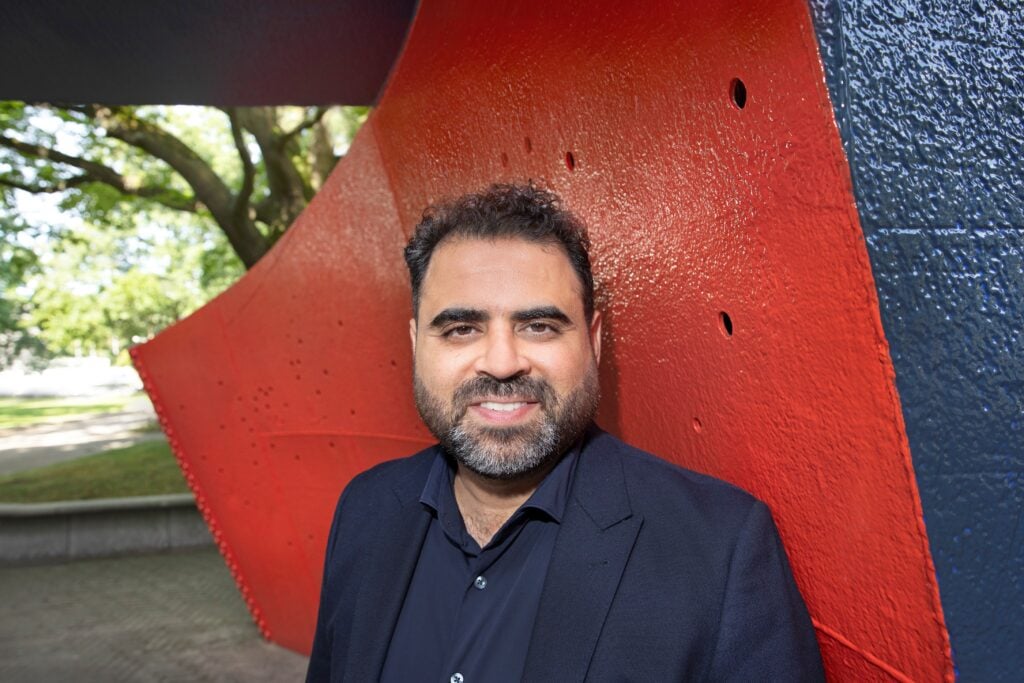
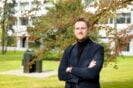
We meet a busy, phone-calling Mohammed Chahim (Fès, 1985) in front of the steps of the university library. The MEP (Progressief Nederland), whose portfolio includes climate, industry and energy, will receive several more calls during his interview with Univers. Chahim has clearly been on campus for a while. ‘I deliberately came early so I could catch up with some old acquaintances.’
As we walk across campus, he notes that much has remained the same since he left in 2013, while quite a bit has changed as well. Chahim would know: he spent around ten years on the Tilburg campus. First as an econometrics student, then as a PhD candidate. With a touch of nostalgia, he says: ‘I look back on it with enormous pleasure.’
Incredibly annoyed
‘I spent quite a few hours here,’ says Chahim as he enters the library. ‘I was always early: I took the 6:30 train from Helmond. I would leave again at around five o’clock to head home. Except on Thursdays, when I would go into town with the others. The next morning, I would teach tutorials with very bleary eyes, because I was also a student assistant at the time.
‘I remember being incredibly annoyed during those tutorials with students who were on Hyves all the time. I would make a huge effort to get there on time in the morning, only to find everyone on Hyves. And then they would quickly close the page whenever I walked past…
‘At one point, I just continued with the three students who actually showed up for the class and sent everyone else home.’ He laughs: ‘I can say that now, right? Sorry, university!’
Catholic education
Suddenly, Chahim wonders whether Tilburg University is still a Catholic university. ‘I recently realised that I have had a Catholic education my entire life. From primary and secondary school all the way through university.
‘As a joke, I sometimes call myself a ‘cultural Catholic’. I was born in Morocco, but I have lived in Brabant for virtually my entire life, so you inevitably absorb those Catholic influences.
‘I also look at it from a political perspective,’ Chahim continues. ‘I have always drawn a lot of inspiration from the social Catholic tradition: the idea that you want to do what is good for your fellow human beings and for society, and that you bring out the best in one another.
‘I learned that from all those wonderful teachers I had. They saw something in me when others didn’t. And they gave me that final push to take a particular subject or pursue an education, even when I doubted myself.’
Individualism
Doesn’t that sense of ‘we’ run counter to today’s social trend towards individualism? ‘It does. But individualism isn’t necessarily bad in itself,’ the Progressief Nederland politician reflects. ‘One of the most beautiful Western values is that you look at your added value as an individual and that you don’t constantly put people into groups or view them primarily as members of a group.’
Chahim immediately thinks of his parents. ‘My father and mother came from Morocco. In the Netherlands, they weren’t seen as individuals, but as part of a group of people, namely those with a migrant background. I’ve always found that unfortunate, because I want everyone to have that liberal-minded view of the individual.’
Admiration
Chahim comes from a family of seven children. He has five brothers and one sister. He is the second-youngest and, by coincidence, the only one born in Morocco. Chahim speaks with pride and admiration about his parents and the path they took to give their seven children a better future.
‘My parents were victims of the Dutch unemployment crisis of the 1980s. Like many people with a migrant background, they were pushed into the WAO (the Disability Benefits Act, replaced by the WIA in 2006, ed.). For employers, it was the cheapest way to get rid of large numbers of employees.
‘My parents were made to sign a document by their employer, and suddenly they found themselves on WAO benefits, even though they were not disabled at all. On the contrary: they had always worked incredibly hard. I don’t think my father and mother – they have since passed away – had any idea at the time what it actually meant.’
Treated disgracefully
‘During that huge wave of unemployment, they thought: we can’t do anything here in the Netherlands, let’s try temporarily in Morocco. And so I was born in Morocco. After six months, our family returned to the Netherlands, because employment opportunities in Morocco turned out to be extremely disappointing as well.
‘The way this group of workers was treated was truly disgraceful. Among other things, my parents lost their pension rights. Eventually, they were entitled to a small state pension, just below the subsistence minimum. Fortunately, they had seven relatively successful children who could provide financial support. That meant they didn’t have to go to the municipality to ask for benefits.’
Illiterate
Chahim speaks about his mother with some emotion. ‘In Morocco, she studied at university. She was never able to complete her degree. It was painful for her to be considered highly educated in one country and to be treated as some kind of illiterate person in another.
‘In the Netherlands, my mother always dedicated herself to women who were illiterate: she taught Arabic so that the women could become more independent and develop in terms of emancipation. Starting from Arabic, it was easier for them to learn Dutch as well. My mother wanted them to be able to fully participate in society. After she died, many of these women attended her funeral.’
Six-unit terrace
‘When I received my PhD, I talked about my parents in my acknowledgements. About how little they had, but how we were never raised with the idea that we were poor. We didn’t even know that concept, because everyone in our neighbourhood lived in the same kind of house.
‘It wasn’t until secondary school that I discovered that houses had names, such as detached or semi-detached. Until then, a house was simply a house to me. I was bullied because we lived in a terraced house. Laughing, he adds: ‘That’s when the term ‘six-unit terrace’ was proudly introduced in our family.’
Wonderful people
‘My parents should have received a PhD in accountancy based on their practical skills alone. They were always dealing with the problems of their parents, uncles, aunts, nieces, nephews, and those of their seven children. They were always switched on. They sacrificed an enormous amount of themselves.
‘There is still a great deal of appreciation in the community for the generation my parents belonged to. I notice it, for example, when I talk to older residents of Helmond and tell them who my parents and parents-in-law were. ‘Wonderful people,’ they say.’
Developing
Chahim himself is the father of two children, aged eight and thirteen. ‘When they start university, I hope I’ll be able to take some of the pressure off them. I saw how my parents gave everything to make sure their children had a better life than they did. Above all, I want my children to enjoy what they do.
‘It doesn’t matter to me what they study or how quickly they graduate. Do they want to serve on a student board, spend a year abroad or travel? Fine, as long as they are developing. I want my children to have the opportunity to do things that there will probably be less room for later in life.’
Mohammed Chahim CV
2003–2006 Bachelor’s degree in Econometrics and Operations Research, Tilburg University
2006–2019 PvdA municipal councillor, PvdA party chair, Helmond
2006–2007 Master’s degree in Econometrics and Operations Research, Tilburg University
2007–2008 Research Master’s in Economics, Tilburg University
2008–2013 PhD candidate and lecturer, Tilburg University
2013–2019 Researcher, TNO
2019–present Member of the European Parliament for Progressief Nederland, Brussels
2021–present Vice-President, S&D, European Parliament, Brussels
Advertentie.