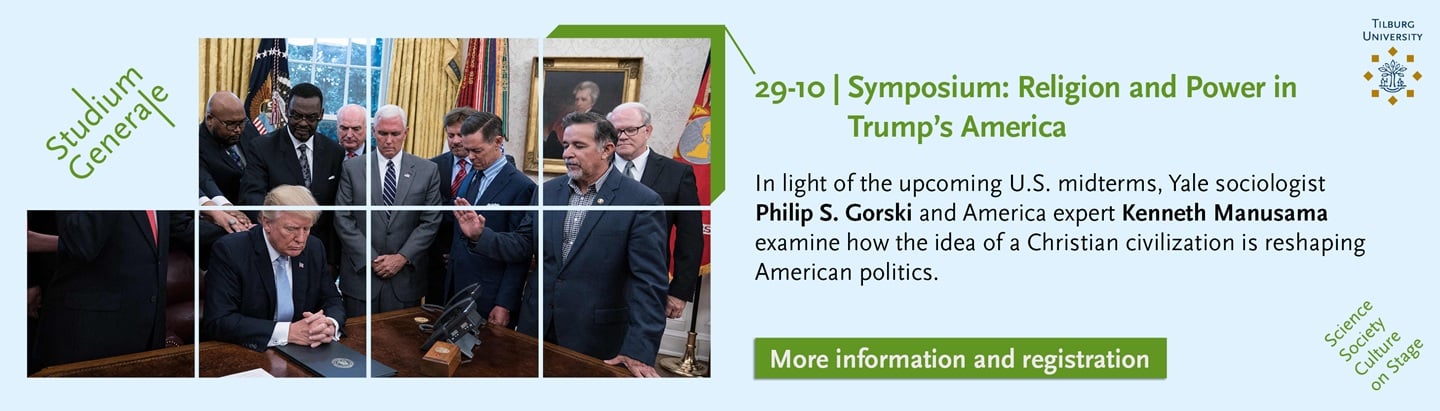
Religious fanatics pervade the White House. How toxic is the mix of politics and religion?
The Iran war as God’s plan, a minister who calls for a crusade and a president who presents himself as Jesus Christ. American politics is hijacked by fundamentalists who glorify violence against non-Christians. Will the separation of church and state soon be abolished in America?
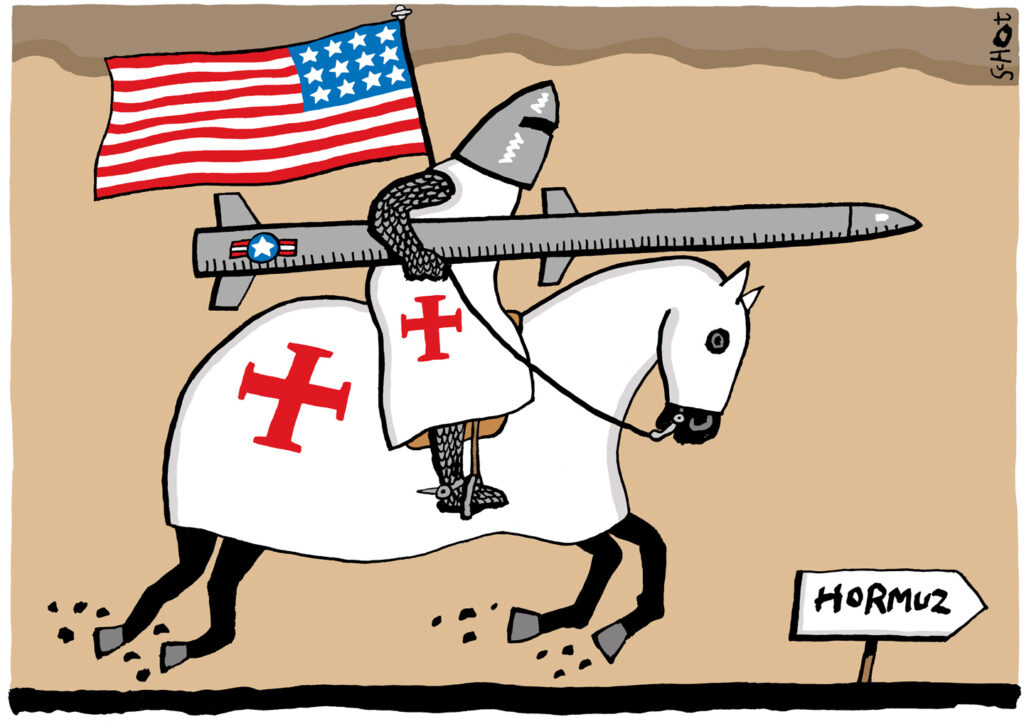
American soldiers were told by their commanders that the war against Iran was ‘biblically-legitimized’ and an ‘unmistakable sign of the imminent arrival of the end times.’ Many soldiers complained to their union about the mixing of religion and politics. Because in the United States, church and state are separated, as it is laid down in the constitution.
The question that concerns many Americans is whether this separation is still tenable in their country, with these Christian fundamentalist politicians and ditto supporters. Because in America, the Christian faith is never far away, and the extreme variant is also playing an increasingly important role in American politics. How is it possible that under President Trump these religious fanatics are gaining ground?
Fairly modern
‘The views of Christian fundamentalists seem very old, but the movement is relatively young,’ says Nora Kindermann, postdoc at the theological faculty in Tilburg. ‘It is a reaction to modernity, a resistance against a progressive, liberal worldview and associated morality. One of the characteristics, for example, is the literal interpretation of the Bible.’
If we zoom in, we see that Christian fundamentalism itself is actually quite contemporary, says Kindermann, who obtained his PhD on this subject at the Vrije Universiteit (VU) in Amsterdam in 2025. ‘The movement uses modern means and technologies. Just think of TV pastors like Jerry Falwell and his Moral Majority movement.’
Call for violence
Today’s fundamentalism in America is of two minds. On the one hand, there is the militant crusader ideology of Defense Minister Pete Hegseth, who renamed his ministry the Ministry of War. Hegseth openly calls for a holy war against Iran and already spoke of a crusade against the Muslims in his 2020 book American Crusade. The recent deadly attack on a mosque in San Diego seems to be an example of such ‘hate crimes.’
On the other hand, there is the Protestant ideology of the ‘end of time’ and the apocalypse. Kindermann: ‘This apocalyptic thinking can go in different directions: some fundamentalists call for a holy war, while other groups withdraw from society to await the end of time.’
Ideology
Under Trump, Christian fundamentalism has also gained a foothold in the center of power, the White House. If the government goes along with that rhetoric, could it form a breeding ground for open battle, as we saw in 2021 with the storming of the Capitol? ‘Fundamentalism does not automatically lead to violence,’ says Kindermann: ‘There are large groups that adhere to an ideology, but there are few people who really act.
‘Of course, adherence to a militant ideology is a risk factor, but there are a lot of other factors that also play a role, such as discussions in the media and the reaction of governments. Unfortunately, we cannot predict it. The fact that there are now leaders who openly speculate about a crusade will not automatically lead to a large-scale war against other groups of believers.’
Separation of church and state
‘Fundamentalism and Christian nationalism regularly overlap, and both lines of thought can be at odds with freedom of religion and other democratic principles. But the separation of church and state has of course been enshrined in the American Constitution for 250 years. Religion should not be imposed or promoted by the state,’ Kindermann says.
‘Fundamentalism is an ideological movement that is becoming stronger and more visible in waves,’ Kindermann knows. Fundamentalists had the wind in their favor under President Reagan in the 1980s, after which the movement became less visible again, she explains. ‘It pops up every few decades but is never completely gone.’
Revenue model
Another question is whether these political leaders also sincerely believe in their ideology, or is fundamentalism just a business model with which they manage to acquire political capital? Kindermann: ‘I think a number of people are really religious, such as Vice-President Vance, who has actually converted to Catholicism.
‘You do see that leaders appeal to the Christian traditions in which the Christian religion is culturalized. It is often difficult to find out how sincere politicians really are in their faith.’
Jesus
The general assumption is that President Trump himself is not a fundamentalist. This often does not matter to fundamentalist Christians, Kindermann argues, they mainly vote en masse for someone who fights for their ideals.
But politicians can also overplay their hand. Trump recently showed this by posting an AI image of himself as Jesus on his socials. That came in for a lot of criticism, especially for Christian groups, Trump has crossed a line. Some even accused him of sacrilege.
Advertenties.