Joris Luyendijk: ‘As individual countries we cannot be free, but as Europe we can’
Europe can finally become militarily and technologically independent, says writer and activist Joris Luyendijk. ‘Once we have pushed the Americans out, we can decide for ourselves how we want to organize our technology. It shapes our entire existence.’
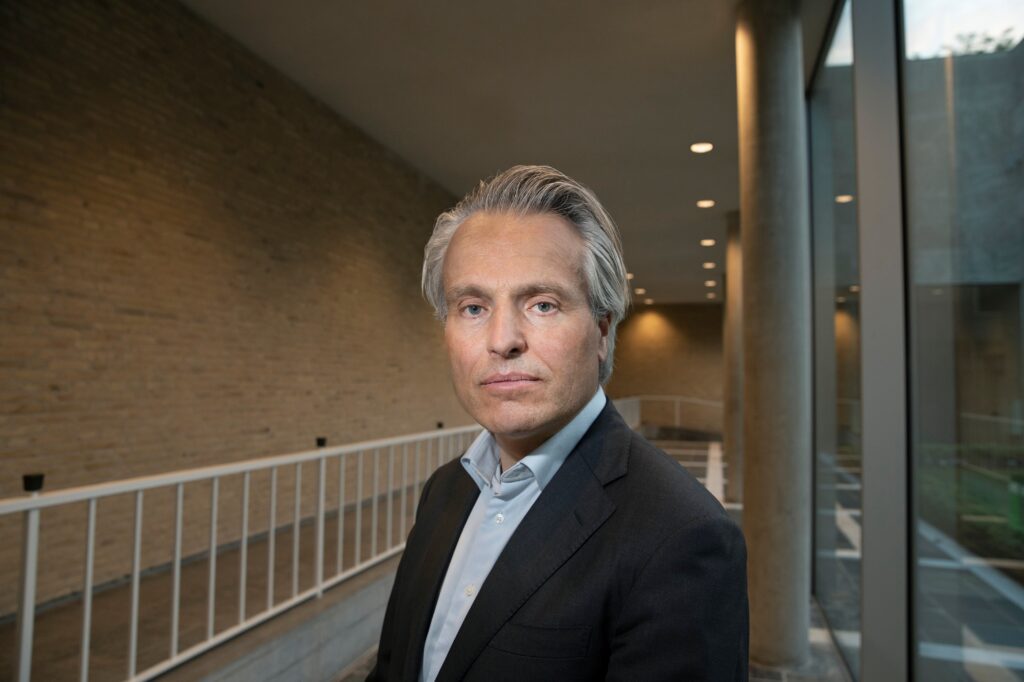
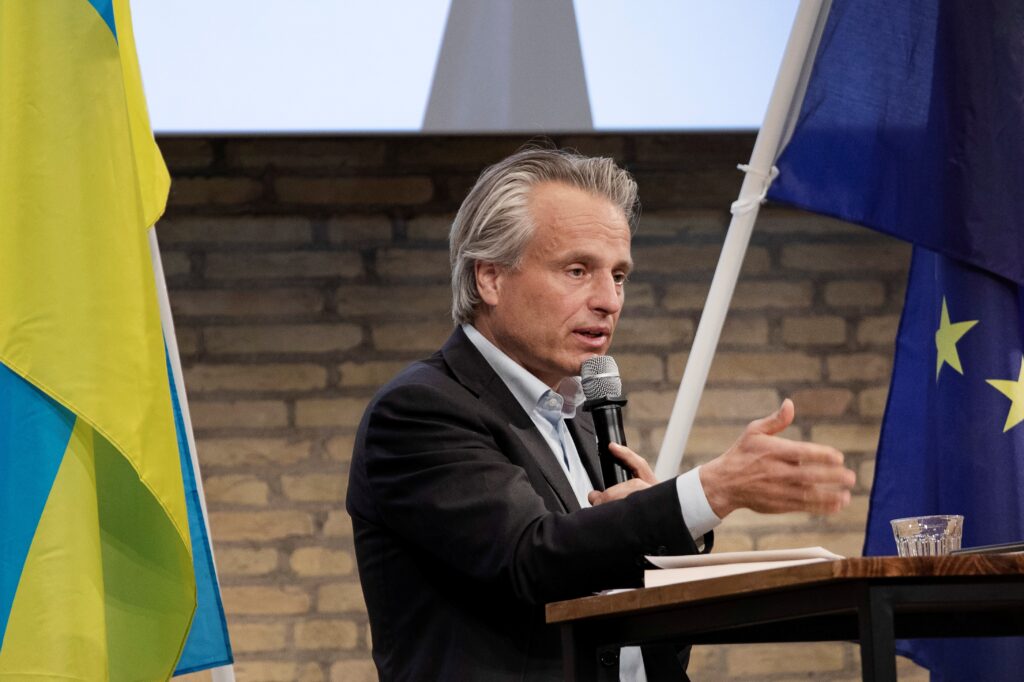
Ukraine has now been resisting Russia for almost four and a half years. What would it mean if Ukraine were to fall, and is Europe capable of standing up to Russia? During the well-attended event Ukraine and Europe – In Conversation with Joris Luyendijk, held in the auditorium of the Cobbenhagen Building, it became clear once again that the war in Ukraine is a European war—and that Europe’s future is being decided there.
Univers spoke with writer, activist, and former journalist Joris Luyendijk after the lecture.
The war Russia started against Ukraine has now been going on for four and a half years. How do things currently stand?
‘I think everyone who has made predictions about the course of this war over the past few years has eventually had to admit they were wrong. Since the beginning, people have been saying that the Russian economy is about to collapse. Yet the Russian economy is still functioning. For four and a half years, people have also been claiming that the Ukrainian front is about to break. Yet it is still holding.
‘The most informed thing you can say is that there is so much uncertainty and ambiguity that predicting the course of the war is impossible. How will technology develop? Take drones, for example. And if technology advances, will that benefit the attacker or the defender? Factors like these make an enormous difference.’
Do Dutch people and other Europeans have a realistic understanding of the threat posed by Russia?
‘What exactly do people mean by ‘threat’? I think that is difficult to investigate precisely. What I do know is that every day more people come to recognize the Russian threat.’
Some people say: as long as there are no tanks rolling through our streets, things can’t be that bad.
‘That’s a very small group of people. So I think we should mostly ignore them.’
The alliance we had with the United States has been broken under Trump. What opportunities does that create for Europe?
‘In the United States, everything is designed to give tech leaders as much power as possible and help them make money. American tech companies are doing everything they can to poison our youth and are using every available tool to make us addicted to our phones. It is very strange that we recognize this danger when it comes to the tobacco industry and say, ‘We’re no longer going to sell that,’ yet we allow tech companies to do whatever they want.
‘Since 2024, Europe has had the Digital Services Act, an EU law aimed at making online platforms safer and more transparent. In response, the Americans essentially said: if you actually enforce this law, we will abandon you militarily, leaving you with a massive problem. The leaders of our continent know perfectly well what would happen if Ukraine fell. Putin would not stop at Ukraine.
‘We need to become independent both militarily and technologically. We now have that opportunity. Make no mistake: technology is everything. It is not just another sector. Technology shapes our entire existence. And right now, that existence is increasingly being determined and directed by America’s destructive short-term capitalism. What we need is long-term capitalism.’
Do we know how Putin views Europe?
‘One of the characteristics of a dictator is that he does not have to explain himself. Dictators make enormous mistakes because nobody dares tell them the truth. That is why they invade countries without realizing it may be a terrible idea.
‘Some people argue that Putin benefits from the war because it has made everyone dependent on him. Others say he has become a hostage to his own war and can no longer stop it.
‘In a democracy, Putin would have had to explain his actions to independent media, at a party congress, or during elections. But Putin does not have to do any of that.’
Is our constitutional democracy capable of withstanding a war with Russia?
‘If it really comes to war, then we will temporarily suspend parts of the rule of law, just as we did during the COVID pandemic. Suppose we urgently need a weapons factory. Are you first going to spend eighteen months on procurement procedures, then start construction and hope no conflict breaks out in the meantime? Or do you temporarily switch certain rules off?
‘When you see Russia buying influence in Dutch politics through a party like Forum for Democracy, in France through the National Rally, in Germany through Alternative for Germany, and when you consider its involvement in Brexit, then these are questions we need to start thinking about now.
‘We also need to think about how we restore those rules afterward. After the pandemic, for example, mandatory face masks and curfews were lifted and things returned to normal. The same principle applies.”
In an interview with Univers last year, David Van Reybrouck said he no longer believes Europe will always remain democratic. He argues that we have taken democracy for granted and failed to invest in it. What do you think?
‘Democracy in the sense of a people coming together through a political process and continuously discussing and examining what it can, wants to, and should be—that has never really existed at the European level. There is no European public sphere.
‘So I’m not entirely sure where David sees things collapsing, because where it ought to exist, it does not yet exist. But it will emerge. We will have to do more and more things together as Europeans because together we can be free, whereas as individual countries we cannot.
‘Together, we can decide how technology should be shaped. If we do not want the Americans’ short-term capitalism, and if we do not want algorithms pushing our youth toward the far right, then Europe can determine for itself how to deal with that and what kind of internet we want.
‘That autonomy will emerge once we have pushed out the Americans—and the Chinese as well, for that matter. To achieve that, we need a European public sphere. We must build and sustain it.’
You have just returned from Ukraine. During the lecture you said: ‘Ukrainians are not pitiful victims: they suffer and are traumatized. But they are also resilient, energetic, and humorous.’ How do they view the future?
‘They don’t. When you are focused on survival, you cannot look to the future. Ukrainians are currently concerned with one question: how do we survive, and how do we avoid losing?
‘But there is certainly room for humor. During my most recent visit, I laughed a great deal again. Ukrainians seem to have inherited the humor gene of the Slavic peoples. Russians are not exactly known for their sense of humor, and neither are Poles. Ukrainians are. Zelensky, for example, is genuinely a very funny man.
‘Humor and war coexist quite naturally there. Perhaps that is because the Ukrainian army is organized in a decentralized way and lacks the rigid Soviet-style hierarchy. Commanders and soldiers interact very informally. I would recommend that everyone visit Ukraine and see it for themselves. Of course, it is also dangerous, so this is not travel advice.’
Fundraising
During the event Ukraine and Europe – In Conversation with Joris Luyendijk, held on Wednesday, June 17, funds were raised for Ukraine. The evening generated €11,237.06. Donations can still be made.
Advertenties.