Marion Koopmans on online threats and disinformation: ‘Scientists, come out of the ivory tower’
According to virologist Marion Koopmans, disinformation, online threats and declining trust in science pose a growing risk. She therefore advocates stricter codes of conduct on social media and greater visibility for scientists: ‘Perhaps academics should all flock to social media.’
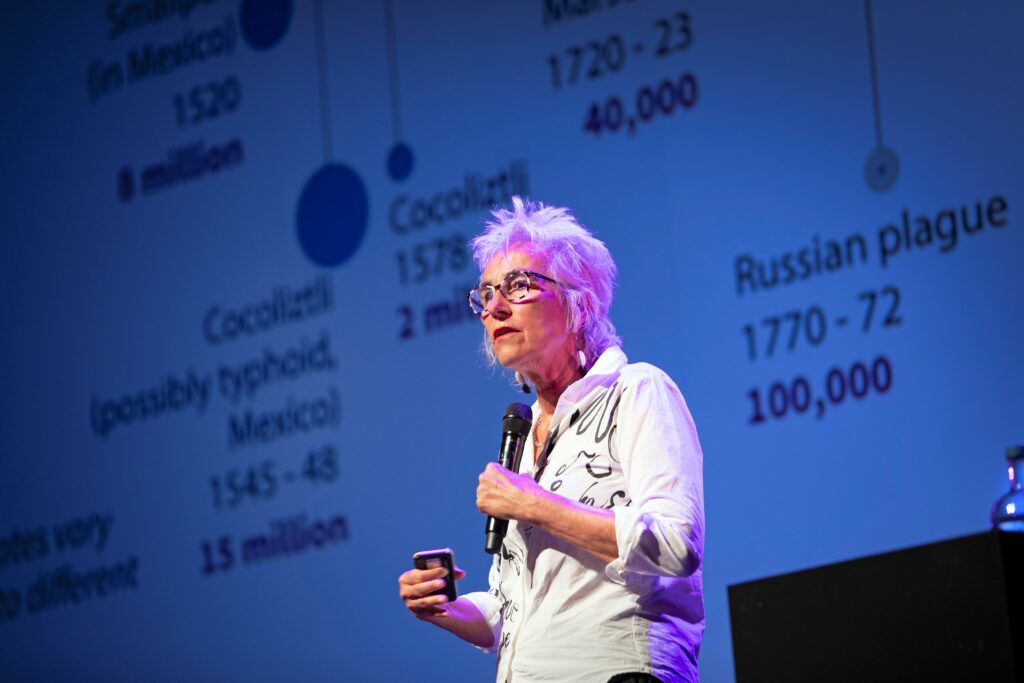
During the COVID 19-pandemic, virologist Marion Koopmans (1956) suddenly became a household name in the Netherlands. As a member of the Outbreak Management Team (OMT), she advised the Dutch government on tackling the coronavirus. An unwanted side effect was that she became the target of serious threats and even required personal security for a period of time.
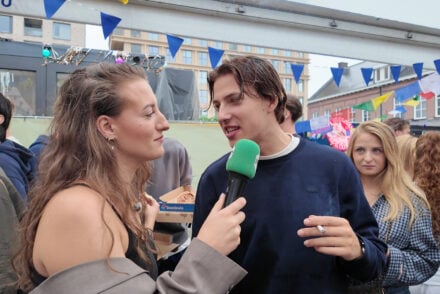
What impact has that had on Koopmans herself, and on science more broadly? Univers spoke with Marion Koopmans (Erasmus MC) via video call ahead of her appearance at Science Café XL in Tilburg last week.
Distrust among certain groups towards science became highly visible during the COVID-19 pandemic. Had you already encountered this as a scientist before then?
‘Groups that deny the existence of viruses, claim vaccines are poisonous, or argue that climate change does not exist had been around for quite some time. But during the pandemic, their influence clearly increased.
‘The combination of informal networks and social media that emerged during that period fundamentally changed the way information is shared. To me, that presents a major challenge.’
Over the past few years, you have often spoken publicly about the serious threats and hatred you received during the pandemic, much of it through social media. You also told the Parliamentary Inquiry Committee on COVID-19 about the impact this had on you and your family. You said: ‘I find it very difficult that there is actually nothing you can do about it.’ What did you mean by that?
‘Everywhere else, there are agreements and codes of conduct that determine how people should treat one another. Online, those simply do not exist. You encounter the most bizarre, horrific and sexist remarks. Only when those expressions become extremely serious, and you report them to the police, are they sometimes stopped.
‘Extreme online posts are often picked up and amplified by politicians, usually from the right. You can only stand by and watch, because as an individual there is nothing you can do about it. I find that deeply worrying.’
Were your remarks to the inquiry committee also intended as a message to politicians?
‘I believe the Netherlands has a strong democracy. But if you look at the United States and see how widespread anti-vaccination thinking has become there, it is now fully embedded in mainstream politics.
‘That same political movement is shutting down climate research institutes because, according to them, climate change is nonsense. American research funders now even maintain lists of banned words. If you want to submit a grant proposal that includes gender differences, forget it—you simply will not receive funding.
‘That goes incredibly far. That is why I keep raising this issue, also as a message to politicians: take a good look at your own ranks. How are we dealing with this in the Netherlands? I am not convinced we are prepared for it. In fact, I do not think we are.’
Do you notice hesitation or reluctance among fellow scientists when it comes to participating in public debate?
‘There are no statistics on this, but I certainly hear it around me. People regularly say to me: I can’t believe you’re still doing this. My response is that what I experience is not really about me personally—it is a societal problem. And it certainly would not be desirable if everyone in a position similar to mine stopped appearing in the media.
‘At the same time, I believe it is the role of scientists to come out of the ivory tower. Go into society, show people what you do and explain how science works. Young researchers are increasingly assessed on this aspect of their work. That means we also need to prepare and support them much better.’
In 2022, the platform WetenschapVeilig was launched. At the time, Universities of the Netherlands (UNL) chair Pieter Duisenberg said that ‘threats constitute an attack on academic freedom’ and that ‘our democratic values are undermined if scientists can no longer participate in public debate’. Does that motivate you to remain visible?
‘Absolutely. I will continue to speak out. And once again, I believe certain aspects of social media really need to change. Anonymous accounts, for example, should no longer be possible. In England, they are exploring the possibility of banning them. I think that is an excellent idea: send people hiding behind anonymous accounts back into the shadows.’
In a recent edition of the current affairs programme Buitenhof, you spoke about another phenomenon: the infodemic. What does that mean?
‘An infodemic occurs when people are overwhelmed by such an enormous amount of information—including false information—that reliable information gets drowned out. We recently saw that during the hantavirus outbreak. There were only thirteen patients, yet media coverage around the world was completely disproportionate.
‘At a certain point, people simply no longer know what information they can trust. The World Health Organization (WHO) now regards the deliberate spread of malicious disinformation about diseases as a serious threat.’
You also expressed concerns before the inquiry committee about how society will deal with future crises. You said: ‘I think we are going to lose a great deal. Including our ability to respond effectively.’ What exactly are we losing?
‘During a crisis, different parties must be able to find one another. On the one hand, you have professionals advising on public health measures. On the other, you have citizens who need to adopt those measures for their own benefit and that of others.
‘If you fail to reach those citizens—whether because of political polarisation or the dynamics of social media—you may have the best possible measures available, but you will still fail to contain a pandemic.
‘Take vaccination, for example. Resistance to vaccines became quite substantial. If that resistance increases even further during a future pandemic, then your most effective tool for combating a virus effectively becomes unusable. That is an enormous risk. That is what we stand to lose.’
In 2020, you received the Machiavelli Prize in recognition of the way you communicated during the pandemic. The jury praised your ability to distinguish facts from myths about the virus in language that everyone could understand. Isn’t there a challenge here for science communication—to become more accessible and approachable?
‘That is exactly why it is important to give young scientists visibility. There are initiatives such as Pint of Science, where people sit together in a pub while researchers talk about their work. There are also projects in schools where pupils become ‘virus experts’.
‘I myself give lectures across the country and also teach older adults. Many of them read the newspaper from front to back every day. During discussions, they challenge you from every possible angle. You learn an enormous amount from those conversations. So there are many opportunities to engage people in discussions about science.’
Can social media also play a positive role in this?
‘Absolutely. For young people who are interested in science but live in countries where access to knowledge and scientific literature is limited, social media can serve as a gateway. That is what researchers who have studied the issue have told me.
‘Scientists can also be trained to communicate effectively on social media. All of our PhD candidates receive blog-writing training, because obtaining research funding increasingly depends on whether you can clearly explain to people what your research is about.
‘Personally, I have sometimes thought: I should just leave social media altogether, so I no longer have to see all that rubbish. But perhaps, as scientists, we should actually join social media en masse—and reclaim that space.’