Children play the Zero Hunger Game: ‘I was shocked, we gained a few million inhabitants’
Children walk around busily, talking and negotiating about population growth and hunger. With Tilburg University’s board game Zero Hunger Game, children in primary schools learn about hunger and inequality in the world. Univers watched a primary school in Tilburg-Noord.
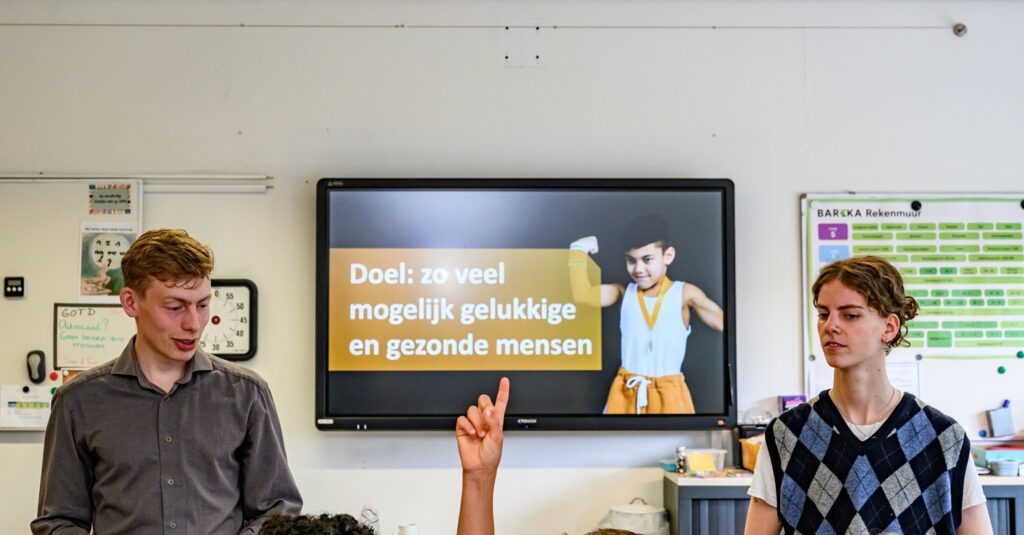
There is a pleasant hustle and bustle this Wednesday morning, June 10, in group 8 of Children’s Campus Het Hazennest. Here and there you can hear excited voices of young participants who want to negotiate with classmates. With a lot of effort, the students play the board game Zero Hunger Game, a so-called serious game.
Inequality is ingrained
‘They are doing very well, everyone is paying attention,’ explains Babette van den Berg. She is one of the two students from Tilburg University who supervise the game. ‘And that’s nice, because for me this was the first time we really got to the fifth round. They all want to participate, even though some don’t think it’s fair how the chances are divided.’
Because inequality is ingrained in the game. Linda Parasiz, program manager of Tilburg University Junior: “We developed the game to teach students about hunger and inequality in the world. The beauty of the game is that children experience the problems themselves. In the long run, players get the feeling: wait a minute. Why can they feed their population and we can’t?’
Enough money for food
‘There are already two million deaths, is that bad?’ asks student and game leader Barend van der Voorden Verheul. “Not for us,” says a group of rich countries. But Van der Voorden Verheul is not satisfied with that. ‘What do you think?’ he asks the rest of the class. “We would like help,” it sounds from the corner of the poor countries. ‘Shall we switch positions then?’ ‘No,’ protest the rich countries.
‘A team had four million ‘inhabitants’ in the game and then two million ‘died’,’ explains Van den Berg. ‘For the children, those cards and coins in the game are abstract numbers. To make it more concrete, I then ask: ‘What if something happens to people in your own environment? Is there not enough money for food?’ In this way, I try to let the consequences of their choices resonate. And then you sometimes see that they understand it a little more.’
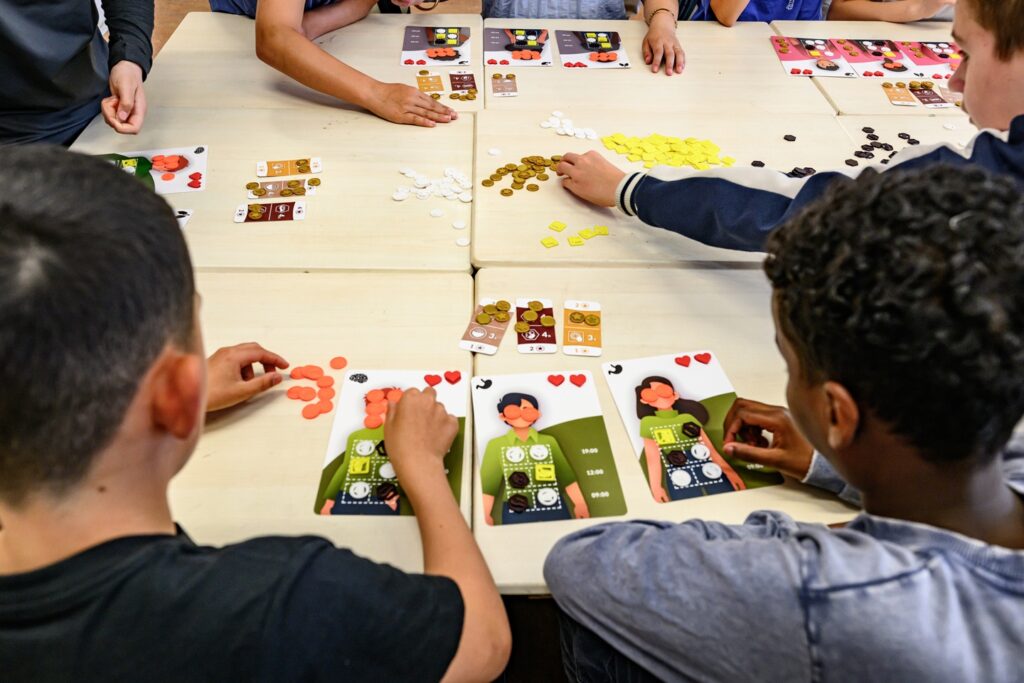
Van der Voorden Verheul: ‘Hunger in the world is an abstract problem. For most of us, it’s a ‘far-from-my-bed-show’. When you play this game, you have to negotiate and make choices to make sure that your population has enough to eat, for example. This game makes participants think about choices they make, and they experience first-hand how unfair hunger and inequality can be.’
Getting to know science
‘The initiative for the game came from the Zero Hunger Lab and Tilburg University Junior,’ Parasiz explains. ‘Scientists from the Zero Hunger Lab conduct research into the social problem of hunger and inequality in the world and are keen to involve a wide audience. We developed the game together with game designers from Breda University of Applied Sciences.
And Tilburg University Junior is involved in the game because of the knowledge of the target group and the rollout of the game to primary schools. Parasiz: ‘This game fits well with our objectives. We want to introduce children to science and the university.
‘We do this in all kinds of ways, including with children’s lectures and science festivals. So, we translate science into a form that children can understand. And if you can explain it to a child, you can explain it to anyone.’
Trading
A bell rings in the classroom. This round of the game has ended, a round in which it was not possible to trade due to an imaginary pandemic. For the ‘poor countries’ this was an acute problem, because in the meantime they have to fill the mouths of the inhabitants.
Sam and Siem have drawn a few cards without much exchange. Their problem is that no one wants to trade with them. Now that it is allowed again, Sam has to provide ‘food’. Siem: ‘He is going to try to negotiate with the rich classmates. Then maybe we can get enough to eat. But I don’t know if it will work.’
Not from a book
Nadine and Olivia are doing a lot better at the game: ‘It’s fun, but with more mouths to feed, it becomes increasingly difficult,’ says Nadine. Olivia thinks so too: ‘I was shocked, because we gained a few million more inhabitants. And they all have to eat. Now we have to arrange more meals.’
In the meantime, the teacher of group 8 looks on benevolently: ‘Through the game, the children not only learn what problems are going on in the world. In interaction with each other, by seeking rapprochement and by negotiating, they also learn to take responsibility. You don’t learn that from a book.’
Learning to present
The students of Tilburg University also learn a lot from the game. ‘There are two supervisors per game, and they are Tilburg students from different courses and backgrounds,’ Parasiz explains. ‘In this way, we contribute to their development.’
‘The students learn to present and explain. They can also use that in their later careers. And they learn to make science accessible and to involve children in social problems such as hunger and inequality.’
Critical of the Netherlands
With the game, the students bridge the gap between theory and practice. Babette van den Berg: ‘When I saw that a vacancy became available, I thought: super nice. My study Global Management of Social Issues fits in very well with this. There we learn how to tackle social problems from the perspective of organizations and institutions.’
Barend van der Voorden Verheul’s study is less in line with the game. He studies Law: ‘I do this work mainly because of the message that the game wants to convey. We should take off our blinkers much more and be more critical of the role and position of the Netherlands in the rest of the world. I think that message is very important and that is my motivation to contribute to this as a game leader.’
Who wins?
And then the game part is over. The children count the number of tickets and their blessings. Van der Voorden Verheul starts the debriefing. ‘Who won?’ he asks the class. Because that is up to the participants to decide for themselves in this game. What do they find more important? More money, or more happy residents?
Most children point to Olivia and Nadine as the winners of the game. They have many healthy and happy inhabitants. The two are beaming. ‘Was the game fair?’ the game leader asks the class.
Many children don’t think so, because the tickets were not fairly distributed at the beginning. ‘Do you see a comparison with the real world?’ is the question to the children. The answer: ‘Yes, if you were born in the Netherlands, you have better chances.’
Helping each other
‘How can you make the game fairer?’ asks Van der Voorden Verheul in conclusion. ‘By exchanging more,’ one team suggests. Because asking for help is quite difficult, they think. And if you are poor and too many children are born, you cannot do without the help of other groups.
‘It was a pity that they didn’t win,’ Van der Voorden Verheul confesses afterwards. ‘As a game leader, you have your own vision of the game. And they were the only group that said: come and deal with us. That is the core of the game, helping and sharing with each other. Anyway, the children were allowed to decide for themselves who won.’