Creativity researcher De Rooij: ‘AI doesn’t make us more, but rather less creative’
Slick photos, professional-looking texts, and leaflets. With AI these days, you can make the most fantastic creations yourself. But we do pay a price for that, research shows. ‘We are becoming less creative.’
Anyone who scrolls through the socials can conclude that many texts and photos are more of the same. But is that really the case? And if so, how do you demonstrate that, wondered Alwin de Rooij, assistant professor of Creativity Research at Tilburg, and his Danish colleague Michael Mose Biskjaer of Aarhus University. The preliminary research result: it is true that AI is reducing the diversity in creative expressions.
For their research into the outcomes of AI applications, De Rooij and Biskjaer compared a number of empirical studies from the period between 2022 and 2026 on Human-Computer Interaction (HCI, ed.) by fellow scientists, starting with the public introduction of chatbots.
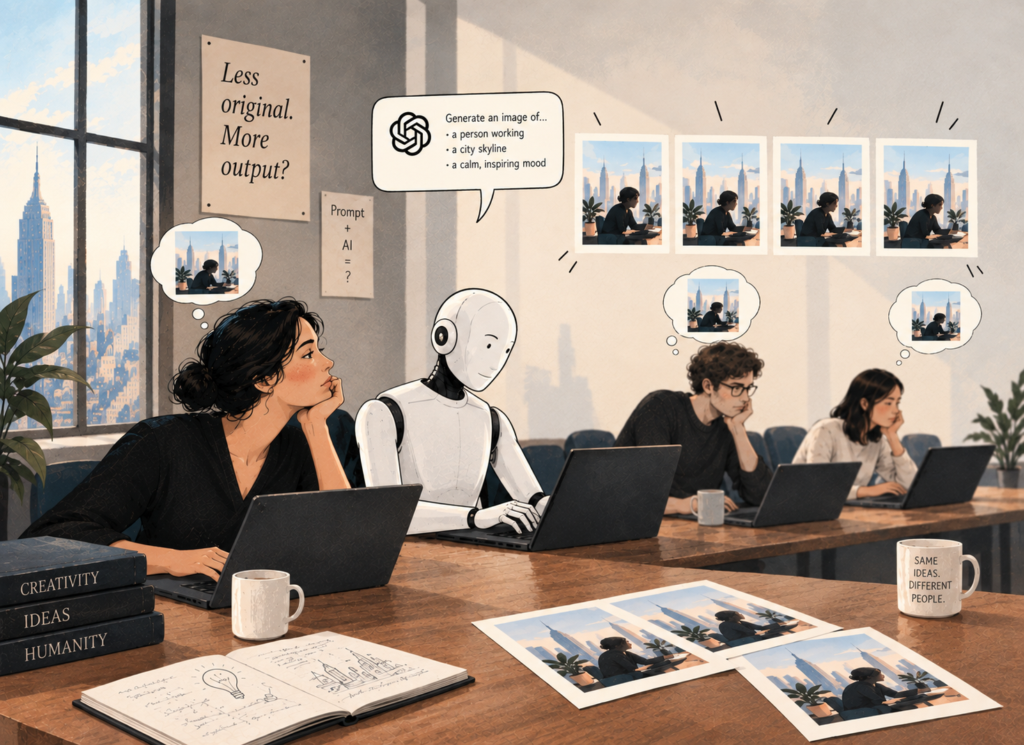
For this article, the editors of Univers asked ChatGPT to create a suitable illustration. This is an exception. Based on journalistic principles, Univers only collaborates with human illustrators and photographers. This illustration from ChatGPT shows why.
Dynamics
Those chatbots tend to produce more of the same. Monoculture and homogenization, in short, uniformity, are not exclusively something of our time. In art movements, you also saw that painters, musicians, and other artists started to imitate each other when something was successful, says De Rooij. But there are always artists who in turn break through the uniformity.
‘The dynamic behind this is that unexpected things offer the opportunity for diversity of new content and can thus lead to new movements,’ says De Rooij. ‘That is the counterpart of monoculture. So that movement, that field of tension, has always been there.’
Benefits
‘The difference with now is the scale on which homogenization occurs,’ says De Rooij. ‘AI technology appears to be an important driver for homogenization. And certainly, the fact that millions of people use the same technology in a similar way to support their creativity. The simultaneous use of that technology plays a significant role in the outcome.’
The use of AI offers benefits to users. ‘We see that it offers people who are not well trained creatively an advantage in that creative process,’ says De Rooij. ‘But what the model mainly does is filter out the lesser ideas at an early stage.’
Groundbreaking ideas
The other side of the coin is that innovative ideas can also die as a result. De Rooij. ‘But we don’t yet know exactly what the AI models do with those excellent results, which are actually desirable.’ That process requires further investigation.
‘Because who is waiting for more average creativity?’ asks De Rooij rhetorically: ‘You’d rather have those few excellent and groundbreaking ideas that really make an impact.’
Uniformity
Will we all become less creative? ‘That depends on how you use AI,’ De Rooij nuances, ‘and at what point in the ideation do you apply AI. I now see students who deliberately do not use AI models, because according to them, that leads to uniformity. They want to preserve their individuality and maintain diversity by staying away from AI technology.’
On the other hand, you also have AI users who use and train models to stimulate their creativity: ‘Some people find AI interesting, because they can extract patterns from data that they find inspiring, for example in developing art.’
Encouraging diversity
Can’t we make models in such a way that they offer more diversity in their output? De Rooij: ‘That has not been quite easy so far. If you raise the randomness of the output, you do not get so much originality, but more incoherence: outcomes that make no sense and have no mutual coherence.’
Large language models, for example, have a kind of ’temperature parameter’. If it is set very low, so to speak, you get the statistically most likely word with the most likely text. If you raise the ’temperature’, you get less and less likely word combinations. So that leads to incoherence rather than meaningful diversity.’
Consequences for society
The large-scale use of AI seems to lead to more homogeneity and less diversity of ideas at a supra-individual level. ‘We are now slowly but surely going to experience the consequences of this for society,’ De Rooij thinks, ‘precisely because we have started using this technology on such a large scale. This was an initial exploratory study, and we should therefore definitely do follow-up research, because of the possible social and cultural implications.’
Advertentie.