From the flood to the forest bath: this is how we find something to hold on to in the climate crisis
Forest fires, droughts and floods make the climate crisis visible. But how do we deal with this crisis? Religious scholar Caroline Vander Stichele investigated which images and rituals people use in this process.
‘We are dealing with an existential crisis, which threatens our survival,’ says Caroline Vander Stichele, departing professor at the theological faculty. ‘And because the climate crisis is so existential, people are looking for frameworks to give meaning to it.’
Vander Stichele and her colleagues analyzed the texts, images and concepts about the climate crisis that circulated in Dutch media between March 2023 and March 2026. What do those texts and images say about us?
Doomsday thinking
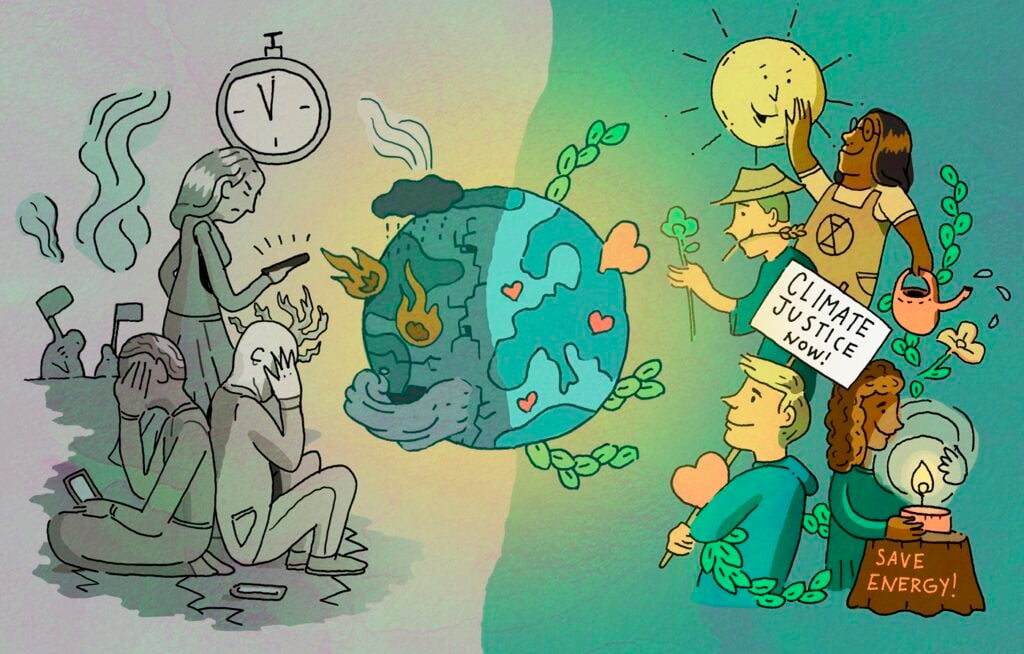
In the image of the climate, we see meaning and moral frameworks, such as in the use of apocalyptic images and texts about an imminent end of the earth, five-to-twelve rhetoric and flood metaphors. These images are intended to emphasize the urgency of the climate problem, says Vander Stichele.
In doing so, climate activists are trying to create support among a larger public for immediate and large-scale intervention, because ‘scientific facts and data about CO2 or warming of the seawater by one and a half degrees do not inspire you to get started,’ Vander Stichele thinks.
Motivate
But whether those alarmist images really get people moving? ‘Sometimes it makes people despondent, and then you end up in a situation that benefits climate skeptics and deniers,’ she says.
‘To mobilize people, you first have to motivate them and the best way to do that is with positive images. Extinction Rebellion does this, for example, with their active hope circles, meetings in which concerned members can participate.’
In such meetings, an appeal is made to people’s spiritual experience, according to Vander Stichele, in order to reconnect with themselves, with others and with the earth.
‘Or take the forest bathing that has blown over from Japan, with which participants find a way to get back in touch with nature,’ says Vander Stichele. ‘People recharge by connecting with a larger whole.’
Primeval mother
Images and metaphors can therefore help to give people something to hold on to and get them moving, but they can also give the wrong impression, Vander Stichele argues in her farewell speech. In it, she goes in search of religiously inspired representations. In one of these scenes, the biblical figure of Mary and the Christ Child symbolize the legacy of future generations.
Just as in the Gaia hypothesis, in which the earth is represented as a living being, the image of Mary can serve as a model for the primeval mother and for a more loving relationship with nature. Such representations can contribute to awareness of our role in the whole.
But images can also evoke unintended and wrong associations, Vander Stichele observes. She calls the image of ‘Mother Earth’ as an inexhaustible source that asks for nothing in return counterproductive. This can also confirm the persistent idea that ‘nature’ is feminine and ‘culture’ is masculine. And that climate activism would be a ‘soft’ and ‘feminine’ activity.
Rituals
Rituals are also powerful tools to give people something to hold on to and get them moving. Rituals are common in religion, but also outside of religion. They are recurring actions that bring people together, get them moving and create a symbolic context. ‘In that sense, you could also call the occupation of the A12 by Extinction Rebellion a ritual,’ says Vander Stichele.
‘You see that people are reaching back to all kinds of tools to shape their attitude, commitment or mental state,’ says Vander Stichele. Religious and spiritual traditions can provide a broader perspective and a moral compass to change course. ‘Our research can help to gain insight into all these different images, forms and practices.’
‘For example, we see that the five-for-twelve metaphor was very dominant, especially in 2018-2019, but that participants in climate marches now choose other themes, such as climate justice,’ says Vander Stichele. ‘Climate Justice Now is such a topical moral theme, which advocates a more positive approach and is not as paralyzing as apocalyptic images and other doomsday scenarios.’
Advertenties.