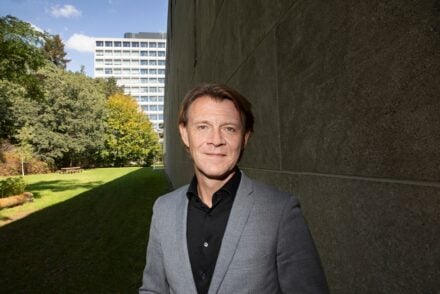
Kim Putters: ‘Prosperity Is About Much More Than Money’
Broad prosperity is about more than your wallet and economic growth. University Professor and Chair of the Social and Economic Council (SER) Kim Putters explains why factors such as education, health, housing, climate and work are at least as important in determining our quality of life.
What does economic growth really mean if young people cannot buy a home, prosperity in the Netherlands is unevenly distributed, and pressure on the environment continues to increase?
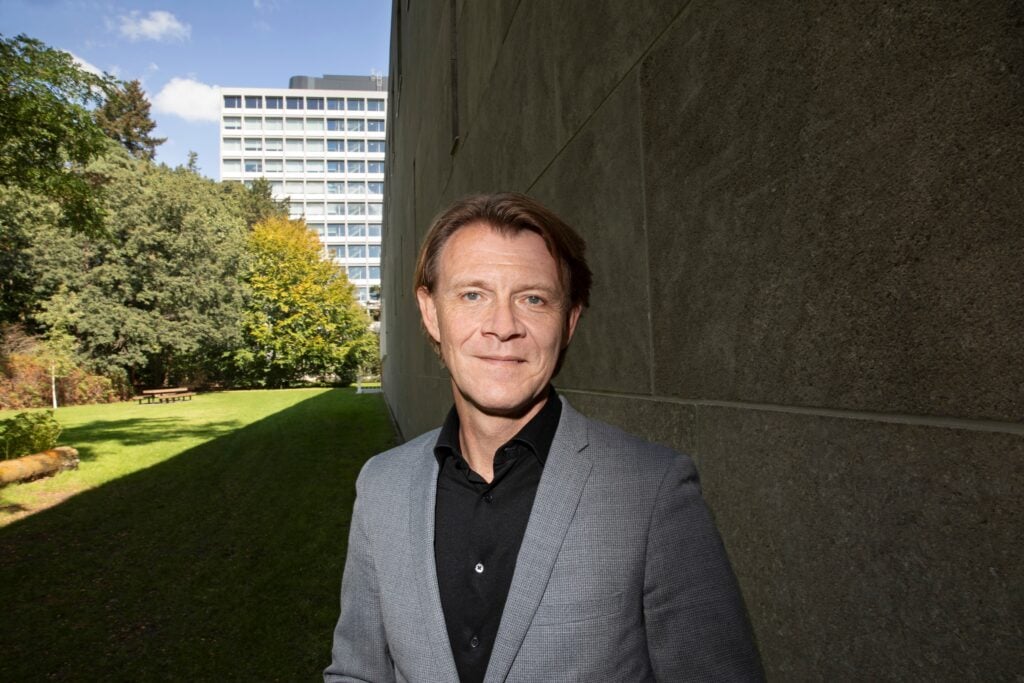
On a late summer afternoon, Professor and Chair of the Social and Economic Council (SER) Kim Putters (1973) invites Univers to the office of Dean Marike Knoef in the Koopmans Building. Here, he explains why broad prosperity is becoming an increasingly important theme and why politicians, especially now, need to demonstrate leadership: ‘A great deal is at stake.’
What exactly is broad prosperity?
‘Broad prosperity encompasses all aspects that determine your well-being as an individual, as well as the prosperity of our country as a whole. It is not only about money or employment, but also about matters such as health, housing, safety, society, the environment, education and social networks.
‘Over the past years, politicians and policymakers have increasingly adopted a one-sided view of prosperity, focusing mainly on its financial and economic dimensions: purchasing power, material wealth or gross national product. In doing so, however, they overlook an important part of what determines our prosperity.’
Why is broad prosperity such an important theme for Tilburg University?
‘What makes this university special is that it has always been a true university of people and society. There is a reason why Understanding Society is our motto.
‘Broad prosperity is not only an interesting issue for economists. If, for example, you ask how much trust people have in one another, you also turn to sociologists and psychologists. In this way, we address broad prosperity from different academic disciplines and perspectives.
‘In our university-wide academic workshops in the TIAS Building, we bring science and practice together. We work with municipalities, companies, social organisations and other partners on societal challenges. By combining scientific knowledge with practical experience, we develop new insights and solutions that contribute to broad prosperity.
‘It is also important for Tilburg University to connect with broader international goals, such as the Sustainable Development Goals. These include combating hunger and poverty. In Tilburg, we contribute to these aims through the Zero Hunger Lab and the Zero Poverty Lab.
‘The key is to view the planet, people and the economy, in other words people, planet and profit, as interconnected. Our university sits at the heart of all three.’
How is the Netherlands performing in terms of broad prosperity, and how is it measured?
‘Statistics Netherlands (CBS) publishes an annual broad prosperity monitor. It assesses the state of broad prosperity and how satisfied Dutch citizens are with various aspects of their daily lives.
‘RaboResearch, Rabobank’s knowledge centre, in which Professor of Practice Otto Raspe is involved, also conducts research at the regional level. Broad prosperity is therefore measured in several ways.
‘What we see is that the Netherlands has a strong economy and is a prosperous country, especially in international comparison. At the same time, we score less well in terms of the living environment and environmental quality. That has to do with issues such as nitrogen emissions, air pollution, water quality and limited space.’
What about regional differences in prosperity within the Netherlands?
‘These differences can be significant, including among different groups within the same region. Some regions continue to lag behind in terms of poverty or social inequality, for example regarding access to education and the labour market.
‘Within Brabant, Brainport, ASML, and the logistics and agri-food sectors perform very well economically. The entire province benefits from that. But you do not want one region to have everything while another has nothing. Major developments should benefit everyone.’
Tilburg University is located in Tilburg West, an area with relatively high levels of poverty and crime. Nearby Tilburg North faces similar challenges. Residents might think: it is great that the university has academic workshops, but what difference does that make in my neighbourhood?
‘That is a fundamental question for the university, which must ensure that it remains firmly rooted in society. That is not always easy, because when researchers enter a neighbourhood with yet another survey, people are right to ask why nothing seems to happen with the results.
‘You therefore need to build a relationship and trust with residents and actually return to explain your findings. If you do not, the disappointment will be even greater.
‘Our academic workshops already collaborate with the Municipality of Tilburg. One example is the Kenniskwartier area development programme in Tilburg West, where broad prosperity is a central theme.
‘We also work on projects with Waalwijk, Helmond and, in the future, probably Veldhoven. But I will say honestly: we have already established quite a lot, yet building further takes time.’
Broad prosperity is also about future generations. In today’s political climate, are politics and business sufficiently open to long-term choices?
‘As both a human being and a scientist, my answer is that we should not ask whether it is possible; it is necessary. We have no choice. Every generation has a duty to ensure that the next generation can also build a good life.
‘And a great deal is at stake. Since the Second World War, we have built enormous prosperity in the Netherlands, but many things are now under pressure.
‘That is why politicians must be courageous, show leadership and spend less time focusing on their own supporters or the next election. They need to rise above party interests and make decisions now in the public interest: what will happen to the environment, social inequality, future jobs and AI? The decisions we make today will also affect what happens in ten or fifteen years.
‘I often refer to the wonderful book The Good Ancestor by philosopher and writer Roman Krznaric, which is about long-term thinking in a short-term world.
‘The essence is that we are building a world we ourselves will never fully experience. Yet we all share the responsibility to help build it now, whether you are a politician, Chair of the SER, or a student at this university.’
Which issue within broad prosperity is particularly urgent for students currently on campus?
‘Students should already be thinking about what AI will mean for their degree in the future. You can no longer rely on a degree for the next thirty years; you will need to continuously update your knowledge and skills in technology and AI.
‘Many young people currently face uncertainty. For example, will they be able to rent or buy a home? At the same time, I believe students have learned, more than previous generations, to be flexible and adapt quickly.’
During the 2024 cabinet formation process, your name was mentioned as a potential new Prime Minister. Instead, you remained at the university and the SER. What motivates that decision?
‘Nothing compares to Tilburg! Throughout my working life, I have combined academic work with another position. In these socio-economic challenging times, I can make a significant contribution as Chair of the SER.
‘At the same time, I find it fantastic to work here at the university with so many different researchers on themes related to broad prosperity. The beauty of my role as University Professor is that I am not tied to a single faculty. I can connect with colleagues across the university and collaborate with them.
‘May I offer students one piece of advice in this context? One of the wonderful things about our university is that we have quite a few international students. Sometimes I wonder: are we learning enough from one another’s backgrounds and perspectives?
‘So talk to a Spanish or Polish fellow student and ask them what the situation is like in Spain or Poland in terms of broad prosperity, and why such large differences exist. I genuinely believe we gain a great deal when we build those connections with one another.’
CV: Kim Putters
1996-2001 PhD research on hospital care, Erasmus University Rotterdam
2000-2003 Assistant Professor of Public Administration, Erasmus University Rotterdam
2003-2008 Assistant Professor of Public Administration, Tilburg School of Politics and Public Administration
2002-2006 Municipal Councillor for the Labour Party (PvdA), Hardinxveld-Giessendam
2006-2012 Chair of the PvdA municipal council group
2003-2013 Member of the Dutch Senate (PvdA) and First Deputy President of the Senate
2013 Appointed Knight of the Order of Orange-Nassau
2008-2013 Endowed Professor of Healthcare Management, Erasmus University Rotterdam
2013-2022 Director, Netherlands Institute for Social Research (SCP)
2013-2022 Professor of Healthcare Policy and Governance in the Changing Welfare State, Erasmus University Rotterdam
2014-present Columnist, Het Financieele Dagblad (FD)
2016-2024 Vice Chair, Oranje Fonds
2018-present Board Member, National Committee for 4 and 5 May
2022-present University Professor of Broad Prosperity, Tilburg University
2022-present Chair, Social and Economic Council (SER)
2024 Informateur during the formation of the Schoof Cabinet
2024 Comenius Prize Recipient
Advertenties.