Tilburg Scientists on the King’s Speech: ‘It’s Time to Make Choices’
If the government has its way, investments will be made in areas including infrastructure, climate and defence. But how affordable are these plans, and what will it take to implement them? Four Tilburg scientists share their views on the King’s Speech. ‘This is a Snollebollekes cabinet.’
Tilburg University’s Black Box is gradually filling with visitors for the Studium Generale symposium After the King’s Speech. The average age in the room is considerably higher than that of most students, because when the King’s Speech is delivered in the afternoon, there is of course a chance that mainly retirees will still have a free spot in their calendars.
Once everyone has found a seat, chair of the event and professor Ton Wilthagen opens with a joke. ‘Many cabinets are given nicknames, such as the Purple cabinets. Personally, I thought of calling this one the “Snollebollekes cabinet”, because it goes from left to right and from right to left.’ The audience laughs. The atmosphere is relaxed.
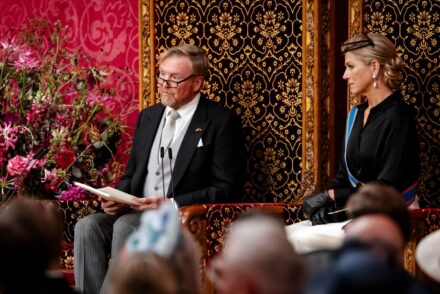
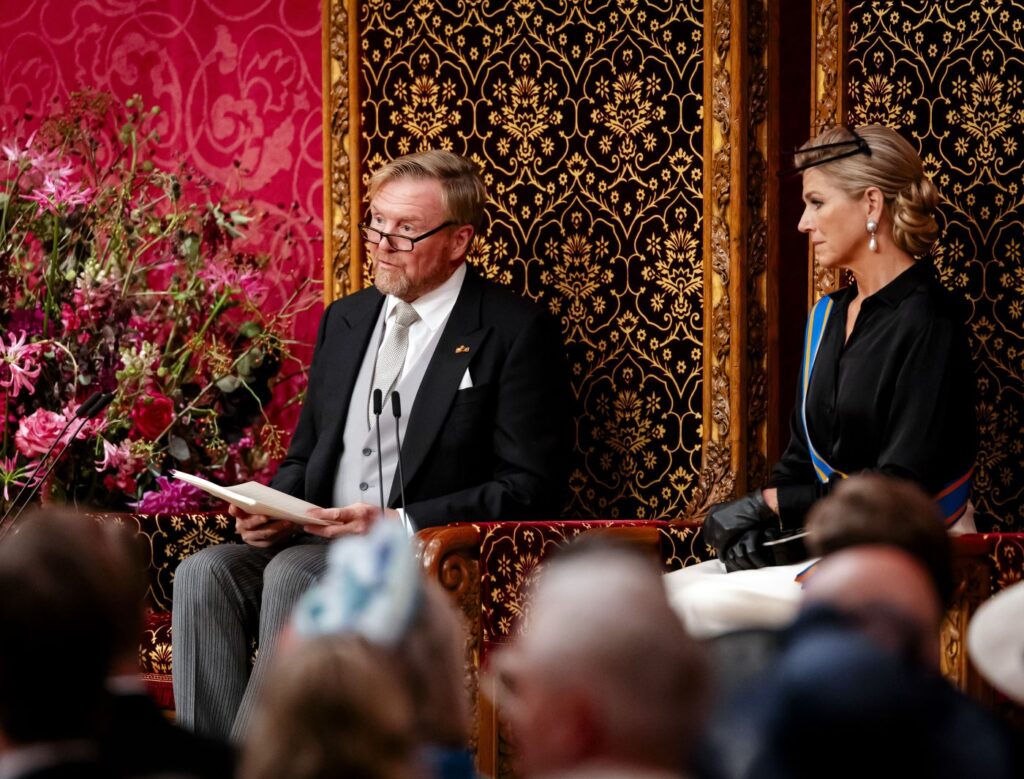
Not long afterwards, the audience watches the NOS broadcast of Prinsjesdag and the delivery of the King’s Speech together. For the afternoon, the Black Box serves perfectly well as a small cinema. During the speech itself, the room remains quiet. The reactions only come afterwards, when the four panel members share their views on the government’s plans.
A broader social agreement
Arjan Lejour, Professor of Taxation and Public Finance and project leader for Taxation at the Netherlands Bureau for Economic Policy Analysis (CPB), gets things started: real choices need to be made, he says.
Maintaining infrastructure, tackling climate change, ensuring security and investing in defence all cost money. But if more money goes towards these areas, less remains for other things, such as compensating for the loss of purchasing power. Lejour therefore advocates a broader social agreement.
According to Lejour, working people are currently being asked to contribute relatively heavily through income tax, while businesses are being asked to contribute less. He mentions corporate tax and taxes on profits, among others, as ways in which companies could contribute more.
Maintaining bridges
Henk Akkermans, Professor of Supply Chain Management and director of World Class Maintenance, is particularly positive about how often the word ‘maintenance’ appeared in the King’s Speech. ‘That’s a good thing. I hope this cabinet eventually earns the nickname “the major maintenance cabinet”.’
According to Akkermans, there is no doubt that there is a great deal of work to be done. Many tunnels and bridges were built in the Netherlands in the 1970s, but insufficient money was set aside for their future maintenance. Akkermans estimates that there is now a shortfall of around €80 billion for maintaining this infrastructure.
A long-term vision
The long term also features in the response from Martijn Groenleer, Professor of Public Administration and Principal Scientist at TNO (the Netherlands Organisation for Applied Scientific Research).
The King’s Speech spoke extensively about the future, for example about our children and grandchildren. Groenleer sees this as a positive development. But, in his view, no concrete plans are subsequently presented to address that future.
An annual King’s Speech and the Budget Memorandum are not enough for this, Groenleer argues. ‘We need long-term plans,’ he says. He advocates a longer-term approach that takes economic, social and ecological stability into account.
Akkermans agrees. He is also frustrated by the idea that ‘budget discipline’ always means spending as little money as possible.
‘I’m a little angry about that framing. For future generations, budget discipline actually means investing in the future. It’s very bad for my children’s future if we don’t invest in upgrading our infrastructure and energy supply, and in maintaining them properly.’
He compares it to buying a house. People are encouraged to borrow money, while the government is expected to be cautious about taking on debt for investments. Lejour is somewhat more sceptical: ‘Unfortunately, the question is whether politicians still know what investing actually means.’
First implement what is already there
Groenleer also sees a lack of concrete steps in the area of sustainability. During Prinsjesdag, the royal carriage drives over the partially removed red paint that climate activists from Extinction Rebellion had applied to the route.
The activists are using the action to draw attention to climate change. But according to Groenleer, the King’s Speech does not sufficiently address sustainable solutions to the climate and energy challenges.
As a public administration scholar, Groenleer prefers to focus on implementation rather than simply introducing new policies. His advice is therefore practical: implement the policies that are already in place.
‘There is, for example, a National Insulation Programme. Implement that programme! Make sure that people’s energy bills are lower in the future. It’s a fast and relatively inexpensive way to address climate change. And it’s social as well, because it gives people lower energy bills.’
Democracy needs maintenance too
The word ‘maintenance’ keeps coming up throughout the afternoon. ‘Does our democracy also need major maintenance?’ someone in the audience asks. The question is put to Ingrid Leijten, Professor of Dutch and European Constitutional Law.
Leijten answers in the affirmative. She is concerned about autocratic tendencies, in which checks and balances and the rule of law are coming under pressure. Both institutional, legal and cultural factors play a role in this. That is why, according to Leijten, we should also examine how we interact with one another and with political opponents.
Leijten: ‘The rule of law is precisely about the ability to understand the other person’s perspective. We need to uphold that awareness.’
Advertentie.