Tilburg students debate ‘Dutch Only’ student rooms
Anyone looking for a student room quickly finds themselves in a flood of Facebook posts. And strikingly often, they encounter one strict requirement: ‘Dutch Only’. Why do Dutch students not want an international roommate? That is the subject of the ‘Dutch Only Housing Debate’ at Tilburg City Hall.
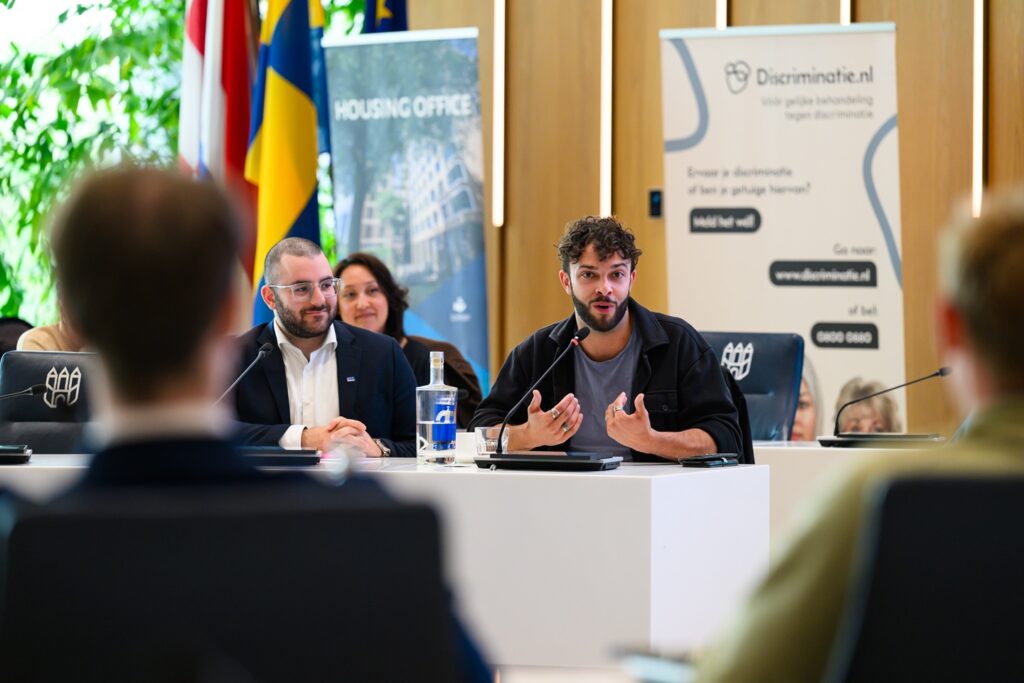
As many as 65% of all room advertisements include the condition “Dutch Only.” International students face not only a severe shortage of rooms but also exclusion from student housing. This is the subject of the debate on Wednesday, May 6, organized by Fractie SAM, F.U.S.T., RADAR, debate society Cicero, the Municipality of Tilburg, and Tilburg University.
Alderman for Housing Yusuf Çelik opens the debate on behalf of the municipality. He thanks the organizing parties for the initiative and emphasizes that Tilburg must be a city ‘where everyone feels at home’.
Prior to the debate, SAM board member Mohammad Barhoumi presents the results of a survey on student housing. According to him, language is by far the most important reason why students choose a ‘Dutch Only’ house. Cultural differences and lifestyles are also frequently mentioned.
That raises the question in the room: are those arguments valid for excluding an entire group of students in advance?
Representatives of the student parties are also participating in the debate. SAM board member Mohammad Barhoumi and former F.U.S.T. chairman Thijs Jansen argue against the ‘Dutch Only’ condition. On the other side stand Barbaros Siraci and Barend van der Voorden Verheul, who defend the condition. Siraci ran in third place for the SAM faction during the last University Council elections.
Language barrier
Van der Voorden Verheul and Siraci point out the comprehensibility of the condition. “I don’t want to constantly speak English in my own home,” says Van der Voorden Verheul. Siraci, who also came to Tilburg as an international student himself, understands that. “Conversations become more superficial when people cannot speak in their native language,” he acknowledges.
According to Jansen, this is just a minor inconvenience, and no reason to exclude international students. ‘A student house consists of countless small inconveniences,’ says Jansen. Dishes left undone, noise, broken appliances. All minor inconveniences.
Student culture
However, according to Van der Voorden Verheul and Siraci, that is not the only stumbling block. They argue that living in a student house in the Netherlands often revolves around a specific way of living together: many shared social activities, student association life, and a similar rhythm regarding studies and free time. Van der Voorden Verheul and Siraci state that international students often structure their time differently.

Barhoumi and Jansen question this. Jansen emphasizes that ‘the’ Dutch student culture does not exist. According to him, student houses vary widely in how they function. Some houses are active and social, while others are quiet and individualistic.
According to Jansen, the same applies to ‘the international student’. ‘It is not a homogeneous group, so you cannot predict at all whether someone fits into a house based on ‘being international’.’ Barhoumi adds: ‘Internationals are now judged on their background, even though they can be very much like you. For a housemate, you want someone who does the dishes, cleans up after themselves, and with whom you click.’
Departing friends
If it works well, Van der Voorden Verheul still prefers a Dutch housemate. He states that many international students leave after their studies. ‘I want to be able to visit my housemates after my student days,’ he says. ‘I think many students are looking for friends for life.’
A certainty that you don’t have with Dutch housemates either, according to the opposing party. ‘I am far from being friends with all my former housemates,’ Jansen argues. ‘That risk is always there.’
Barhoumi also states that international students do not always want to leave. ‘Sometimes they are forced to leave because they were not given the opportunity to integrate or could not find suitable housing.’
Equality of opportunity
Barhoumi and Jansen, on the other hand, see many opportunities. Barhoumi: ‘People assume differences too quickly, whereas living together can actually broaden your horizons.’ Jansen adds: ‘I think friendships with internationals have many benefits; you can learn a lot from each other.’
In addition, Barhoumi emphasizes that international students are often already in a vulnerable position on the housing market. Jansen also recognizes this from his year on the board of F.U.S.T. ‘I spoke to students who had to sleep in a car for weeks.’ He finds this difficult to justify to the students the university invites to study in Tilburg, and from whom the community benefits, in his view.
The debate shows how thin the line is between a practical housing preference and exclusion. While proponents view ‘Dutch Only’ as a way to feel at home in a student house, opponents emphasize that this same choice excludes international students in advance during a time of housing shortage.
Advertenties.