Vincent Bleuzé Studies and Teaches at Odulphus: ‘You Receive a Lot of Appreciation’
Teaching and studying at the same time. In the university teacher-training program at Tilburg University, students combine practice and theory. Univers spent a day following trainee teacher Vincent Bleuzé at Odulphus Lyceum. ‘It’s busy, but I really enjoy it.‘
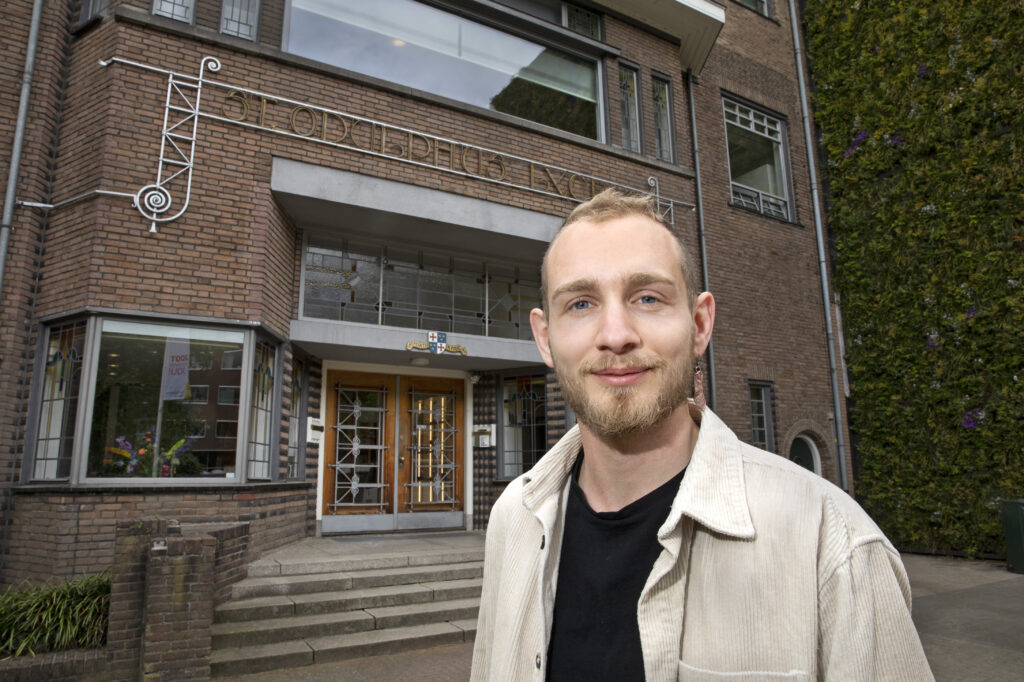
As Vincent Bleuzé (26) sets up his PowerPoint presentation, the fourth-year pre-university (VWO 4) students gradually enter the classroom. Bleuzé is enrolled in a post-master’s teacher-training program to become a philosophy teacher, following his philosophy degree at Tilburg University. On a Thursday in May, he is teaching at Odulphus Lyceum in Tilburg, where he is completing his internship.
A group of boys looks curiously at the camera of photographer Ton Toemen, who has joined Univers to report on the school day. ‘Are we going to be in the news?’ they ask enthusiastically. Bleuzé walks over to them. ‘Are you dressed for the occasion today?’ he jokes, pointing at the photographer.
‘I always look good, so that’s not a problem,’ one of the students replies with a broad grin. Once everyone is seated, Bleuzé addresses the class. ‘I hope you all had a good weekend. Today we’re going to work with primary philosophical texts. It’s Thomas Hobbes’s turn.’
Enjoy Some Reading
He explains the assignment. The students are given fifteen minutes to independently read a primary philosophical text: Leviathan by the English philosopher Thomas Hobbes. Not everyone seems to be paying attention right away.
‘What are we going to do now?’ Bleuzé asks one student. ‘We’re going to enjoy some reading,’ the student replies, emphasizing the word enjoy, clearly proud that he knows the lesson plan.
At first, there is still some chatter in the classroom. But after Bleuzé mentions that one of the questions will appear on the test, the room gradually becomes quieter. The students immerse themselves in the text.
That is not a given, as philosophical texts are complex. The language is outdated, Hobbes wrote Leviathan in 1651. But the content of a philosophical text can also be challenging in itself.
That is precisely why these texts are the subject of Bleuzé’s research. In addition to his school internship, he is also conducting research as part of his university teacher-training program.
‘Students are increasingly struggling with reading comprehension. I notice that in philosophy as well,’ he explains. ‘That’s why I looked at how they approach it in Dutch language classes. There they use the Salevo method, which stands for collaborative reading in secondary education.’
Responsibility
According to Bleuzé, research shows that students understand texts better when they share responsibility for the content. ‘Each student receives a different text and then has to explain to their classmates what they have read.’
‘This creates shared responsibility,’ he continues. ‘That helps with understanding difficult texts. On top of that, they know one of the questions will appear on the test, so there’s extra motivation to read carefully.’
Later in the lesson, the students discuss their texts with one another. As the end of the class approaches, some conversations gradually drift toward the previous weekend. When the bell rings, the students gather their belongings. ‘Thank you, Mr. Bleuzé,’ comes from various corners of the classroom.
Appreciation
After the lesson comes a quieter part of the day. Bleuzé has several free periods during which he prepares lessons in the staff room and works on his reading-comprehension research for his training program.
He is not only standing in front of a classroom but is still attending university lectures himself. He also takes time to update his internship supervisor on how the lesson preparation went.
‘Preparing lessons takes quite a lot of time,’ he says. ‘I want to be well prepared when I stand in front of a class. That’s why I read a lot of philosophical texts and books, such as Leviathan for the previous lesson, so that I have enough knowledge to answer students’ questions.’
His supervisor, Joop van der Kuip, recognizes this. ‘In the beginning, lesson preparation takes a lot of time. That decreases as you gain more experience in the classroom,’ he says.
Talking About Philosophy
Bleuzé himself has noticed that his view of teaching has changed over the past year. He has now been teaching for almost a year, as students in the post-master’s program complete internships throughout the entire academic year.
‘At first, I entered a classroom in a very academic way, as if I were speaking at a philosophy society. Now I also devote a lot of attention to building relationships with the class and with individual students. I didn’t expect it, but I find that aspect almost as enjoyable as talking about philosophy. And that says a lot.’
Those relationships with students sometimes lead to unexpected moments. ‘Recently, I ran into a HAVO student in the hallway. He asked, ‘Sir, are you teaching us again today?’ When I said no, he sincerely replied, ‘That’s a shame.’ Those are wonderful moments. You receive a lot of appreciation in return.’
A Busy Schedule
Combining studying and teaching is intensive, Bleuzé says. He spends three days a week on his internship and currently teaches one lesson per day, while also taking courses at the university and conducting research.
‘When I was teaching two classes, I found that quite a lot. You’re essentially busy full-time throughout the week, especially with the university on top of it. Sometimes I even work during the weekends. It’s busy, but I really enjoy it.’
Learning from Experienced Teachers
At the end of the afternoon, Bleuzé observes a philosophy lesson for fourth-year HAVO students taught by his internship supervisor. ‘It’s also valuable to learn by watching teachers who have twenty years of experience,” he says. “That’s just as much a part of the program as standing in front of a class yourself.’
During the lesson, he helps a group of students by asking targeted questions. As he joins their table, one of the students looks up. ‘Hi, sir,’ she says enthusiastically. ‘It’s been a long time, hasn’t it?’ Bleuzé laughs. Even before officially becoming a teacher, he already seems to have found his place within the school.
Advertenties.