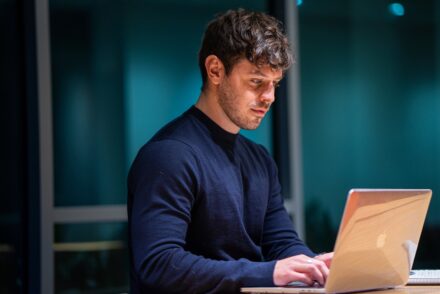
Eva Kaljée on her timeline: ‘I am aware of my bubble’
Algorithms guide us through the endless maze of the internet. Sometimes handy, sometimes entertaining, and sometimes AI-generated. This month we dive into Eva Kaljée’s bubble. She is doing a board year at study association Complex and will then start her master’s in Economic Psychology.
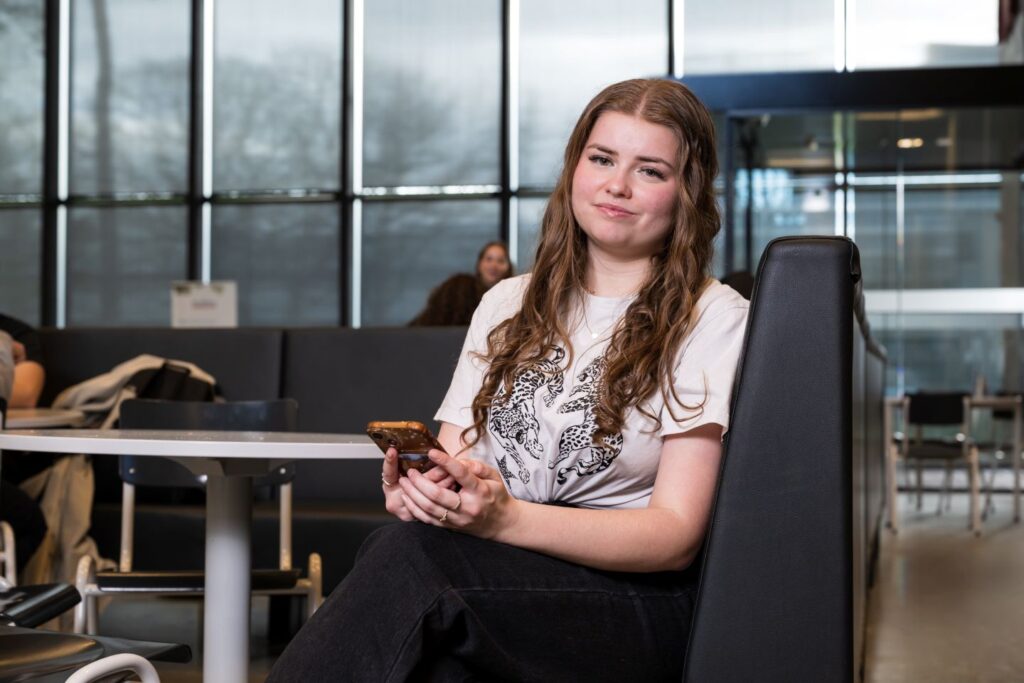
What do you notice most about your phone usage?
‘You are very dependent on your phone in this society. Two years ago my phone was stolen and I couldn’t buy a new one immediately. I was without a phone for two weeks. Then I noticed how difficult that actually is. Taking the bus for example: you have to look up what time it goes, but you can’t do that anymore. Or handing something in at the university while you need the Authenticator app.’
Are you in a filter bubble?
‘What I see does correspond with my political preferences or topics I’m already interested in. I mostly see cooking videos, funny videos, or news about science. Like when NASA discovered something again. I try to consciously deal with it, but at the same time I’m also aware that there are many things I’m not aware of. I try to remain critical. When I see videos where I agree with them, I also think: yes, but this is my algorithm. So I don’t just assume something.’
Have you ever deleted social media?
‘No, I never have. Some friends delete it completely. For me it’s just an important communication tool and also nice for relaxation. That’s why I never really felt the need to delete it. But I do understand why people do that.’
Do you think you become more resilient against algorithms?
‘Partly yes, because you start to recognize things. More and more is becoming known about how algorithms work. At the same time, AI is now also becoming bigger. I used to believe everything I saw immediately, but now I think more often: is this AI? Sometimes it even goes a bit the other way. Then I see a video of Trump saying something and I think: this is definitely AI. And then it turns out to be real. So sometimes I’m maybe a bit too critical. But it’s good that you know it’s a possibility.’
Do you deal with algorithms differently than your parents?
‘Yes. My parents understand technology quite well on its own and are also consciously busy with it. I grew up more with it, so for me it feels like a kind of second nature. For them it’s something they had to learn more. My mother is very critical online. She immediately looks up if something is a hoax.’
Do you see algorithms mainly as something positive or negative?
‘A bit of both. It’s positive that it’s narrowed down to your interests. That works well for relaxation. When I look at friends’ feeds, I sometimes think: I don’t find this funny at all. Then you notice how different someone’s algorithm can be. Because of that you are in a certain bubble with people who think or like roughly the same thing. For information that’s less good, but for relaxation it actually works quite well. It therefore depends a bit on your goal.’
Advertenties.