Tilburg law students beat British competition in London moot court
For many law students, it stays with books for a long time. Gaia Recinti and Patrick Daniil, however, went to London for a prestigious moot court competition. As the only non-British team, the Tilburg duo achieved a shared first and second place.
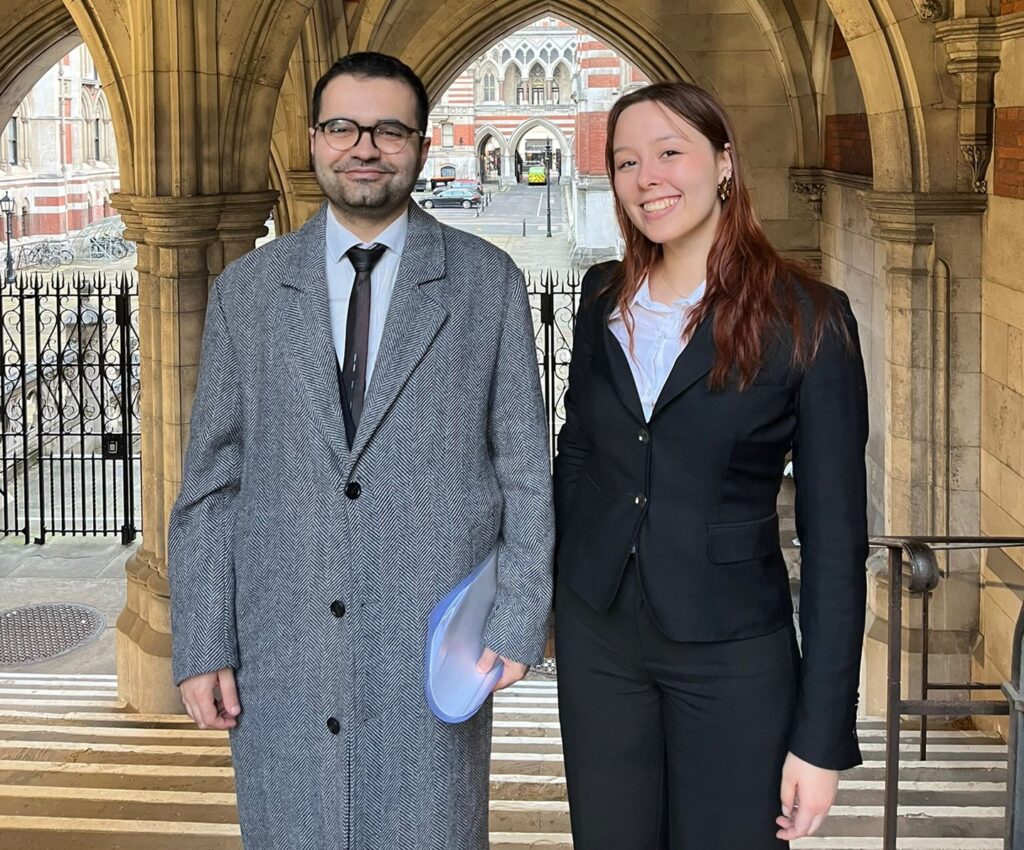
Participants in the moot court competition of Landmark Chambers, a collective of English barristers, work on complex legal cases based on English law, where they defend their positions against an opponent and at the same time respond to questions from the judges. It requires quick thinking and clear argumentation, Global Law students Patrick Daniil and Gaia Recinti tell Univers.
During the competition, the duo, the only non-British team, was presented with challenging cases, ranging from an immigration case about a visa application to care for a family member to a case about a student who was at risk of being expelled from school, where the right to education was at stake.
How it started
But how do Tilburg law students end up in a moot court competition in the United Kingdom? Daniil found the competition when he looked into the English Bar, the professional group of barristers. ‘It immediately seemed like a valuable chance to gain practical experience,’ he says.
Recinti also wanted to join the competition. ‘I already had an interest in English law and saw this as a good chance to improve my skills and learn more about the legal system.’ Their participation was arranged through Tilburg University and guided by Professor of Global Law and Development Morag Goodwin, who is originally from the United Kingdom.
Intensive preparation
‘The preparation was intensive,’ Recinti says. ‘In England, you work with so-called ‘skeleton arguments’, short written arguments that only include the main points. You need to know your arguments well, because judges ask unexpected questions and sometimes ask you to explain points earlier than you planned.’
Daniil adds: ‘It is one thing to understand something in theory, but actually defending it in front of a judge is something else. We practiced a lot, together and separately, so we could work well together during the pleadings.’
The final
Reaching the final on 25 February was a surprise for both of them. ‘We did not have strong expectations,’ says Recinti. ‘We mainly wanted to learn and gain experience.’ According to Daniil, this attitude played an important role. ‘We put less pressure on ourselves and could focus better on the content.’
The first and last rounds took place in London, while the rounds in between were held online. The final took place in the Royal Courts of Justice, in a real courtroom. Finalists wore the traditional wigs and gowns of the English legal profession. ‘It felt a bit unreal, really a ‘pinch-me’ moment where everything came together,’ says Recinti.
Although the law students do not specialize in English law during their studies in Tilburg, they did very well. Recinti and Daniil beat trainee barristers and a team from the University of Cambridge. They took part as a team, but were also judged individually. Recinti was named joint winner of the competition, and Daniil joint runner-up.
A special dinner
And then the final part was still to come. After the final, the finalists were invited to a dinner with the judges. ‘This way you not only see the professional side, but also the human side,’ says Daniil. ‘The judges were really interested in our background and future plans.’
Recinti adds: ‘They took the time to give advice and encouraged us to ask questions. It gives a special insight into what it is like to work as a barrister.’ The competition also offered real opportunities at Landmark Chambers, such as a ‘mini-pupillage’, a short period where students can observe barristers in practice.
Future plans
The moot court competition confirmed Daniil and Recinti’s interest in English law and their ambition to continue in this field. ‘The feedback we got from experienced legal professionals was the most valuable for me,’ says Daniil. ‘It helped me improve my way of arguing.’
Recinti agrees: ‘By pleading in front of real judges, I realized how interesting this work is and that with the right preparation and determination, you can go far.’
Advertenties.