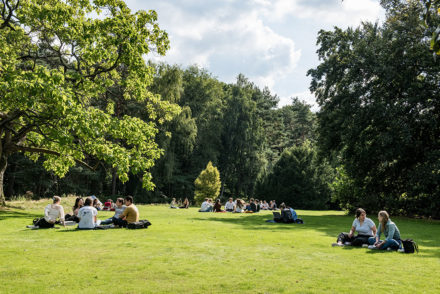
Studying after your studies: Tilburg University brings working people back to the lecture halls
Are we going to see more gray haircuts and bald heads in the library and on campus? If it is up to Tilburg University, yes. With the Lifelong Development training programme, the university wants to bring workers back to the classrooms. ‘After graduation, you’re not done yet’.
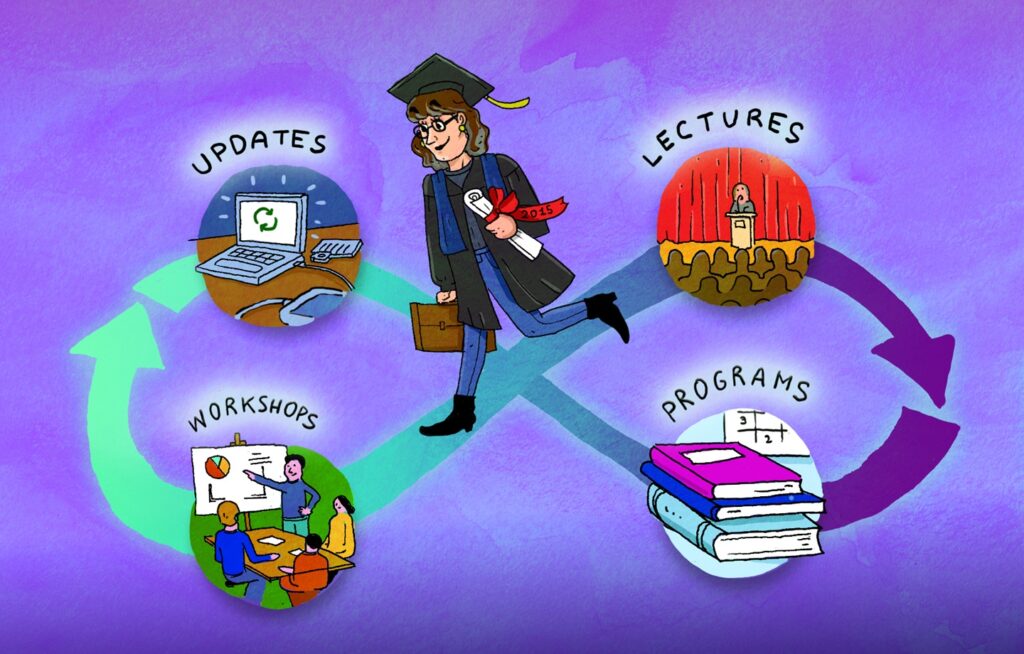
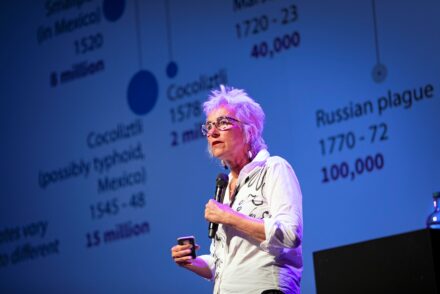
As a teacher, Marjan Groen was looking for depth and reflection. For example, Groen has indicated in her department at the Faculty of Economics (TiSEM) that she would like to supervise neurodiverse students with their thesis. That is why she followed the course ‘Make your education more neuro-inclusive‘ and the course ‘The moral conversation‘ also offered her reflection on her work. The courses were useful for ‘quickly finding out what the current developments are in a certain area,’ says Groen.
Studying is something you do for a lifetime, is the message of the university. With the Lifelong Development (LLO) program, Tilburg University wants to streamline the range of courses, workshops, and lectures for postgraduate education much more and also better align it with the demand from professional practice.
Brushing up
It was already possible for alumni to brush up on a field, or to ‘join’ a lecture series out of pure interest in a subject. But the offer for Tilburg University graduates was fragmented, so it was not always easy to find a way around.
‘We want students to always be able to come back to our university to learn and develop,’ emphasises Inge van Rijt, programme director of LLO. ‘In this programme, we bundle the offerings of all faculties, with the intention of making the knowledge we have in-house accessible to our alumni and to other professionals.’
Learning in the workplace
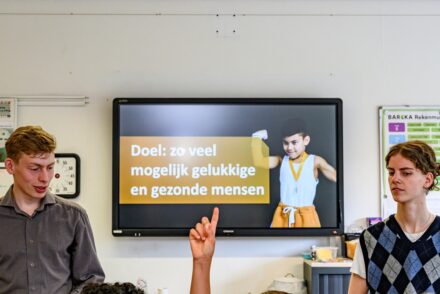
Working people do not always have to come to the Tilburg campus to brush up on something. Education is also given on location. Adil Azoum and Dirk van Dijk work in Eindhoven for ASML’s Manufacturing Academy. Azoum: ‘We manage the Learning, Development and Knowledge Management department and we do that for people who work in the factories and the logistics centre in Veldhoven.’ In addition to training, the leadership team of the Manufacturing Academy wants to delve more into the subject of ‘learning on the job’.
Until now, ‘learning on the job’ was relatively unknown, according to Van Dijk. Azoum and Van Dijk therefore followed a so-called ‘in-company’ training in Eindhoven, provided by the Lifelong Development team. According to the university, ‘workplace learning’ is often more effective for the desired task performance than traditional training courses and is therefore a sustainable investment for the longer term.
Van Dijk: ‘We want to bring learning to the workplace, instead of taking people out of the workplace and into classrooms. Because then you interrupt the work. So we train people, for example, in the logistics center, as order pickers on the forklift, or in the shop where we sell the machines.”
Three principles
In the LLO programme, the university works according to three principles, says Van Rijt. ‘Firstly, we have an open range of existing lectures and courses, and secondly, we are looking at forms of structural collaboration with partners from outside the university, in which we develop educational offerings in co-creation, tailored to the wishes of professional practice.’
Thirdly, the team focuses on contributing to the impact of research by developing lessons from a research programme based on the latest scientific insights, in which learning needs from the professional field are met.
Fixing a problem
‘Suppose you follow a work instruction,’ says Van Dijk. ‘We are going to make it a little more complex or we are going to ‘cycle in’ a problem, so that you improve yourself step by step, while you are just working. This is the outcome of a new vision of ‘workplace learning’, and LLO has helped with that.’
Groen cites another example: ‘The Neurodiversity course mainly helps me to understand much better what students are up against. And the latest insight is: it is not so effective to make a specific approach for every diagnosis. It would be better if we made our education more inclusive across the board. I thought that was a real eye-opener.’
Reflection
‘If I hadn’t taken this course, I would still have been able to do my job,’ says Marjan Groen. ‘But it mainly helps me when it comes to moral issues, where you can’t do much with the established rules.
‘To give you an example,’ says Groen: ‘I had a student on holiday who should have been in class. They worked in a team, and then that team misses that student. I learned from that course how to address them on that. We as teachers always look for punishment and reward. But that is not possible here at all, because there is no attendance requirement. So: how do you teach students to take responsibility for themselves?’
In addition, mutual contact with other students is very valuable, Groen says: ‘This way you get to know new people in other places in the organization. And that sometimes helps you to look at things differently and to reflect. So it’s not just about substantive knowledge.’
Professions are changing
Many professions are changing, due to robotization but also due to the rise of AI, which will probably make further training more self-evident. And not only in traditional sectors where further training is a mandatory part of professional practice, such as the legal profession, accountancy or among general practitioners.
‘We also want to contribute to that,’ says Van Rijt. ‘And how can we ensure that companies invest not only in technology or infrastructure, but also in people?’
It seems that more elderly people will soon be seen on campus and in the library. ‘Yes, I hope so. I think that would be cool,’ says program director Inge van Rijt. ‘The future of the university looks different. You now have mainly regular students walking around, and that will broaden much more in the coming years, we will see more students who already have more work and life experience.’
‘Will it still be normal in ten years’ time to only start working after a bachelor’s and a master’s?’ Van Rijt wonders aloud. ‘Why don’t students first work for a few years after a bachelor’s degree, and then go on to do a master’s again?’
Costs
While regular students pay for their studies with a grant or a loan, the funding of LLO education with different target groups is less obvious. Groen: ‘Well, that’s still an issue, because the course The Moral Conversation was free, but Neuro-inclusive education cost six hundred euros.
‘I asked my manager for a budget for this, with the idea that I can further disseminate the insights within the department. But if I had to pay for it myself, I wouldn’t do it, because it’s part of the job anyway.’
Normal case
Yet the program has not been developed as a new revenue model, Van Rijt emphasizes. ‘We are not for profit. Accessible LLO education for everyone, that’s what we strive for, not just for large companies and wealthy alumni.’
Marjan Groen: ‘It should become a normal thing that you follow new workshops every so often. Everyone who teaches must take the University Teaching Qualification (UTQ). It seems logical to me that you take such a course again two years later. My English is not bad, but it is refreshing, for example, to listen to someone from the Language Centre and think together about how you can use language more effectively in your teaching.’