‘Even my teachers in training use AI, while they disapprove of it in their students’
Writing texts, generating photos and videos and even taking exams. Artificial intelligence has also become an integral part of the university. How does AI change education according to teachers? ‘If you allow AI in exams, you are no longer testing what a student knows.’
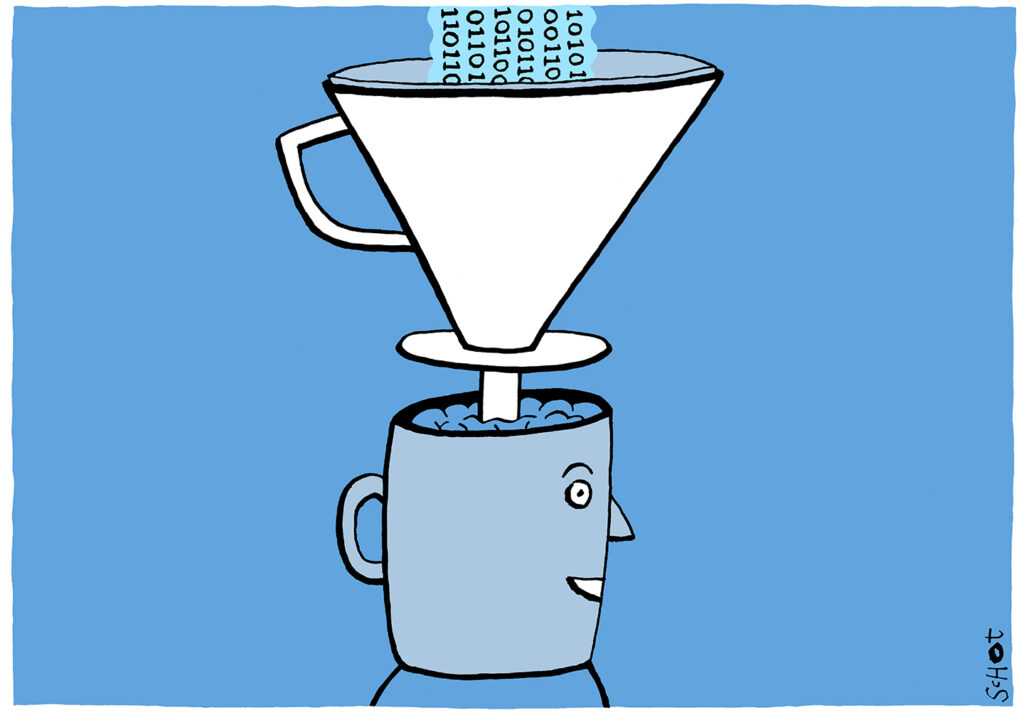
‘Something will go wrong if we leave the learning process to artificial intelligence (AI),’ says an outspoken Siebe Bluijs. He sees the arrival of generative AI, especially commercial chatbots, with sorrow. Bluijs is assistant professor of literary history at the Faculty of Humanities and Digital Sciences, and he is a lecturer at the Tilburg Center of the Learning Sciences (TiCeLS).
‘The use of commercial free AI, without further preconditions and guidance from the university, is a big risk,’ Annelieke Mooij agrees. As an assistant professor, she lectures on constitutional and administrative law at the Faculty of Law. ‘ChatGPT and Copilot are now very well established, but what happens to your data?’ she wonders. ‘There are all kinds of risks associated with using these free versions of AI.’
Chatbots always answer
The world was introduced to generative AI at the end of 2022, with the introduction of so-called Large Language Models (LLM) such as ChatGPT. The Tilburg academic community also had to switch quickly to find an answer to students who no longer write their papers and exams themselves but have chatbots do so.
‘Do you still understand exactly what it says when you use so much AI?’ wonders Mooij. She thinks that a university-educated lawyer should also be able to reflect on the results of ChatGPT.
‘I can immediately provide you with an insight, but you will only make that insight your own by repeating it, by practicing and ultimately by fitting it into your own frame of mind and connecting it to your worldview,’ Bluijs agrees. ‘That’s learning as far as I’m concerned. That’s not passively cramming knowledge into your head.’
In addition, chatbots are trained in such a way that they always answer the questions you ask. And that seems nice, but that’s a problem, according to Bluijs: ‘In science, we also want to teach students to name the assumptions behind the questions.’
Oral examinations
‘If you allow AI in exams, you are no longer testing what a student knows, but how well a student can prompt,’ says Mooij. To check whether a student has actually mastered the material, Bluijs therefore argues for oral tests. That is already fine, because it allows him to ask deeper questions and let students reflect on knowledge, attitude and skills.
Yet it is only part of the solution, Bluijs thinks: ‘Maybe students turn to AI because we test too much. If we continue to find numbers very important, the temptation to use AI will increase. Even my teachers in training sometimes fall back on AI, while they disapprove of the use by their students. They also know that they learn less from it themselves, but when they run out of time, the temptation is too great to ‘cheat’ a bit.
AI in professional practice
In the meantime, AI is finding its way into professional practice, and that is also a responsibility for the university, Mooij believes: ‘What skills should students possess in a world in which AI is established?’ In practice, AI can help lawyers, she thinks, for example by proofreading contracts or by checking legislation and previous outcomes of court cases: ‘AI is there and we need to adjust our educational goal accordingly.’
She sees the new technology in a long line of developments: ‘Card indexes have been developed to make searching easier. Then libraries came with a digital search function and Google Scholar and suddenly you could find everything worldwide. AI is a logical continuation of technological developments that have been going on for hundreds of years.’
Losing humanity
Bluijs also teaches about the use of AI, in a different, more creative way: ‘I teach a course on the interaction between contemporary technologies and literature. About writers and creators who use AI in creative ways, to hold that technology up to the light and critically question it. For example, how ‘digital literature’ influences and reshapes the reading experience.’
To teach students to reflect on the influence of AI, Bluijs shows in his lectures how AI technology and society are intertwined: ‘It’s never a one-way street,’ he argues. Makers of technology were inspired by literature and film at an early age: ‘The artistic imagination often precedes those technologies. Just think of the novel I, Robot by Isaac Asimov.
‘Or take the beautiful film Her, in which lead actor Joaquin Phoenix enters into a ‘relationship’ with voice assistant Scarlett Johansson. That film was a source of inspiration for the creators of ChatGPT. The striking thing is these kinds of representations are often dystopias, in which characters lose their humanity.’
Own chatbot
To become less dependent on big tech, Mooij is in favor of developing its own AI tools, such as the chatbot Tilly by Tilburg.ai, a working group of Tilburg University. ‘At our faculty, we are working on creating our own chatbot where students can test legal cases. The student no longer gets a case on paper, but has to talk to that chatbot,’ says Mooij.
AI is a tool, and it is important that all students have the right tools, Mooij believes. ‘If we don’t do anything, you will have a gap between students with more financial spending capacity, who can afford paid and privacy-safe AI, and students who have to fall back on free tools. So, then we will widen the gap between those two groups, and that is what we do not want.’
The influence of AI
‘I don’t think we can keep AI technology out completely,’ Bluijs also acknowledges. But he denounces the ‘instrumental attitude’ with which AI is embraced: ‘AI is there and we have to do something with it, is the sales pitch from Silicon Valley. And we take that over blindly. We should be much more critical about that.’ Mooij agrees: ‘As a training institute, we don’t have to let Silicon Valley determine our strategy.’
According to Bluijs, AI penetrates into the capillaries of our lives. Students use chatbots not only as a source of information, but increasingly as a ‘buddy’ for personal issues and even as a therapist. And he is concerned about the emotional bond you can build with such a chatbot: ‘We need to reflect more on the influence of AI.’
‘And that’s where the university can play a major role’, says Bluijs. ‘Because it is there to ask fundamental questions about the role of technology in society, and the humanities are ideally suited for that. As far as I’m concerned, we don’t just prepare students for the job market, but we teach them to reflect on these kinds of social developments.’
Advertenties.