Mayor Fleur Gräper – van Koolwijk: ‘As a student, you don’t have to have life all figured out yet’
Nearly six months into her tenure as mayor, Fleur Gräper – van Koolwijk (51) is gradually getting to know Tilburg better. Speaking to Univers, she discusses female leadership, the strength of a city that does not have to be perfect, and her own student years: ‘Make mistakes—that’s ultimately how you learn the most.’
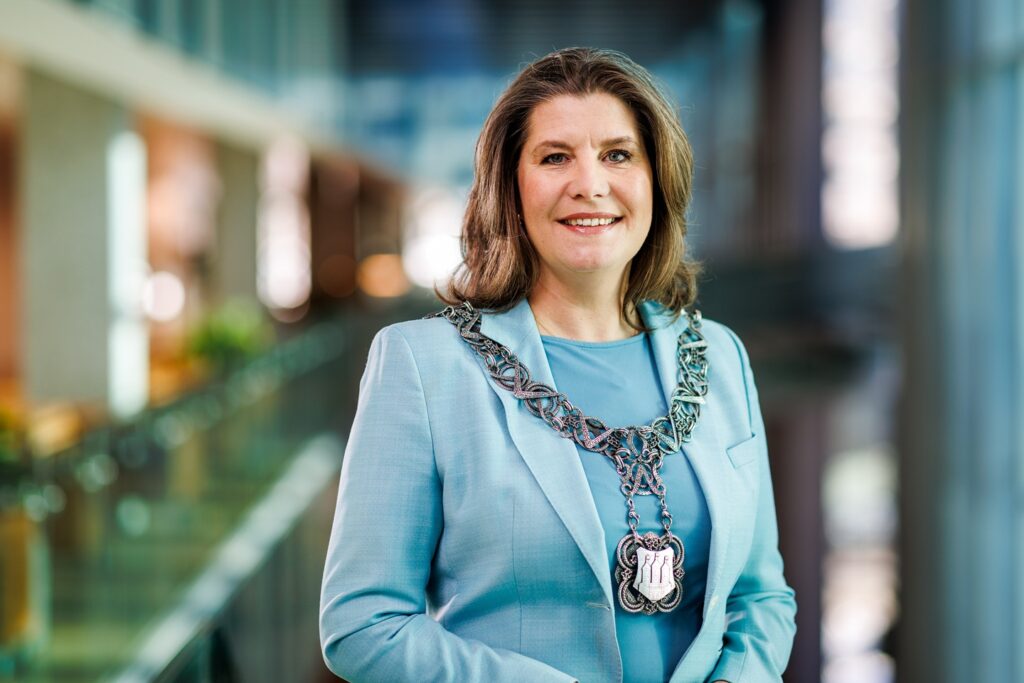
Since January this year, Tilburg has, for the first time in the city’s history, a female mayor. Fleur Gräper – van Koolwijk succeeded Theo Weterings, who stepped down early last year to spend more time with his wife, children and grandchildren.
Who is Tilburg’s new mayor? Univers met with Gräper – van Koolwijk at Tilburg City Hall for an introductory interview.
You have been mayor for almost six months now. Have you started to unravel the DNA of the city and its residents?
‘I describe myself as a ‘consciously incompetent Tilburger’. I visit neighbourhoods, drop by organisations and institutions, and meet a great many people. At the same time, I realise just how much I still haven’t seen. Even so, I’m gradually forming a picture of the city. What strikes me is that Tilburg doesn’t have a single DNA. Instead, it is characterised by its diversity and its vibrant network of associations.
‘I had only been mayor for a few days when I was introduced to Carnival and several Carnival associations.’ She laughs. ‘As an outsider, you think: what on earth is this? But I threw myself into it for all five days.
‘Since then, it’s become clear to me that these associations are always rooted in a social purpose, with a strong sense of community and openness. If you zoom out, that’s exactly what defines Tilburg as a city.’
Did you think in advance about the kind of mayor you wanted to be?
‘I already had experience in public administration before taking on this role. But this position allows me to discover new sides of myself. For example, I can make a real difference to people simply by showing up somewhere.
‘I call it the magic of the mayoral chain of office: because I ask a question, show interest, or attend an event, something is sometimes set in motion that directly helps residents. That’s something entirely new to me.’
In an interview with the Brabants Dagblad, you said that there are aspects of being a woman that make governing different. What did you mean by that?
‘It means I’m often asked what makes me different as a female public administrator, or how I combine my job with family life. In other words, I’m expected to justify myself on that level. How I respond depends on who’s asking and whether I can blame them for the prejudice embedded in the question.
‘The question I’m asked most often at schools is why I’m not a ‘lady mayor’. That says something about the image children have of a mayor. That’s why it’s important for them to see that, of course, a woman can simply be a mayor.
‘If I’m asked a question in a political or administrative setting that contains a prejudice, I can get irritated and throw the question right back. Or when I speak firmly about something and notice that people react differently than they would if a man had said exactly the same thing.’
Tilburg University alone has nineteen thousand students. According to some, the city struggles to retain enough talent after graduation. How do you see that?
‘To be perfectly honest, that’s classic underdog behaviour from universities outside the Randstad. It’s actually a good thing that young people spread their wings elsewhere for part of their development.
‘I think three things are important here. First of all, it’s crucial for Tilburg’s economy that we connect students with local businesses at an early stage, so that students think: hang on, it’s actually interesting and enjoyable here.
‘The second step is already well underway: making sure there are enough homes that suit the needs and financial possibilities of recent graduates.
‘The third point is just as important. Students who leave Tilburg become potential ambassadors for the city: people who look back on their student years with enthusiasm. Together, they form a large network.
‘Within ten years of graduating, many of them may reach a stage where they have children and think: suddenly the Randstad isn’t quite so attractive—or affordable—anymore. If we can tempt those people back with an appealing career in Tilburg, it’s no problem if they leave first and return several years later as professionals to settle here.’
You have children who are students themselves. As a mother, do issues such as student debt, housing and mortgages worry you?
‘Like every mother, I worry about many things. About climate change, nitrogen emissions, biodiversity, and the challenges my daughter and son may face in the future.
‘My father had to leave school when he was fourteen. I was fortunate enough to go to university, and I’ve been able to give my children opportunities that I never had myself. They will both graduate without student debt. That’s an enormous privilege, and I’m very aware of that.’
What kind of student were you yourself?
‘The kind who served on all sorts of boards and committees. Sometimes I think: oh yes, I was studying history as well. In the end, I learned more from my extracurricular activities on the road to the labour market than I did from my degree itself. That’s why I’ve always encouraged my children to get involved in activities alongside their studies, because that’s also how you discover and develop yourself.
‘I met my husband fairly early in my student years. Even though we were already together, I still chose to spend a year abroad. That experience shaped me enormously. It taught me that, even within a relationship, you can and should make your own choices.’
What advice would you give students who want to discover Tilburg?
‘Before my job interview, my husband and I explored Tilburg by bicycle. We visited the LocHal, several museums and the Piushaven. Along the way we stopped at cafés and struck up conversations with Tilburg residents. That’s how you get a real feel for the city’s dynamics.
‘Tilburg isn’t perfect. That’s precisely what’s so wonderful about it, because it means you don’t have to be perfect either. There’s room here to develop yourself. That fits very well with Tilburg’s identity as a university city. So I’d say to prospective students: look beyond that imperfection.’
What personal message would you like to give students?
‘Make the very most of your student years. Get involved in activities outside your studies. Enjoy the fact that you’re allowed to discover things and experiment. As a student, you don’t have to have life all figured out yet. In fact, make mistakes. I’ve made mistakes too. In the end, that’s how you learn the most.’