Sheila Sitalsing on her NSB grandfather: ‘Whether Grandpa Sjarrel knew about Auschwitz is beside the point.’
An NSB grandfather, a silent mother, and deep shame for the family history. Journalist Sheila Sitalsing wins the E. du Perron Prize for her book Waar ik me voor schaam (What I am ashamed of) : ‘No one in the family knew anything about my grandparents’ NSB past.’
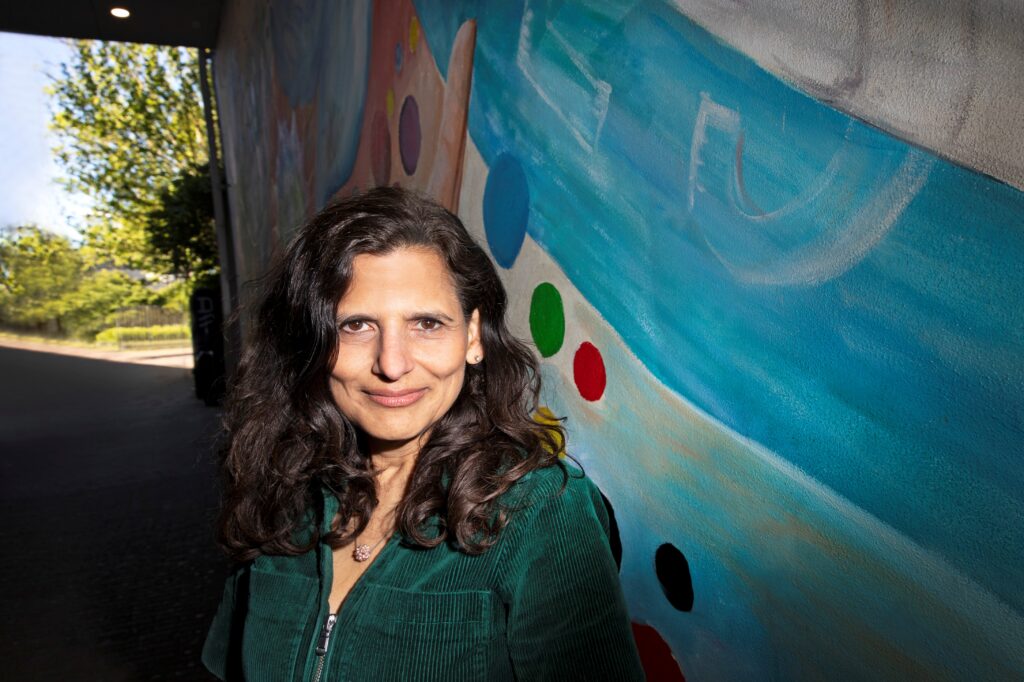
On her mother’s deathbed, journalist and writer Sheila Sitalsing is handed a digital legacy. Only after her mother’s death does she read the A4 sheets left behind. They state, without beating around the bush: her grandfather Sjarrel was a member of the National Socialist Movement (NSB). ‘A Jew-hater,’ writes her mother. ‘I don’t know why.’
In Waar ik me voor schaam, Sitalsing shows what happens when a family secret is no longer kept secret. Among the brown boxes of the National Archives in The Hague, she goes in search of answers.
Your mother only shared this family secret on her deathbed. Does that feel like a form of protection, or rather a burden she has passed on?
‘At first, it didn’t feel like protection, but like a secret she was passing on to me. No one in the family knew anything about my grandparents’ NSB past. I remember thinking: am I reading this correctly?
‘Then came the grief, especially for my mother. The idea that she never felt free to tell anyone this touches me. And anger too: we had a good bond and I often asked her about the war. I felt a bit cheated because she never said anything about it. The idea that her silence might also have been a form of protection only came later.
‘Quite soon after that came the practical questions: should I tell this to the editors of de Volkskrant? And are you still allowed to write ‘preachy and moralizing’ pieces with such a family history? Fortunately, that feeling didn’t last long. Friends with whom I shared the family history were very clear about it: ‘What nonsense,’ they said. ‘Of course you can just keep working for the newspaper.’’
How do you deal with shame about something you weren’t present for?
‘By speaking with descendants of NSB members, I have gained more insight into how many levels of shame can exist. First of all, there is the vicarious shame regarding a fraught family history, which is often softened or smoothed over within families. For instance, the role of a wrong ancestor is trivialized with statements such as that it ‘wasn’t that bad’, that he ‘meant well’, or that one ‘has to view it in the context of the times’.
‘In addition, there is the tension between loving your parents and the realization that they did morally reprehensible things. For children of NSB members, it is often difficult to let those two realities coexist, which can lead to deep shame.
‘Finally, there is the shame associated with anger over the way NSB members and their relatives were punished and humiliated after the war. I cannot make statements about whether these punishments were too severe or not. Research needs to be done on that. ‘What I do see is that that anger often functions as a coping mechanism: a way to shift the conversation from the wrongdoings of NSB parents to the supposedly excessive or humiliating manner in which they were punished.’
There has been much discussion in recent years about the opening of the war archives. What is your view on that?
‘What helped me – and what I want to show with this book – is that such a family history is also a societal story. It shows how a society functions under extreme pressure: what choices people make and what drives them to do so.
‘Moreover, the file on my grandfather in the National Archives is not just about him, but also about the people affected by his actions. The descendants of those victims have a right to insight into what happened. That is why I do not believe that descendants of ‘wrongdoers’ should be allowed to determine who gets access to that history.’
In your book, you mention the desire to know whether your grandfather knew about Auschwitz. Later, you call that a ‘child’s question’. What do you mean by that?
‘Initially, I wanted to find out exactly what my grandfather had done. So that I could categorize his actions from ‘very bad’ to ‘less bad’. For me, Auschwitz served as a kind of benchmark in this regard. If you knew what was happening there and consciously participated in it, you are extremely bad. Then, by definition, you fall severely short morally.
‘Legally speaking, that is relevant, for example when a judge has to reach a verdict and a sentence. But morally speaking, it is more complicated. The NSB had been a radical, violent, and antisemitic movement since as early as 1935. Within the broader machinery of collaboration with the German occupier, people could be dragged from their homes under the watchful eye of many. Their possessions were confiscated, and they were put on transport.
‘Even if someone did not know the exact final destination of those transports, there was already more than enough visible to understand that something was fundamentally wrong here. In that light, that question – whether he knew about Auschwitz or not – is actually a childish question. She suggests that guilt only begins with knowledge of the destruction, whereas in reality it was already inherent in cooperating with (and allowing) exclusion, expropriation, and deportation.’
E. du Perron and your grandfather both grew up in colonial Dutch East Indies, in comparable circumstances of wealth and privilege. Yet they made radically different moral choices. What does that say, in your opinion?
‘My grandfather Sjarrel and Du Perron had a strikingly similar start to their lives: both bearing the first name Charles, shaped in the same colonial world, with a similar upbringing and a life between the Indies and Europe. Whereas Du Perron actively opposed nationalism and critically questioned colonial thinking – partly inspired by Multatuli – my grandfather moved in the opposite direction and embraced that very worldview.
‘What touches me about this is that it shows that moral choices do not simply stem from ancestry or environment. No matter how difficult it is to go against the current, especially when the majority is moving in a different direction, there always remains a possibility to resist.’
What is it like for you to receive the E. du Perron Prize with a story about your ‘flawed’ family history?
‘I am really very happy with it. What I appreciate most is that the jury read the book as it was intended. Not just as a personal story or an individual quest, but also as a societal call to start a conversation about how a society functions under extreme pressure. And honestly: when I think of my grandfather, I find it beautiful in a way too.’
Sitalsing laughs: ‘He probably won’t be proud of me.’
The presentation of the E. du Perron Prize will take place on Tuesday, May 12 (4:30 PM – 6:00 PM), prior to the Night University festival, in the Marga Klompé Hall of the university. Writer Karin Amatmoekrim will deliver the accompanying E. du Perron Lecture.
Advertenties.